Identity and Cooperation in Multicultural Societies: An Experimental Investigation
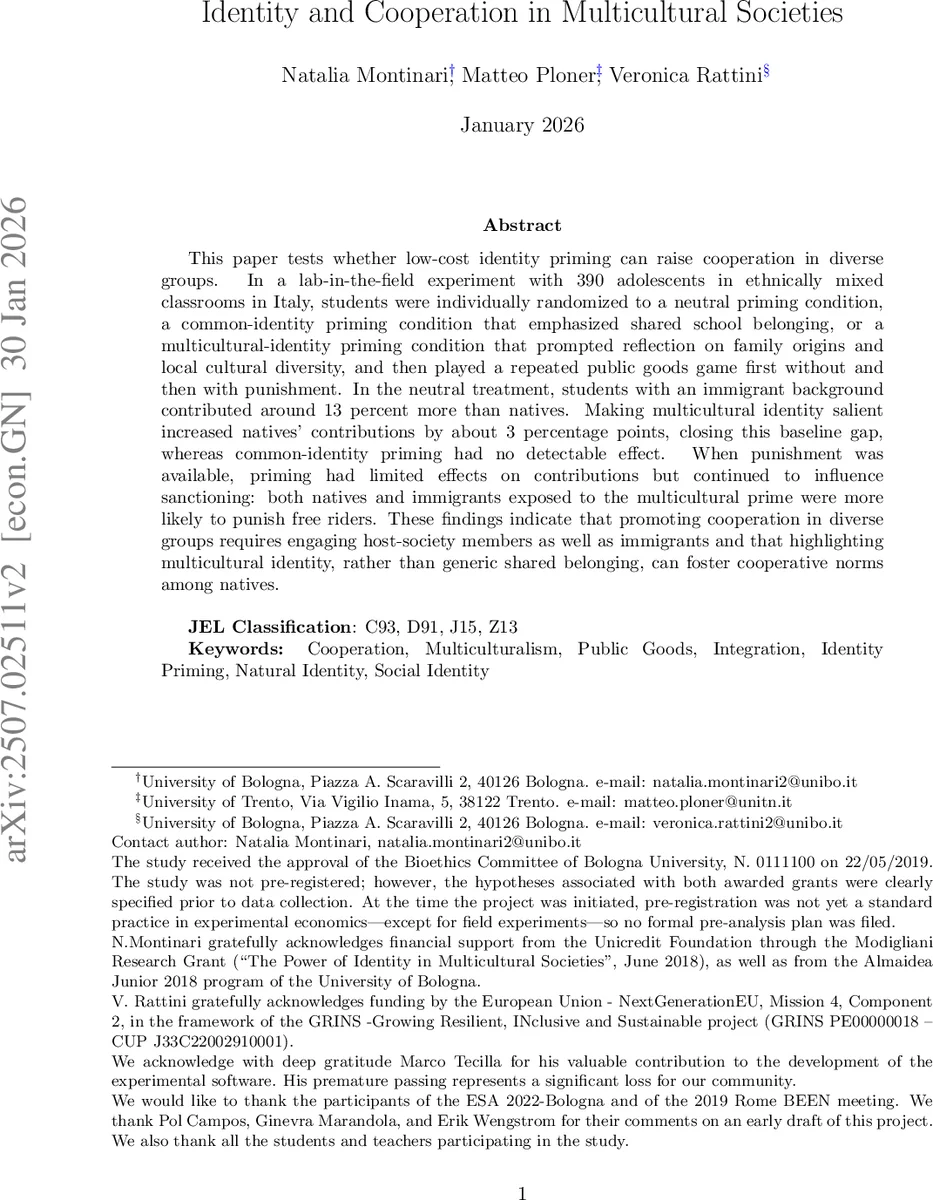
Immigration has shaped many nations, posing the challenge of integrating immigrants into society. While economists often focus on immigrants’ economic outcomes compared to natives (such as education, labor market success, and health) social interactions between immigrants and natives are equally crucial. These interactions, from everyday exchanges to teamwork, often lack enforceable contracts and require cooperation to avoid conflicts and achieve efficient outcomes. However, socioeconomic, ethnic, and cultural differences can hinder cooperation. Thus, evaluating integration should also consider its impact on fostering cooperation across diverse groups. This paper studies how priming different identity dimensions affects cooperation between immigrant and native youth. Immigrant identity includes both ethnic ties to their country of origin and connections to the host country. We test whether cooperation improves by making salient a specific identity: Common identity (shared society), Multicultural identity (ethnic group within society), or Neutral identity. In a lab in the field experiment with over 390 adolescents, participants were randomly assigned to one of these priming conditions and played a Public Good Game. Results show that immigrants are 13 percent more cooperative than natives at baseline. Natives increase cooperation by about 3 percentage points when their multicultural identity is primed, closing the initial gap with immigrant peers.
💡 Research Summary
This paper investigates whether low‑cost identity priming can increase cooperation between immigrant and native adolescents in a natural school setting. Using a lab‑in‑the‑field experiment, the authors recruited 390 middle‑school students (aged 12‑14) from two schools in Bologna, Italy, of whom roughly one‑third have an immigrant background. Within each classroom, participants were randomly assigned to one of three treatments: a “Common Identity” prime that emphasized shared belonging to the school, a “Multicultural Identity” prime that prompted reflection on family origins and the coexistence of multiple cultures, or a neutral condition with no identity activation. After the priming task, participants played a repeated public‑goods game consisting of ten rounds. The first five rounds allowed only contributions, while the last five introduced a punishment option whereby participants could sanction free‑riders at a cost to themselves. Monetary incentives ensured real stakes.
The baseline results show that immigrants contribute about 13 percentage points more than natives in the public‑goods game. The multicultural identity prime raises native contributions by roughly three percentage points, effectively closing the initial gap between the two groups. By contrast, the common‑identity prime has no statistically significant impact on contributions. When the punishment stage is introduced, the priming effects on contributions become small and imprecise, but both natives and immigrants who received the multicultural prime are significantly more likely to punish free‑riders. This indicates that making multicultural identity salient not only boosts cooperative contributions but also strengthens norm‑enforcement behavior.
The authors explore heterogeneity by examining classroom composition, social‑network position, and individual characteristics such as risk preferences, altruism (measured by a dictator game), and generalized trust. The multicultural‑prime effect on natives is strongest in classrooms with a low share of immigrant students and where immigrant peers occupy peripheral positions in the friendship network. Robustness checks rule out alternative explanations related to comprehension of instructions, experimenter demand effects, or emotional states, and the results hold across various regression specifications and clustered standard errors.
The study contributes to several strands of literature. It extends the contact hypothesis by showing that low‑cost identity interventions can improve group‑level cooperation, not just dyadic trust. It adds to experimental work on identity and public‑goods provision by focusing on naturally occurring immigrant‑native identities rather than artificially assigned groups. It also provides policy‑relevant evidence that emphasizing multiculturalism in school curricula can foster inclusive cooperation, suggesting a scalable tool for integration policies.
Limitations include the focus on a single country and age group, and the short‑term nature of the experiment. Future research could test the durability of the priming effect, explore other cooperative contexts (e.g., collaborative projects), and examine whether similar interventions work with older students or in different cultural settings. Overall, the paper demonstrates that a simple, inexpensive multicultural identity prime can substantially narrow cooperation gaps between immigrant and native youths, highlighting the mutual nature of successful integration.
Comments & Academic Discussion
Loading comments...
Leave a Comment