On some results of Harish-Chandra for representations of p-adic groups, extended to their central extensions
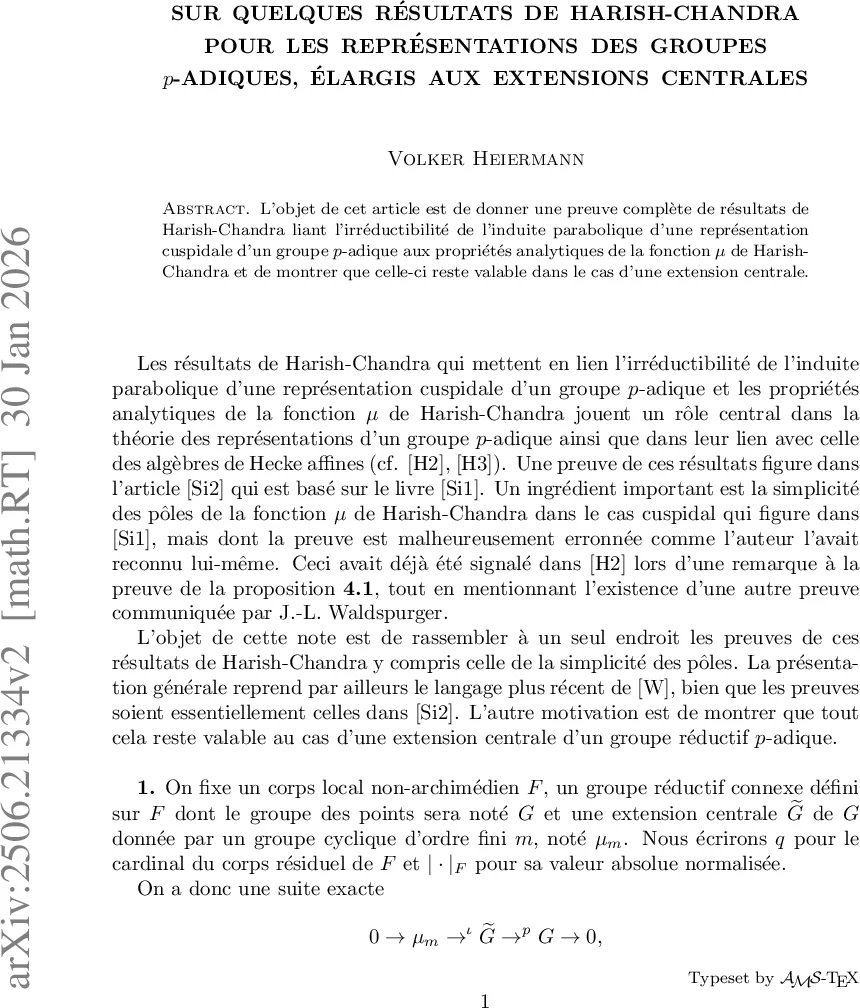
The aim of this article is to give a complete proof of results of Harish-Chandra linking the irreducibility of parabolic induction of a supercuspidal representation of a p-adic group to the analytic behavior of the mu-function of Harish-Chandra and to show that the proof remains valid in the case of a central extension.M
💡 Research Summary
The paper provides a complete and rigorous proof of Harish‑Chandra’s classical results that relate the irreducibility of parabolic induction of a super‑cuspidal representation of a p‑adic reductive group to the analytic behavior of the Harish‑Chandra μ‑function. The author not only fills a gap in earlier proofs (notably those in Silberger’s works) by correctly establishing the simplicity of the poles of the μ‑function in the cuspidal case, but also shows that the entire argument carries over unchanged to finite‑order central extensions of the group.
The setting is a non‑archimedean local field F, a connected reductive group G over F, and a central extension (1\to \mu_m \to \widetilde G \to G \to 1) with μₘ a finite cyclic group. After fixing a minimal parabolic (P_0=M_0U_0), a maximal parabolic (P=MU) containing it, and a maximal split torus A in the centre of M, the paper introduces the usual Weyl‑group element w that intertwines the two parabolics. The analysis distinguishes three mutually exclusive situations: (a) w does not preserve M, (b) w preserves M but does not fix the super‑cuspidal representation σ, and (c) w preserves both M and σ (up to isomorphism). These cases dictate the behavior of the induced representation (i_{\widetilde G}^{\widetilde G}(\widetilde\sigma_\lambda)) for a complex parameter λ.
The central objects are the Harish‑Chandra μ‑function (\mu(\widetilde\sigma_\lambda)) and the standard intertwining operator (J_{\widetilde G|\widetilde G}(\widetilde\sigma_\lambda): i_{\widetilde G}^{\widetilde G}(\widetilde\sigma_\lambda)\to i_{\widetilde G}^{\widetilde G}(\widetilde\sigma_\lambda)). Both are shown to be rational functions of the unramified character variable X∈X_{nr}(\widetilde M). The paper proves that μ is a product of simple linear factors of the form ((1\pm X^{\pm1})) and ((1\pm q^{-a}X^{\pm1})) with a≥0, and that its poles are all simple. Moreover, the poles of μ coincide exactly with the zeros of the intertwining operator, and vice‑versa. This precise correspondence yields a clean criterion for reducibility:
-
If w does not preserve M or w·σ is not isomorphic to σ, then for every real λ the induced representation is irreducible and μ(λ) is regular and non‑zero on the real line.
-
If w preserves M and σ≅w·σ, there exists at most one non‑negative real λ₀ such that the induced representation becomes reducible; at that λ₀ the μ‑function vanishes, and the induced module splits into two non‑isomorphic irreducible constituents. If μ does not vanish, the induced representation remains irreducible.
-
All poles of μ are simple, and the corresponding intertwining operators have simple zeros; consequently the composition of the two standard intertwining operators is a scalar multiple of the identity on the induced module, and this scalar is regular except at the simple poles.
The paper introduces the algebra B=ℂ
Comments & Academic Discussion
Loading comments...
Leave a Comment