Singular flat bands in three dimensions: Landau level spreading, quantum geometry, and Weyl reconstruction
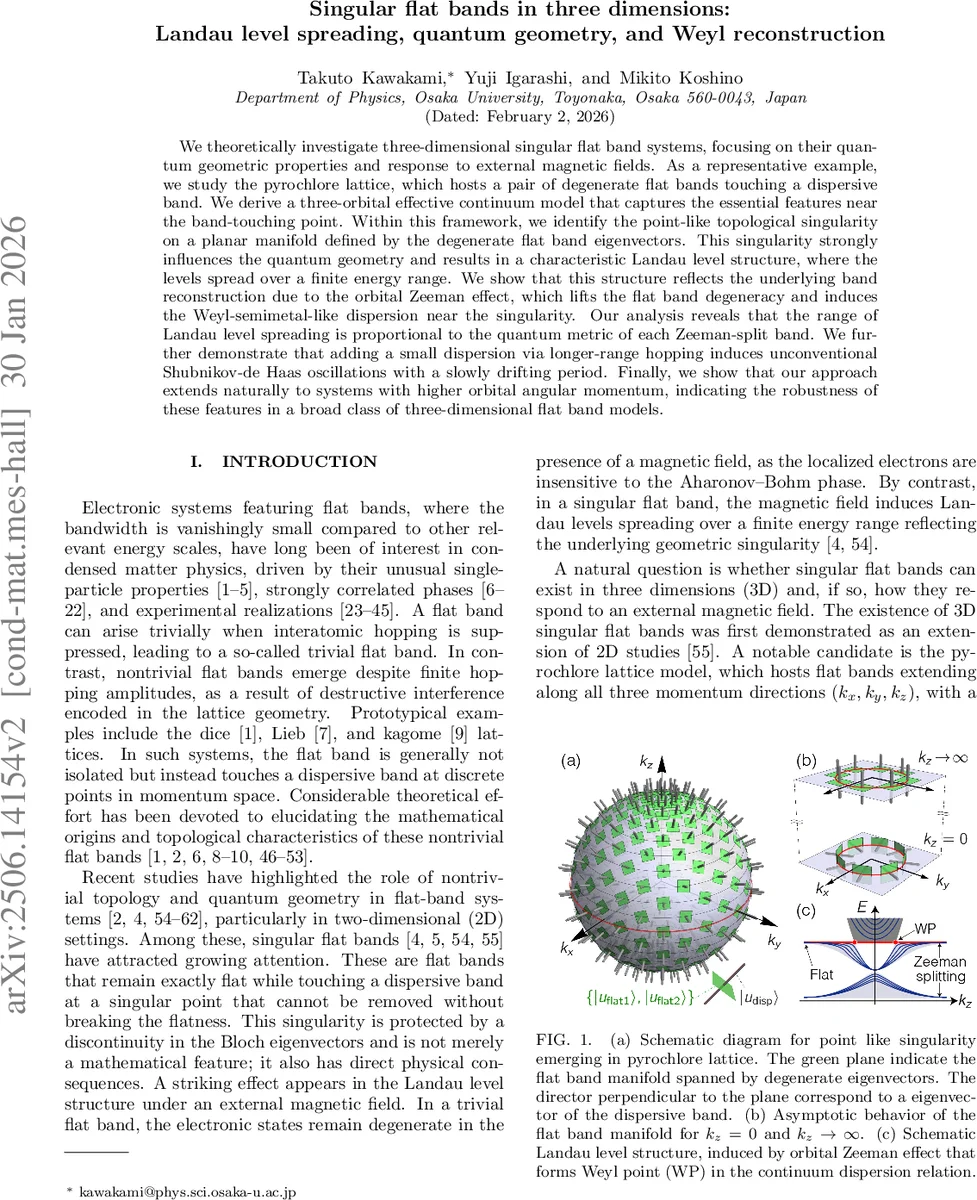
We theoretically investigate three-dimensional singular flat band systems, focusing on their quantum geometric properties and response to external magnetic fields. As a representative example, we study the pyrochlore lattice, which hosts a pair of degenerate flat bands touching a dispersive band. We derive a three-orbital effective continuum model that captures the essential features near the band-touching point. Within this framework, we identify the point-like topological singularity on a planar manifold defined by the degenerate flat band eigenvectors. This singularity strongly influences the quantum geometry and results in a characteristic Landau level structure, where the levels spread over a finite energy range. We show that this structure reflects the underlying band reconstruction due to the orbital Zeeman effect, which lifts the flat band degeneracy and induces the Weyl-semimetal-like dispersion near the singularity. Our analysis reveals that the range of Landau level spreading is proportional to the quantum metric of each Zeeman-split band. We further demonstrate that adding a small dispersion via longer-range . Finally, we show that our approach extends naturally to systems with higher orbital angular momentum, indicating the robustness of these features in a broad class of three-dimensional flat band models.
💡 Research Summary
This paper presents a comprehensive theoretical study of three‑dimensional (3D) singular flat‑band systems, focusing on their quantum‑geometric properties and magnetic‑field response. The authors choose the pyrochlore lattice as a concrete platform because its nearest‑neighbor tight‑binding model hosts a pair of two‑fold degenerate flat bands that touch a dispersive band at the Γ point. By constructing an orthonormal basis of sublattice states, they derive a low‑energy effective continuum Hamiltonian near the band‑touching point:
H_eff = (t d²/2)
Comments & Academic Discussion
Loading comments...
Leave a Comment