Classification of exact structures using the Ziegler spectrum
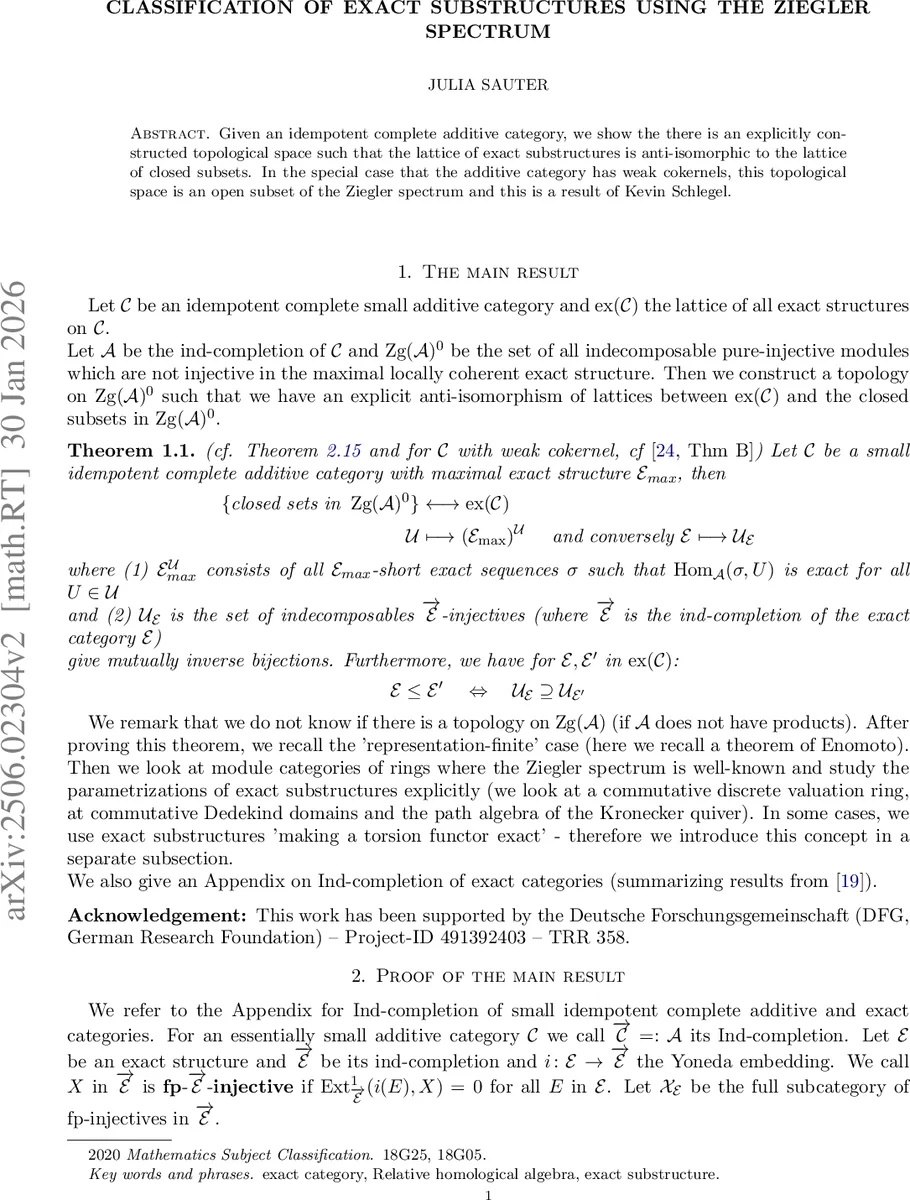
Given an idempotent complete additive category, we show the there is an explicitly constructed topological space such that the lattice of exact substructures is anti-isomorphic to the lattice of closed subsets. In the special case that the additive category has weak cokernels, this topological space is an open subset of the Ziegler spectrum and this is a result of Kevin Schlegel. We also look at some module categories of rings where the Ziegler spectrum is known and calculate the global dimensions of the corresponding exact substructures. Second version contains minor changes to first version.
💡 Research Summary
The paper studies exact structures on an idempotent‑complete additive category C and shows that they can be classified by a topological space built from the Ziegler spectrum of the ind‑completion A = Ind‑C. The main theorem (Theorem 2.15, also called Theorem 1.1 in the introduction) establishes a bijective anti‑isomorphism between the lattice of exact structures on C and the lattice of closed subsets of a certain subspace Zg(A)₀ of the Ziegler spectrum.
Construction of the space:
- A is a locally finitely presented additive category; its pure exact structure is the split exact structure lifted to Ind‑C.
- An object of A is called pure‑injective if it is injective with respect to this pure exact structure.
- Zg(A) denotes the set of isomorphism classes of indecomposable pure‑injective objects.
- Zg(A)₀ is the subset consisting of those pure‑injectives that are not injective in the maximal locally coherent exact structure on C.
The authors endow Zg(A)₀ with a topology (the Ziegler topology restricted to Zg(A)₀). Closed subsets of this space are called Ziegler‑closed. For any exact structure E on C they define
U_E = indecomposable objects in the category of Ind‑E‑injectives
and prove that U_E = Zg(A) ∩ X_E, where X_E is the full subcategory of fp‑Ind‑E‑injective objects. X_E is shown to be “strongly definable”: it is definable, closed under pure subobjects, under quasi‑products (a weak form of products existing in locally finitely presented categories), and under pure‑injective envelopes. Consequently U_E is Ziegler‑closed.
Conversely, given a Ziegler‑closed subset U ⊆ Zg(A)₀, they define an exact structure E_U as the collection of all E_max‑short exact sequences σ such that Hom_A(σ, U) is exact. They prove that E_U is indeed an exact structure and that the assignments
E ↦ U_E and U ↦ E_U
are mutually inverse, yielding the desired anti‑isomorphism of lattices. Moreover, the order is reversed: E ≤ E′ iff U_E ⊇ U_E′.
When C has weak cokernels, Zg(A)₀ coincides with an open subset of the full Ziegler spectrum, recovering a result of Kevin Schlegel. The paper also revisits Enomoto’s theorem, showing that the effective (eff) category of the maximal exact structure is a Serre subcategory of Mod‑C, and that the correspondence above respects this Serre structure.
The authors illustrate the theory with several concrete module categories where the Ziegler spectrum is known:
-
Discrete valuation rings (DVRs) – Zg(A) consists of two points (the simple module and its injective hull). The two possible exact structures have global dimensions 0 and 1 respectively.
-
Dedekind domains – each non‑zero prime ideal gives a point in Zg(A). Closed subsets correspond to collections of such primes, and the associated exact structures have global dimension equal to the number of primes in the chosen set.
-
Path algebra of the Kronecker quiver – Zg(A) contains infinitely many points coming from regular modules. Closed subsets that contain all preprojective and preinjective points give rise to exact structures that make the torsion functor exact; their global dimensions are computed to be 2 or 3 depending on the chosen closed set.
In each example the authors compute the global dimension of the exact structure obtained from a given Ziegler‑closed set, showing a direct link between the topological complexity of the closed set and homological invariants of the corresponding exact category.
Technical tools employed include:
- Quasi‑limits and quasi‑products in locally finitely presented categories (following Krause).
- Pure cogenerators and the fact that Zg(A) is a set and a pure cogenerator for A.
- Definable subcategories described as X(S) for a class of morphisms S, and the observation that such subcategories are closed under pure exact sequences.
- The existence of pure‑injective envelopes (Herzog) and their compatibility with the ind‑completion.
The paper’s contribution is twofold: it provides a clean, topological classification of exact structures on any idempotent‑complete additive category, and it connects homological invariants (global dimension) of these exact structures to the geometry of the Ziegler spectrum. This bridges relative homological algebra, model‑theoretic module theory, and representation theory, offering a new perspective and tools for studying exact categories beyond the classical abelian setting.
Comments & Academic Discussion
Loading comments...
Leave a Comment