Calderón-Zygmund estimates for double phase problems with matrix weights
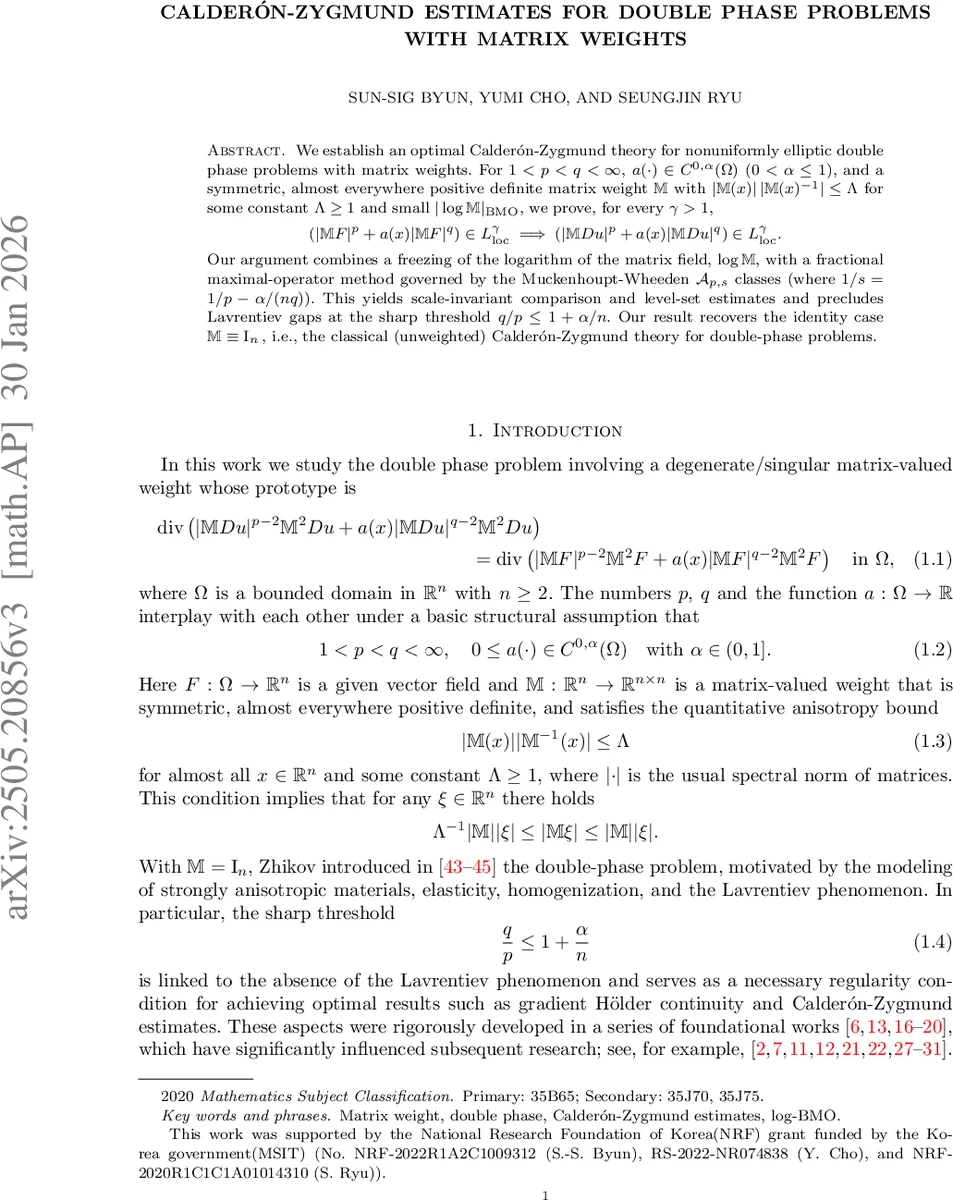
We establish an optimal Calderón-Zygmund theory for nonuniformly elliptic double phase problems with matrix weights. For $1<p<q<\infty$, $a(\cdot)\in C^{0,α}(Ω)$ ($0<α\le1$), and a symmetric, almost everywhere positive definite matrix weight $\M$ with $|\M(x)|,|\M(x)^{-1}|\leΛ$ for some constant $Λ\ge 1$ and small $|\log \M|{\mathrm{BMO}}$, we prove, for every $γ>1$, $$ (|\M F|^p+a(x)|\M F|^q)\in L^γ{\mathrm{loc}} ;\Longrightarrow; (|\M Du|^p+a(x)|\M Du|^q)\in L^γ_{\mathrm{loc}}. $$ Our argument combines a freezing of the logarithm of the matrix field, $\log \M$, with a fractional maximal-operator method governed by the Muckenhoupt-Wheeden $\mathcal{A}_{p,s}$ classes (where $1/s=1/p-α/(nq)$). This yields scale-invariant comparison and level-set estimates and precludes Lavrentiev gaps at the sharp threshold $q/p\le 1+α/n$. Our result recovers the identity case $,\M\equiv {\rm I}_n,$, i.e., the classical (unweighted) Calderón-Zygmund theory for double-phase problems.
💡 Research Summary
The paper investigates the Calderón‑Zygmund regularity theory for a class of non‑uniformly elliptic double‑phase equations equipped with a matrix‑valued weight. The model problem is
\
Comments & Academic Discussion
Loading comments...
Leave a Comment