Measurement-Induced Crossover of Quantum Jump Statistics in Postselection-Free Many-Body Dynamics
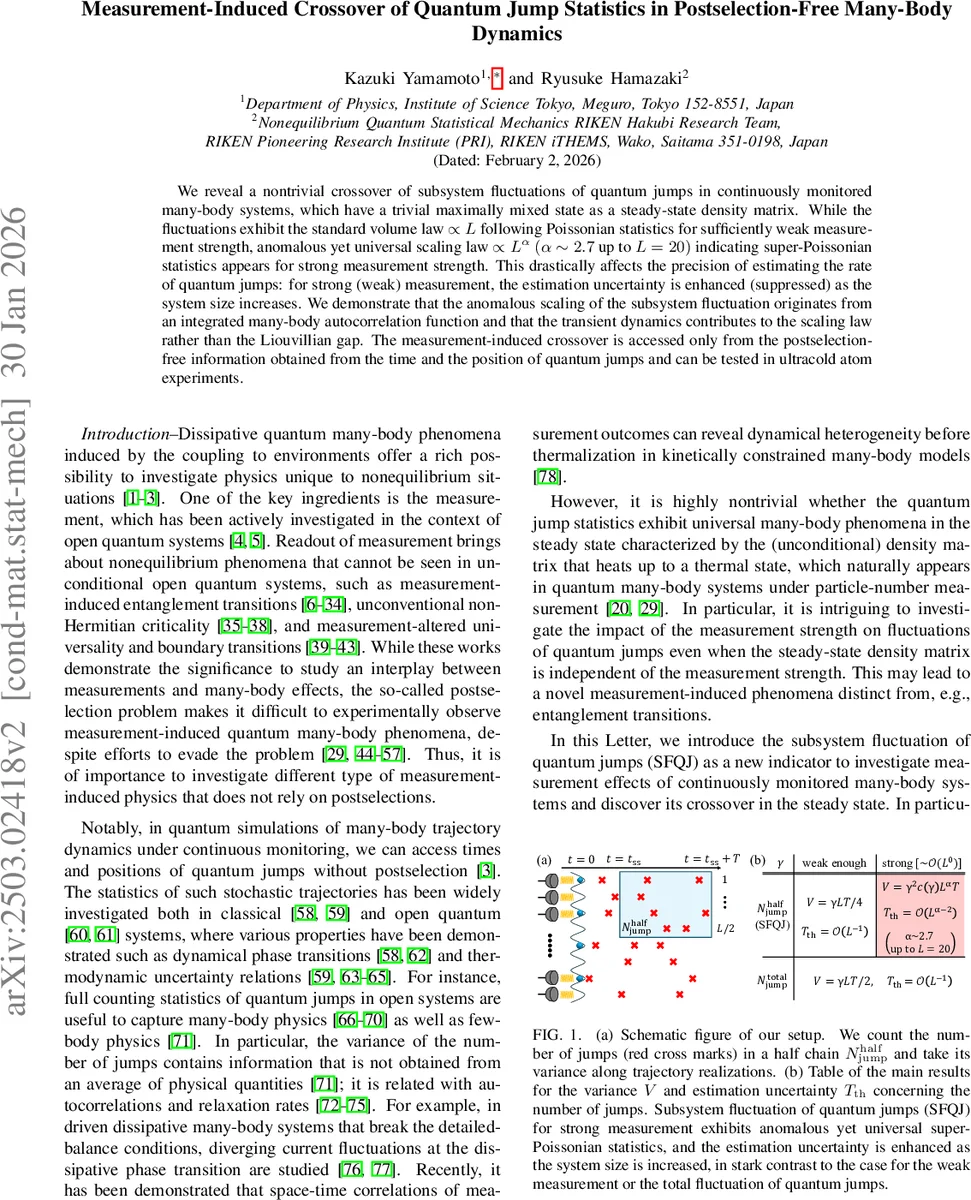
We reveal a nontrivial crossover of subsystem fluctuations of quantum jumps in continuously monitored many-body systems, which have a trivial maximally mixed state as a steady-state density matrix. While the fluctuations exhibit the standard volume law $\propto L$ following Poissonian statistics for sufficiently weak measurement strength, anomalous yet universal scaling law $\propto L^α:(α\sim 2.7$ up to $L=20)$ indicating super-Poissonian statistics appears for strong measurement strength. This drastically affects the precision of estimating the rate of quantum jumps: for strong (weak) measurement, the estimation uncertainty is enhanced (suppressed) as the system size increases. We demonstrate that the anomalous scaling of the subsystem fluctuation originates from an integrated many-body autocorrelation function and that the transient dynamics contributes to the scaling law rather than the Liouvillian gap. The measurement-induced crossover is accessed only from the postselection-free information obtained from the time and the position of quantum jumps and can be tested in ultracold atom experiments.
💡 Research Summary
In this work the authors investigate how continuous monitoring influences the statistics of quantum jumps in a many‑body system, even when the unconditional steady state is a trivial infinite‑temperature (maximally mixed) state. They introduce a new observable, the subsystem fluctuation of quantum jumps (SFQJ), defined as the variance of the number of jumps occurring in a spatial subregion (typically half of a one‑dimensional chain) during a long observation time T. The model studied is a hard‑core boson chain of length L with periodic boundary conditions, described by the XXZ Hamiltonian
(H=\sum_{j=1}^{L}\big
Comments & Academic Discussion
Loading comments...
Leave a Comment