Andreev spin qubits based on the helical edge states of magnetically doped two-dimensional topological insulators
We show that Andreev spin qubits can be realized in a Josephson junction based on the helical edge states of a two-dimensional topological insulator (quantum spin Hall system) proximized by superconducting films, in the presence of magnetic doping. We demonstrate that the electrical dipole transitions between the Andreev spin states induced by the magnetic doping can be harnessed to optically manipulate the Andreev spin qubit by microwave radiation pulses. We numerically simulate the realization of NOT and Hadamard quantum logic gates, and discuss implementations in realistic setups.
💡 Research Summary
The paper proposes a new platform for Andreev spin qubits (ASQs) that exploits the helical edge states of a two‑dimensional quantum spin Hall insulator (QSHI) embedded in a Josephson junction (JJ). In conventional ASQ implementations based on semiconductor nanowires, hyper‑fine interaction with nuclear spins limits coherence times to a few tens of nanoseconds. The authors argue that the helical edge of a QSHI naturally provides spin‑split Andreev bound states (ABSs) without the need for strong spin‑orbit coupling, and that these edge states are protected against non‑magnetic disorder and phonon scattering, promising much longer coherence.
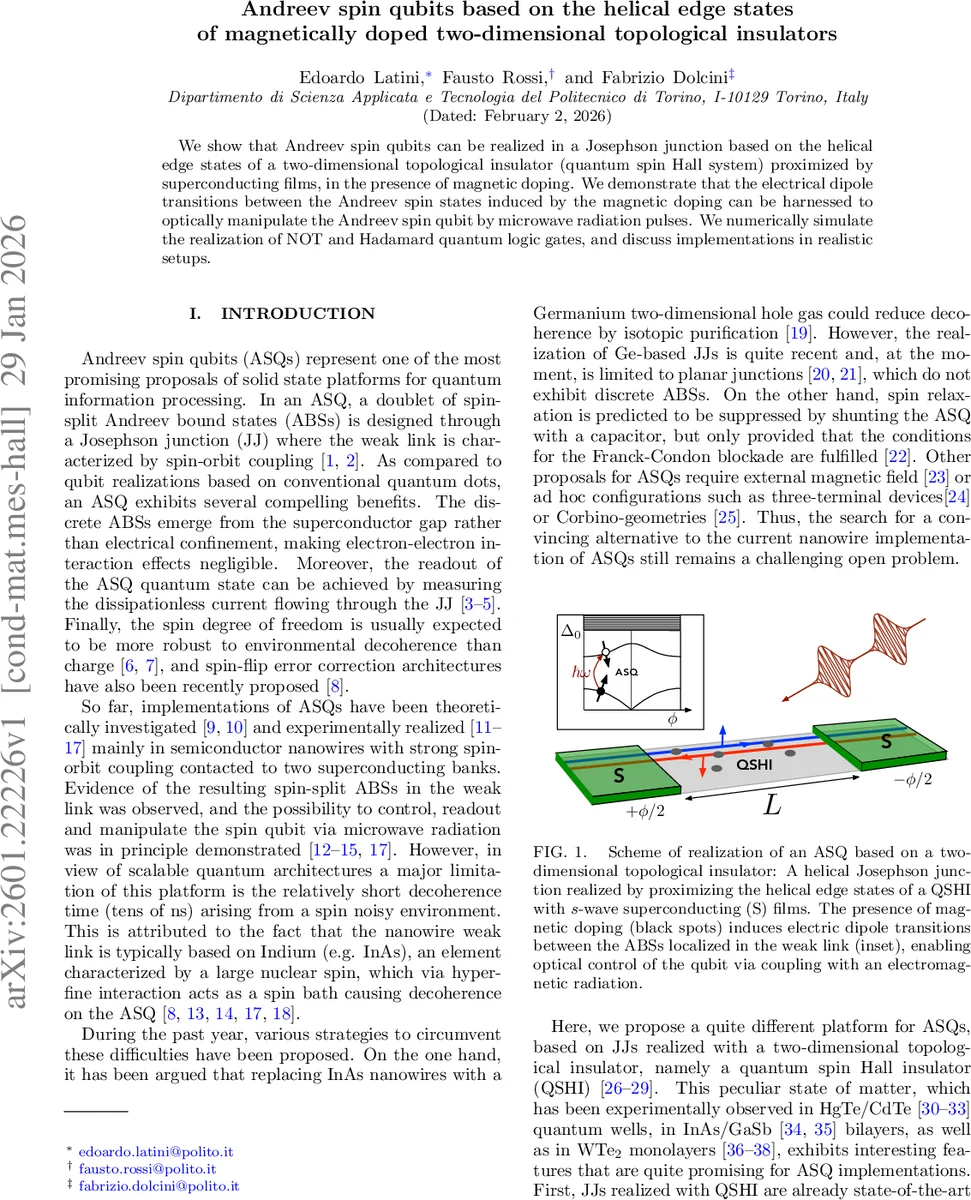
A key obstacle is that, because the helical edge locks spin to propagation direction, electric‑dipole transitions between the two spin‑polarized ABSs are forbidden by selection rules. The authors solve this by introducing magnetic doping (e.g., Mn or Cr atoms) into the weak link of the JJ. The transverse components of the magnetization (mx, my) break time‑reversal symmetry and mix the spin texture of the ABSs, thereby generating non‑zero electric‑dipole matrix elements. This enables strong coupling to microwave radiation and fast Rabi oscillations.
The theoretical model starts from a 1‑D massless Dirac Hamiltonian for the helical edge, adds proximity‑induced s‑wave pairing, and includes a spatially varying magnetic term m(x)·σ. In Bogoliubov‑de Gennes form the system is solved by matching Andreev reflections at the superconducting interfaces with normal scattering from the magnetic barrier. The scattering matrix S_e(E) is parameterized by transmission T_E, reflection R_E, and phase shifts Γ, Θ, χ, which depend on the barrier strength α = m⊥L/ℏv_F and its spatial profile. The ABS energies satisfy a transcendental equation (Eq. 12) that is solved numerically for intermediate junction lengths L ≈ ξ_S (λ = L/ξ_S ≈ 2), where only a few subgap levels exist—ideal for a two‑level qubit.
Numerical results show that, without magnetic doping, the ABS spectrum is symmetric and the electric‑dipole matrix element vanishes. Introducing a magnetic barrier of length L_m and position x_0 produces sizable dipole amplitudes; the optimal configuration yields transition probabilities >90 % with microwave pulses of ≈10 ns duration. Using these transition rates, the authors simulate the implementation of single‑qubit gates: a π‑pulse realizes a NOT gate, while a π/2‑pulse implements a Hadamard gate. Gate fidelities exceed 99 % under realistic disorder and interaction parameters. Readout can be performed nondestructively by measuring the supercurrent, which depends on the occupied ABS.
For experimental realization, the authors suggest state‑of‑the‑art QSHI materials such as HgTe/CdTe quantum wells, InAs/GaSb bilayers, or monolayer WTe₂, combined with Nb or Al superconducting leads. Magnetic doping can be achieved by molecular beam epitaxy or ion implantation of transition‑metal atoms. These platforms have negligible nuclear spin content and weak electron‑phonon coupling, potentially extending coherence times to the 100 µs regime—orders of magnitude longer than nanowire ASQs. Moreover, the planar geometry facilitates lithographic scaling to multi‑qubit arrays.
In summary, the work demonstrates that helical‑edge‑based Josephson junctions, when modestly magnetically doped, provide a robust, electrically controllable Andreev spin qubit. The approach overcomes the decoherence limitations of nanowire devices, offers fast microwave control, and is compatible with existing topological insulator and superconducting fabrication technologies, opening a promising route toward scalable solid‑state quantum processors.
Comments & Academic Discussion
Loading comments...
Leave a Comment