Optimal cross-correlation technique to search for strongly lensed gravitational waves
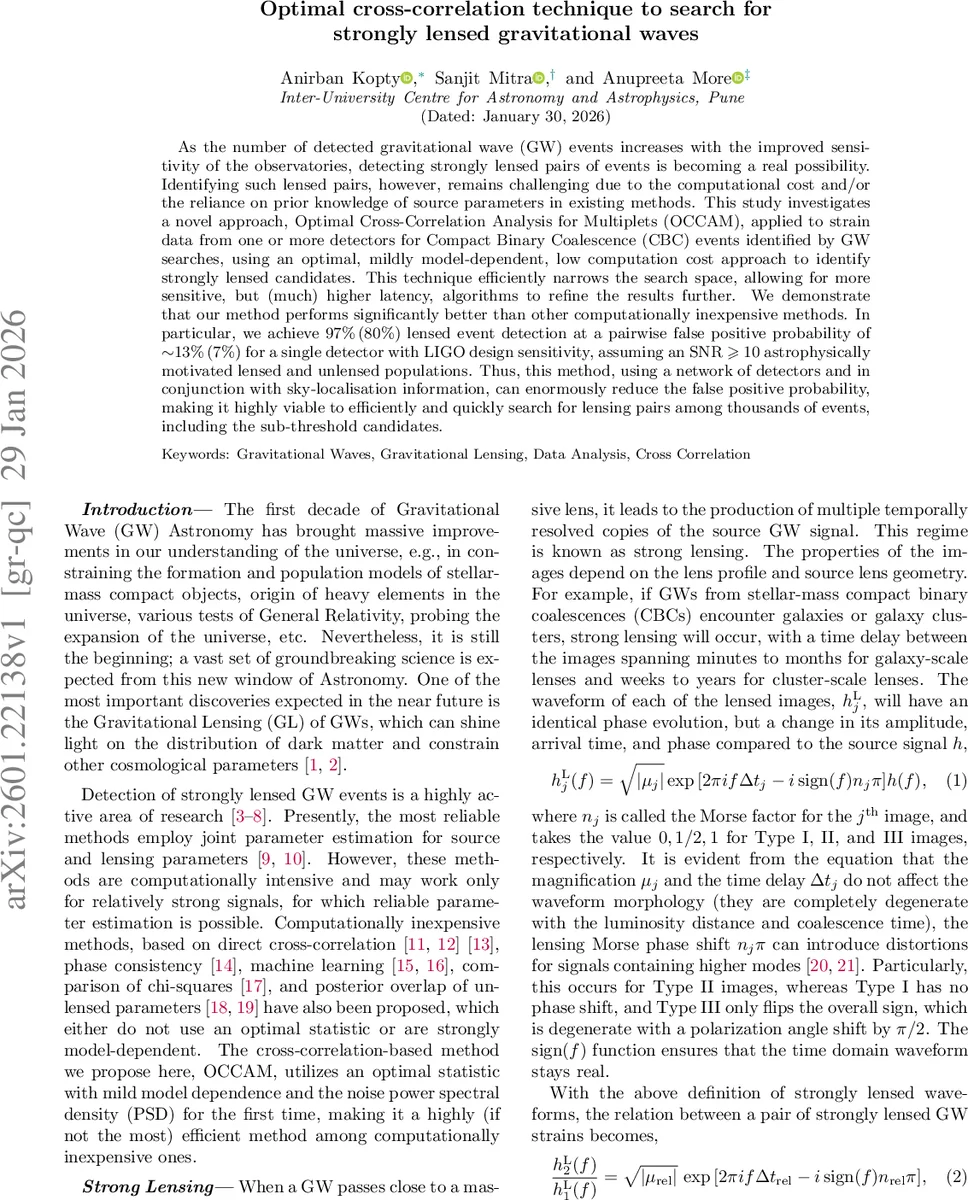
As the number of detected gravitational wave (GW) events increases with the improved sensitivity of the observatories, detecting strongly lensed pairs of events is becoming a real possibility. Identifying such lensed pairs, however, remains challenging due to the computational cost and/or the reliance on prior knowledge of source parameters in existing methods. This study investigates a novel approach, Optimal Cross-Correlation Analysis for Multiplets (OCCAM), applied to strain data from one or more detectors for Compact Binary Coalescence (CBC) events identified by GW searches, using an optimal, mildly model-dependent, low computation cost approach to identify strongly lensed candidates. This technique efficiently narrows the search space, allowing for more sensitive, but (much) higher latency, algorithms to refine the results further. We demonstrate that our method performs significantly better than other computationally inexpensive methods. In particular, we achieve 97 percent (80 percent) lensed event detection at a pairwise false positive probability of approximately 13 percent (7 percent) for a single detector with LIGO design sensitivity, assuming an SNR greater than or equal to 10 astrophysically motivated lensed and unlensed populations. Thus, this method, using a network of detectors and in conjunction with sky-localisation information, can enormously reduce the false positive probability, making it highly viable to efficiently and quickly search for lensing pairs among thousands of events, including the sub-threshold candidates.
💡 Research Summary
The paper addresses the emerging need to identify strongly lensed gravitational‑wave (GW) pairs as the detection rate of compact‑binary coalescences (CBCs) rises with improving detector sensitivities. Existing approaches either rely on full joint parameter estimation, which is computationally intensive and limited to high‑SNR events, or on inexpensive methods such as simple cross‑correlation, phase‑consistency checks, or machine‑learning classifiers that either lack optimality or depend heavily on waveform models. To fill this gap, the authors propose the Optimal Cross‑Correlation Analysis for Multiplets (OCCAM), a low‑cost, mildly model‑dependent technique that directly operates on strain data from one or more detectors.
Physical background
In the strong‑lensing regime a GW signal is duplicated into multiple images. Each image (h_{Lj}(f)) differs from the source waveform (h(f)) by a magnification factor (\mu_j), a time delay (\Delta t_j), and a Morse phase (n_j\pi). For a pair of images the relation simplifies to
(h_2(f) = p,|\mu_{\rm rel}|,e^{i\phi_{\rm rel}},h_1(f))
with (\phi_{\rm rel}=n_{\rm rel}\pi). The time‑delay term can be ignored for the purpose of cross‑correlation because it is degenerate with the coalescence time.
Statistical formalism
Given two strain streams (s_1(t)=h_1(t)+n_1(t)) and (s_2(t)=h_2(t)+n_2(t)), the authors define a filtered cross‑correlation estimator
(\hat s(t)=\int \tilde s_1^(f)\tilde s_2(f)\tilde Q^(f),df).
The expected signal‑to‑noise ratio (SNR) of this estimator is maximized when the filter (\tilde Q) is proportional to (\tilde h_1^*\tilde h_2/\xi), where (\xi) incorporates the one‑sided noise power‑spectral densities (PSDs) of the two detectors. Substituting the lensing relation yields the optimal cross‑correlation statistic
\
Comments & Academic Discussion
Loading comments...
Leave a Comment