The Economics of No-regret Learning Algorithms
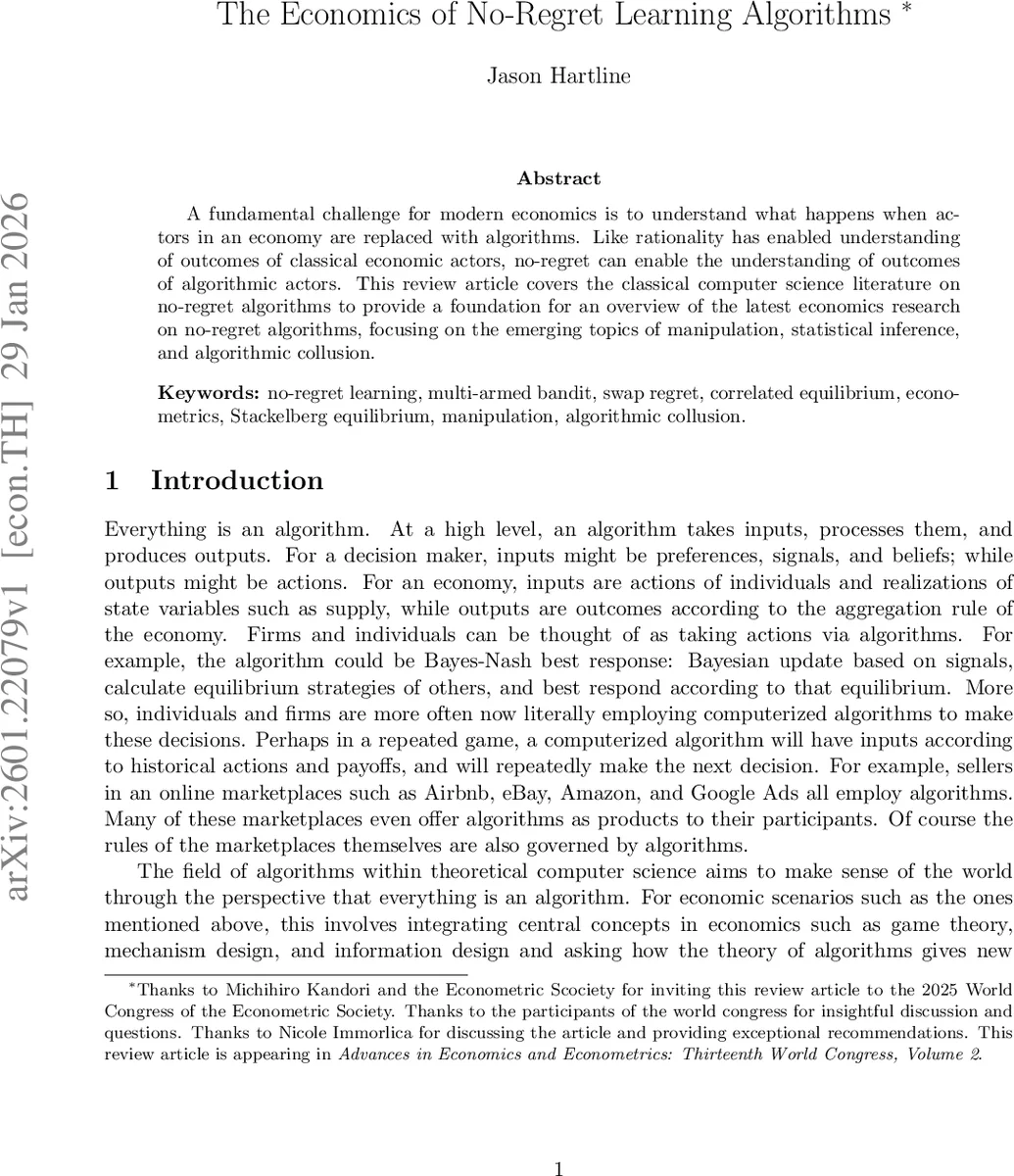
A fundamental challenge for modern economics is to understand what happens when actors in an economy are replaced with algorithms. Like rationality has enabled understanding of outcomes of classical economic actors, no-regret can enable the understanding of outcomes of algorithmic actors. This review article covers the classical computer science literature on no-regret algorithms to provide a foundation for an overview of the latest economics research on no-regret algorithms, focusing on the emerging topics of manipulation, statistical inference, and algorithmic collusion.
💡 Research Summary
**
The paper “The Economics of No‑Regret Learning Algorithms” is a comprehensive review that bridges the extensive computer‑science literature on no‑regret online learning with the newest strands of economic research that employ these algorithms as models of strategic agents. The authors begin by observing that modern markets increasingly rely on software agents—pricing bots, recommendation systems, ad‑allocation algorithms—and that traditional economic analysis, which assumes fully rational, equilibrium‑computing agents, is ill‑suited to capture the dynamics of such algorithmic actors. No‑regret learning, originally introduced by Hannan (1957) and later refined in the online‑learning community, offers a weaker but tractable notion of rationality: an agent’s cumulative payoff is asymptotically as good as the best fixed action in hindsight (best‑in‑hindsight regret) or, more strongly, as good as any action that could be obtained by swapping one of its past actions for another (swap regret).
The review first formalizes the standard adversarial online‑learning model: in each of n rounds a learner selects one of k actions, observes the payoff vector for all actions, and seeks to minimize average regret. Deterministic algorithms cannot achieve sub‑linear regret against an adversary; randomization is essential. The authors then discuss four canonical algorithms that illustrate the evolution from naïve to optimal no‑regret methods:
- Follow‑the‑Leader (FTL) – chooses the action with the highest cumulative payoff so far. It works in i.i.d. settings but suffers linear regret under adversarial payoffs.
- Exponential Weights (EW) – a multiplicative‑weights update rule that assigns probabilities proportional to (1+ε) raised to cumulative payoffs. With learning rate ε≈√(log k / n) the algorithm attains O(√(log k / n)) regret, the optimal order for adversarial environments.
- Be‑the‑Leader (BTL) – a hypothetical benchmark that, after seeing the entire history, would pick the best action for each round. BTL always dominates the true optimum (OPT), providing an upper bound but is not implementable.
- Perturbed‑Follow‑the‑Leader (PFTL) – a practical approximation of BTL that adds random perturbations to initial payoffs (often geometric‑distributed “tails”). This randomization smooths the leader’s path and yields the same O(√(log k / n)) regret guarantee as EW.
The authors then connect these algorithmic guarantees to game‑theoretic equilibrium concepts. When many agents repeatedly play a normal‑form game and each runs a no‑regret learning algorithm, the empirical distribution of joint actions converges to a coarse correlated equilibrium (CCE) if the agents only guarantee best‑in‑hindsight regret, and to a correlated equilibrium (CE) if they guarantee swap regret. This link, originally proved by Foster & Vohra (1997) and Hart & Mas‑Colell (2000), is crucial because CE and CCE are computationally tractable (they can be found by linear programming) whereas Nash equilibria are PPAD‑complete in general bimatrix games. Thus, no‑regret learning provides a realistic, algorithmic pathway to equilibrium outcomes that are both observable and computable.
The review devotes three substantive sections to emerging economic applications of these ideas:
(i) Manipulation in Stackelberg Settings. In a Stackelberg game where a leader commits to a strategy and a follower learns via a no‑regret algorithm, the type of regret matters. Followers with best‑in‑hindsight regret will learn to best‑respond to the leader’s fixed strategy, reproducing the Stackelberg equilibrium payoffs. However, followers with swap‑regret are more robust: they cannot be coaxed into giving the leader a higher payoff than the Stackelberg equilibrium, as shown in Braverman et al. (2018) and Deng et al. (2019). This distinction suggests that regulators might require platforms to enforce swap‑regret‑type learning to prevent “price‑leadership” manipulation.
(ii) Structural Inference and Econometrics. Nekipelov, Syrgkanis, and Tardos (2015) demonstrate that observed action data together with a no‑regret guarantee can be used to back out the set of underlying preferences and regret parameters that rationalize the data. Unlike classic structural estimation that assumes Nash equilibrium, the no‑regret framework relaxes the equilibrium condition, allowing econometricians to test models with weaker rationality assumptions and to construct confidence sets for latent utilities.
(iii) Algorithmic Collusion. Recent work (Calvano et al., 2020; Hartline, Immorlica, and others 2024‑2025) shows that in online marketplaces, price‑setting algorithms that minimize regret can converge to collusive outcomes even without explicit communication. The authors argue that swap‑regret guarantees provide a partial safeguard: while best‑in‑hindsight regret can be exploited to sustain supra‑competitive pricing, swap‑regret algorithms limit the extent to which one algorithm can manipulate another’s payoff. This insight informs antitrust policy, suggesting that monitoring the regret‑type of deployed algorithms could be a practical tool for detecting and preventing tacit collusion.
Throughout, the paper emphasizes that no‑regret learning offers a computationally feasible, empirically observable, and policy‑relevant alternative to classical equilibrium analysis. It reconciles the algorithmic intractability of Nash equilibria with the need for tractable predictions in markets dominated by AI agents. By summarizing the core definitions, classic algorithms, and the latest economic applications, the review serves as a roadmap for researchers who wish to incorporate learning dynamics into economic theory, experimental design, and regulatory frameworks.
In conclusion, the authors argue that the economics of no‑regret learning is poised to become a central pillar of modern economic analysis, especially as digital platforms and autonomous agents proliferate. The blend of rigorous online‑learning guarantees, equilibrium‑theoretic implications, and concrete policy applications makes the field both intellectually rich and practically urgent.
Comments & Academic Discussion
Loading comments...
Leave a Comment