Fully exact and fully dualizable module categories
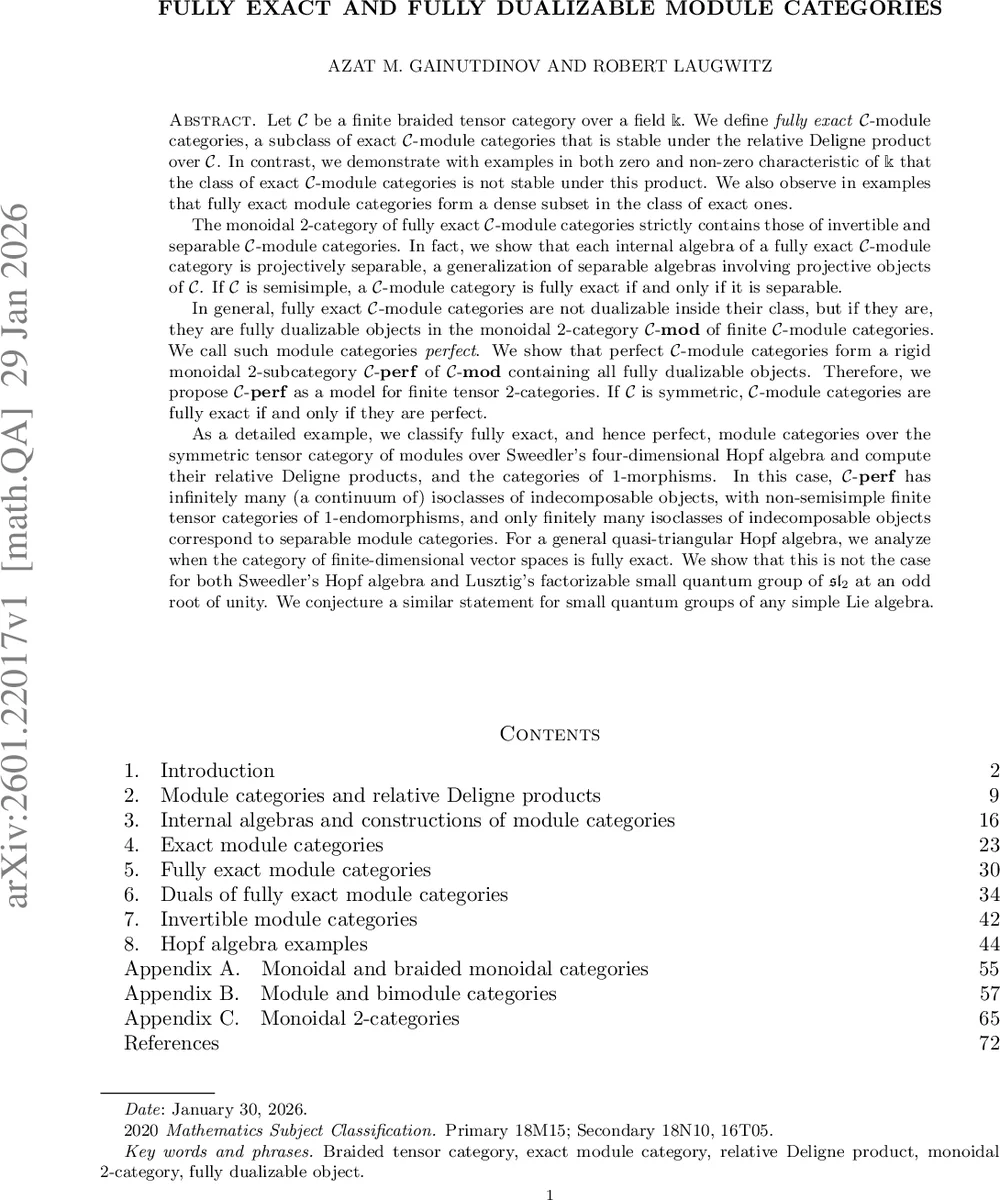
We define fully exact module categories, a subclass of exact module categories over a finite braided tensor category that is stable under the relative Deligne product. In contrast, we demonstrate with examples in both zero and non-zero characteristic of the base field that the class of exact module categories is not stable under this product. We also observe in examples that fully exact module categories form a dense subset in the class of exact ones. The monoidal 2-category of fully exact module categories strictly contains those of invertible and separable module categories. In fact, we show that each internal algebra of a fully exact module category is projectively separable, a generalization of separable algebras involving projective objects. In the semisimple case, a module category is fully exact if and only if it is separable. In general, fully exact module categories are not dualizable inside their class, but if they are, they are fully dualizable objects in the monoidal 2-category of finite module categories. We call such module categories perfect. We show that perfect module categories form a rigid monoidal 2-subcategory containing all fully dualizable objects. Therefore, we propose perfect module categories as a model for finite tensor 2-categories. If the braiding is symmetric, a module category is fully exact if and only if it is perfect. As a detailed example, we classify fully exact, and hence perfect, module categories over the symmetric tensor category of modules over Sweedler’s four-dimensional Hopf algebra and compute their relative Deligne products, and the categories of 1-morphisms. For a general quasi-triangular Hopf algebra, we analyze when the category of finite-dimensional vector spaces is fully exact. We show that this is not the case for both Sweedler’s Hopf algebra and Lusztig’s factorizable small quantum group of type $A_1$ at an odd root of unity.
💡 Research Summary
The paper introduces a new class of module categories over a finite braided tensor category C, called “fully exact” module categories, and studies their properties in depth. A left C‑module M is defined to be fully exact if for every exact left C‑module N, the relative Deligne product N ⊠_C M is again exact. This definition guarantees closure under the Deligne product, a property that the previously studied class of exact module categories lacks. The authors provide explicit counter‑examples showing that exact module categories are not stable under ⊠_C: in positive characteristic, the Deligne product of graded vector spaces Vect^G with itself fails to be exact when the characteristic divides |G|; in characteristic zero, the Deligne product svect ⊠_C svect over Sweedler’s four‑dimensional Hopf algebra S‑mod is also non‑exact.
The paper then characterizes fully exact module categories via several equivalent conditions. The centralizer functor A_M: C → Fun_C(M,M) preserves projective objects; equivalently, for any exact N, the internal Hom Fun_C(N,M) is exact; equivalently, the centralizer category C * M = Fun_C(M,M) is exact as a left C‑module; and finally, the algebra A associated to M is “projectively separable”: there exists a projective object P in C such that P⊗A is a direct summand of A⊗P⊗A as an A‑bimodule. In the semisimple case, projectively separable algebras coincide with the classical separable algebras, so fully exact module categories are precisely separable ones. In general, however, fully exact is a strictly weaker condition.
Fully exact module categories need not be dualizable inside the 2‑category of all module categories. The authors therefore single out those that are both fully exact and dualizable, calling them “perfect” module categories. Perfect module categories form a rigid monoidal 2‑subcategory C_perf of the 2‑category C‑mod of finite C‑modules. In C_perf, every object has left and right duals and every 1‑morphism (module functor) has left and right adjoints, so perfect objects are fully dualizable in the sense of the cobordism hypothesis. Moreover, when the braiding on C is symmetric, fully exact and perfect coincide, giving a clean description in the symmetric case.
A substantial part of the paper is devoted to concrete examples. For the symmetric tensor category S‑mod of modules over Sweedler’s Hopf algebra S, the authors re‑parameterize the indecomposable module categories by two copies of ℂ ∪ {∞}, denoted V_λ (and S_λ for the super‑vector version). They prove that V_λ and S_λ are fully exact if and only if λ = ∞, and they compute all relative Deligne products and internal Hom categories among these fully exact modules. The resulting 2‑category C_perf contains a continuum of indecomposable objects, but only finitely many of them correspond to separable (hence semisimple) module categories. This illustrates that the fully exact class is vastly larger than the separable class.
The authors also analyze when the trivial module category Vect is fully exact for a braided category C = H‑mod coming from a finite-dimensional quasitriangular Hopf algebra H. They show that Vect is fully exact precisely when the restriction functor along the Hopf algebra map φ_R: H^* → H preserves projectives. If H^* is semisimple, this condition always holds; however, for Lusztig’s small quantum group u_q(sl₂) at an odd root of unity, the condition fails, and consequently Vect is not fully exact. The same failure occurs for Sweedler’s Hopf algebra. The authors conjecture that for any small quantum group u_q(g) the trivial module category is not fully exact.
Overall, the paper provides a robust framework for studying non‑semisimple monoidal 2‑categories with strong dualizability properties. By isolating fully exact and perfect module categories, the authors obtain a class stable under both Morita equivalence and the Deligne product, making them suitable candidates for modeling finite tensor 2‑categories in higher‑dimensional topological field theory. The detailed computations for Sweedler’s Hopf algebra and the analysis of small quantum groups illustrate both the richness of the theory and its relevance to concrete algebraic structures.
Comments & Academic Discussion
Loading comments...
Leave a Comment