Highest weight categories via pairs of dual exceptional sequences
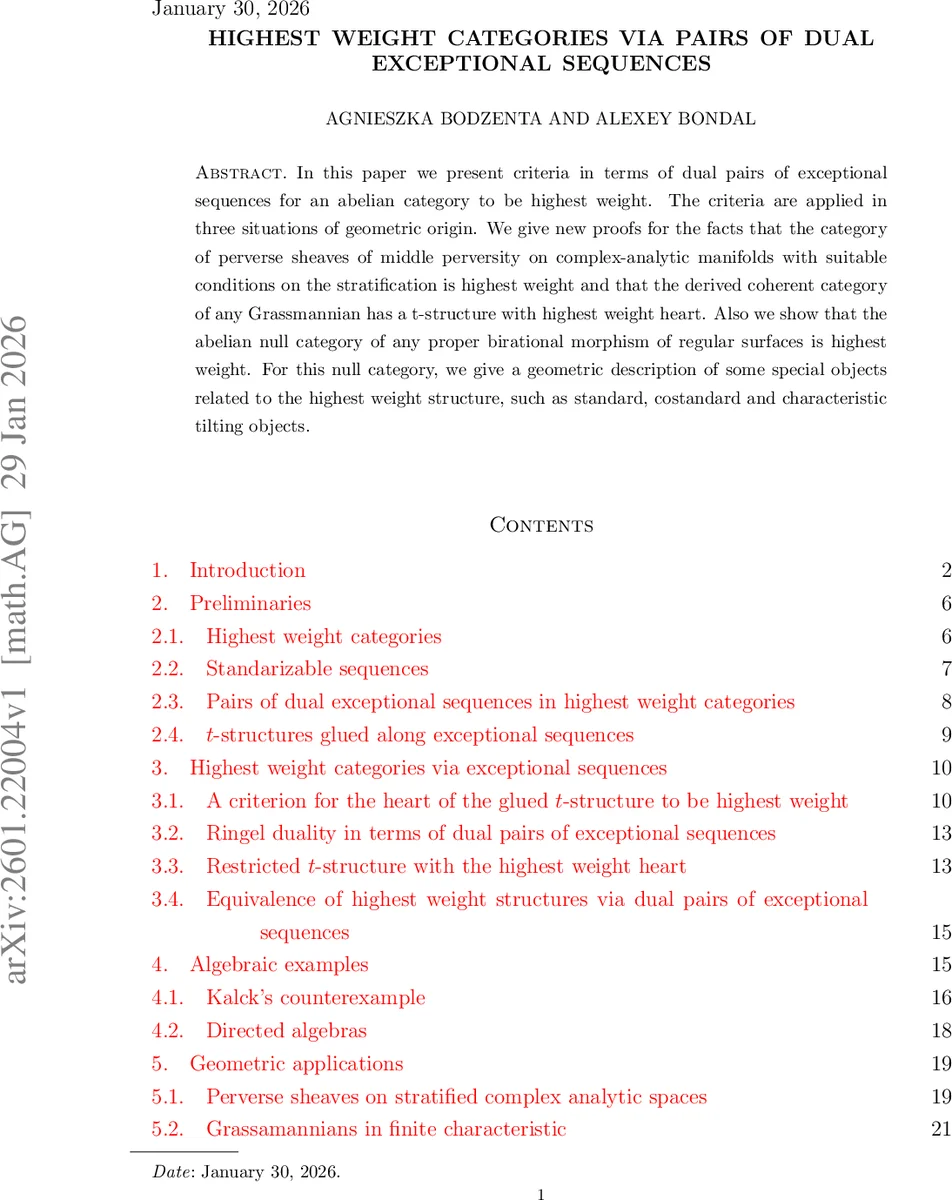
In this paper we present criteria in terms of dual pairs of exceptional sequences for an abelian category to be highest weight. The criteria are applied in three situations of geometric origin. We give new proofs for the facts that the category of perverse sheaves of middle perversity on complex-analytic manifolds with suitable conditions on the stratification is highest weight and that the derived coherent category of any Grassmannian has a $t$-structure with highest weight heart. Also we show that the abelian null category of any proper birational morphism of regular surfaces is highest weight. For this null category, we give a geometric description of some special objects related to the highest weight structure, such as standard, costandard and characteristic tilting objects.
💡 Research Summary
The paper “Highest weight categories via pairs of dual exceptional sequences” develops new criteria for an abelian category to carry a highest weight structure, expressed entirely in terms of dual pairs of exceptional sequences in its bounded derived category. The authors first recall the classical definition of a highest weight category (CPS88): a finite length, Deligne‑finite abelian category equipped with a partial order Λ on simples and a set of standard objects Δ(λ) satisfying the usual filtration axioms (st1, st2). They then introduce the notion of a standardizable sequence in an abelian category and the iterated universal extension P associated to such a sequence, recalling the DR92 theorem that End(P)‑modules form a highest weight category with standards given by Hom(P, E_i).
The core contribution lies in translating the homological conditions on exceptional sequences into the language of highest weight theory. An exceptional sequence (E₁,…,E_n) in a triangulated category D admits a left dual sequence (F_n,…,F₁) defined by successive left mutations. When the sequence is full, the duality property Hom_D(E_i, F_j
Comments & Academic Discussion
Loading comments...
Leave a Comment