Error-detectable Universal Control for High-Gain Bosonic Quantum Error Correction
Protecting quantum information through quantum error correction (QEC) is a cornerstone of future fault-tolerant quantum computation. However, current QEC-protected logical qubits have only achieved coherence times about twice those of their best physical constituents. Here, we show that the primary barrier to higher QEC gains is ancilla-induced operational errors rather than intrinsic cavity coherence. To overcome this bottleneck, we introduce error-detectable universal control of bosonic modes, wherein ancilla relaxation events are detected and the corresponding trajectories discarded, thereby suppressing operational errors on logical qubits. For binomial codes, we demonstrate universal gates with fidelities exceeding $99.6%$ and QEC gains of $8.33\times$ beyond break-even. Our results establish that gains beyond $10\times$ are achievable with state-of-the-art devices, establishing a path toward fault-tolerant bosonic quantum computing.
💡 Research Summary
The paper addresses a fundamental bottleneck in bosonic quantum error correction (QEC): operational errors introduced by the ancillary transmon qubit (ancilla) used for control and syndrome extraction. While bosonic modes (microwave cavities) can have lifetimes on the order of milliseconds, the ancilla typically decays in tens of microseconds, leading to an operation error ε_op ≈ 5 % when conventional two‑level (|g⟩, |e⟩) control is employed. This limits the achievable QEC gain to roughly a factor of two beyond the break‑even point, far short of the order‑of‑magnitude improvements required for practical fault tolerance.
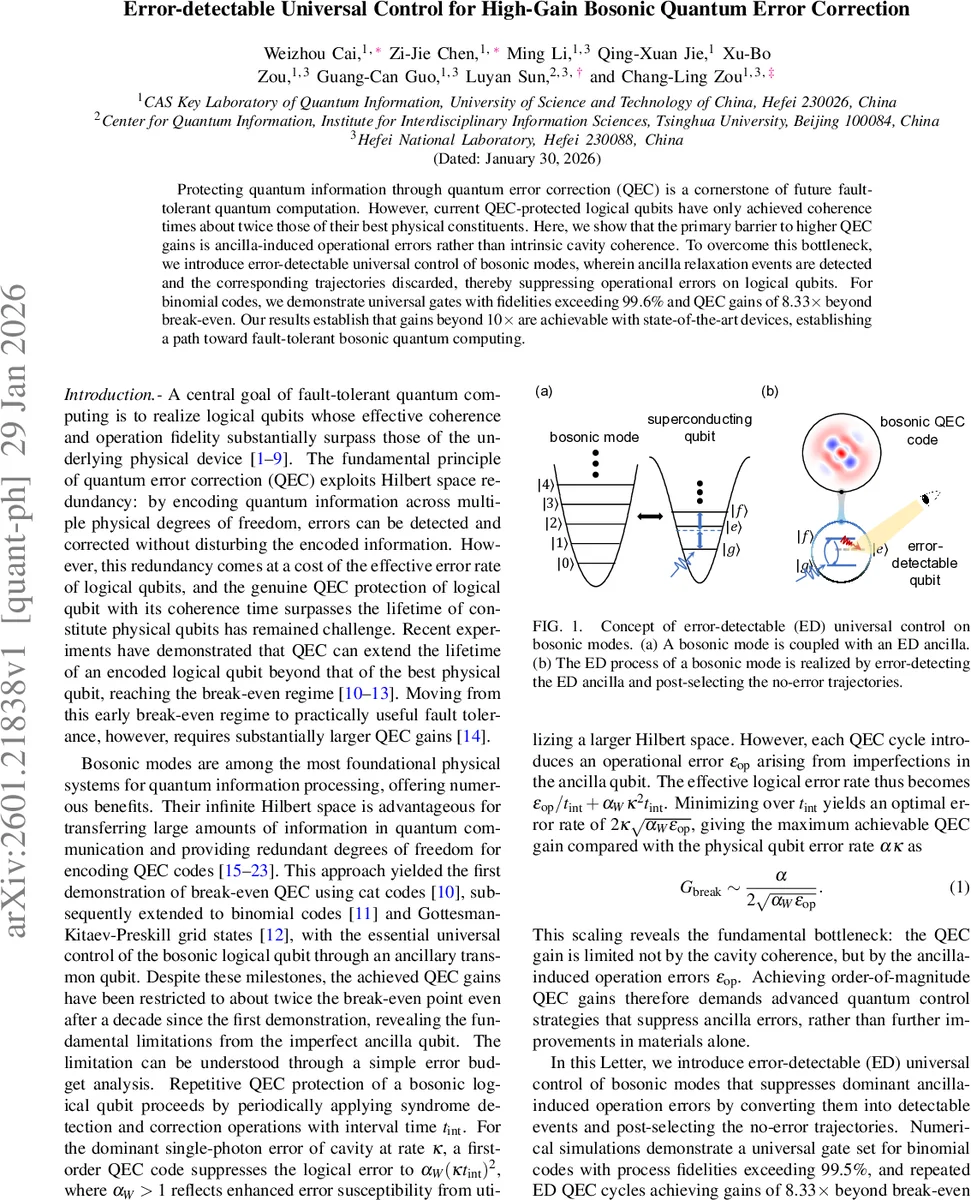
The authors propose “error‑detectable (ED) universal control,” a scheme that converts the dominant ancilla relaxation error into a detectable event. By promoting the ancilla to a three‑level system using the |g⟩, |f⟩ manifold for logical control and reserving the intermediate |e⟩ state as an error flag, any relaxation of the ancilla inevitably populates |e⟩. A projective measurement of the ancilla after each operation reveals whether an error occurred; trajectories that register |e⟩ are discarded (post‑selection, PS). This transforms a coherent, undetectable error into a heralded loss, reducing ε_op to below 0.4 % while preserving a high success probability (≈95 %).
To implement the ED control, the authors extend Gradient Ascent Pulse Engineering (GRAPE) to include two‑photon drives on the ancilla, yielding an effective Hamiltonian that simultaneously drives the |g⟩↔|f⟩ transition and couples dispersively to the cavity mode. The resulting Hamiltonian (Eqs. 2‑3) contains terms proportional to σ_x^gf and σ_y^gf, as well as cavity‑dependent Stark shifts χ_e and χ_f. Numerical optimization produces waveforms for logical gates on the binomial code (|0_L⟩ = (|0⟩+|4⟩)/√2, |1_L⟩ = |2⟩). Simulations show that, with PS, the Hadamard, T, and controlled‑phase (CZ) gates achieve process fidelities >99.5 % (Table I), compared with ~96 % without PS. The post‑selection success probabilities remain above 0.9 for all gates, indicating that the extra measurement overhead does not dramatically reduce throughput.
The ED framework is then applied to repeated QEC cycles. Two strategies are examined:
- ED‑A (ancilla‑only detection) – after each QEC operation the ancilla is measured; if |e⟩ is observed the cycle is aborted.
- ED‑AB (ancilla + bosonic detection) – in addition to ancilla measurement, the parity of the cavity (used for syndrome extraction) is also post‑selected, discarding trajectories that reveal a photon‑loss event.
Simulations of long‑time evolution (Fig. 3) reveal that ED‑A extends the logical qubit lifetime to T₁ ≈ 18.8 ms, a 5.6‑fold improvement over an unprotected physical qubit (T₁ ≈ 3.35 ms). ED‑AB further suppresses residual errors, achieving a peak process‑infidelity ratio of 8.33 relative to the physical baseline, corresponding to an effective QEC gain G_break ≈ 8.33. The logical process fidelity decays slightly non‑exponentially at long times due to a small coherent error accumulated in repeated parity measurements, but the overall performance remains far superior to prior bosonic QEC demonstrations.
A compact error budget is derived (Eq. 4) to elucidate how the QEC gain depends on the ancilla relaxation rate κ_e, the interval time t_int, the number of parity measurements N_PM, and the residual error contributions from waiting (E_W), parity measurement (E_PM), and the QEC operation itself (E_QEC). The analysis predicts a crossover: improving ancilla lifetime yields larger gains up to a critical point, beyond which further improvements give diminishing returns because the success probability of post‑selection falls and higher‑order cavity loss (κ t_int)^3 dominates.
The authors conclude that by converting ancilla decay into a heralded, discardable event, the dominant source of operational error can be suppressed by an order of magnitude without hardware changes. With realistic device parameters (χ ≈ 1–2 MHz, cavity loss κ ≈ 0.5 ms⁻¹, ancilla T₁ ≈ 20 µs), the scheme already predicts QEC gains exceeding 8× and suggests that gains >10× are within reach of current technology. This establishes a clear pathway toward fault‑tolerant bosonic quantum computing, where the infinite Hilbert space of cavities can be fully exploited once ancilla‑induced errors are rendered detectable and removable.
Comments & Academic Discussion
Loading comments...
Leave a Comment