RAG-E: Quantifying Retriever-Generator Alignment and Failure Modes
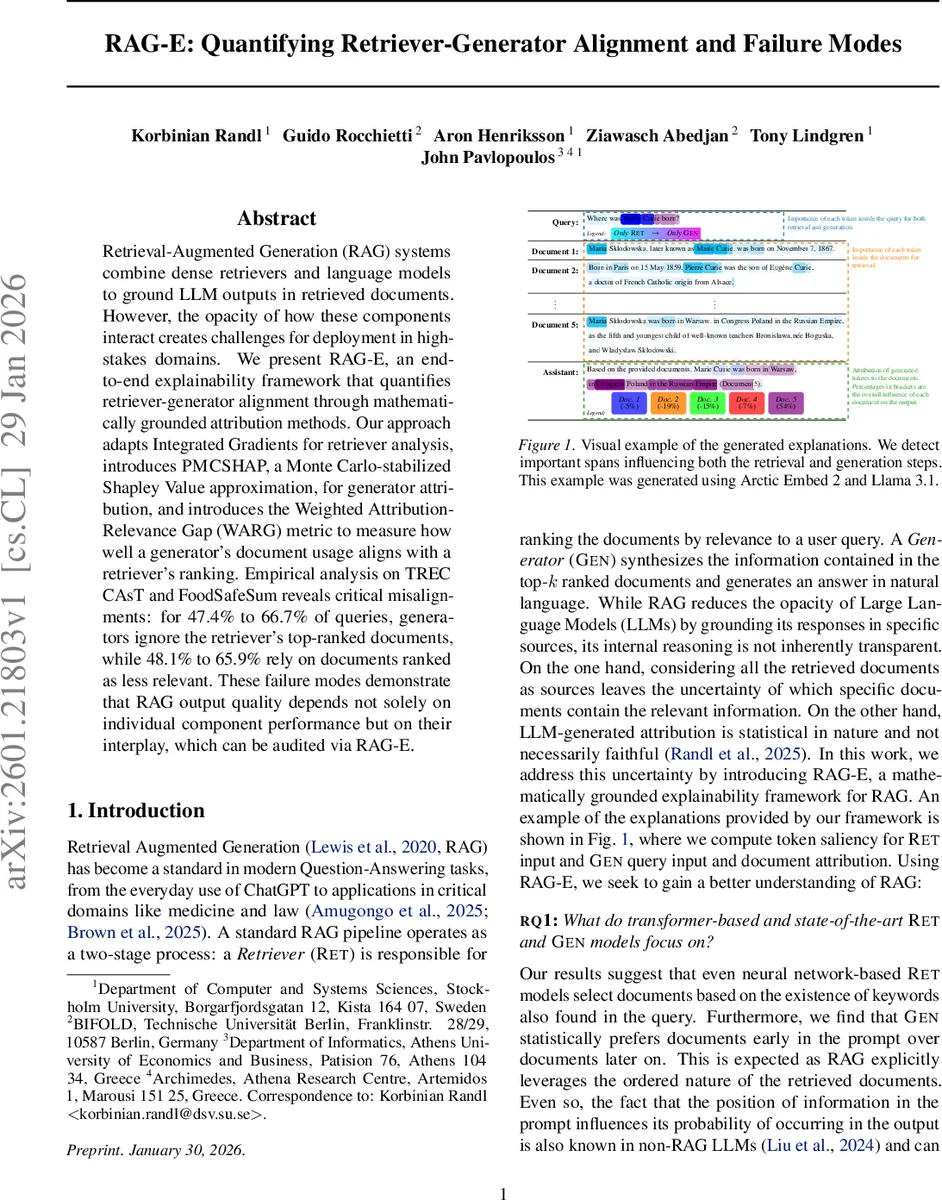
Retrieval-Augmented Generation (RAG) systems combine dense retrievers and language models to ground LLM outputs in retrieved documents. However, the opacity of how these components interact creates challenges for deployment in high-stakes domains. We present RAG-E, an end-to-end explainability framework that quantifies retriever-generator alignment through mathematically grounded attribution methods. Our approach adapts Integrated Gradients for retriever analysis, introduces PMCSHAP, a Monte Carlo-stabilized Shapley Value approximation, for generator attribution, and introduces the Weighted Attribution-Relevance Gap (WARG) metric to measure how well a generator’s document usage aligns with a retriever’s ranking. Empirical analysis on TREC CAsT and FoodSafeSum reveals critical misalignments: for 47.4% to 66.7% of queries, generators ignore the retriever’s top-ranked documents, while 48.1% to 65.9% rely on documents ranked as less relevant. These failure modes demonstrate that RAG output quality depends not solely on individual component performance but on their interplay, which can be audited via RAG-E.
💡 Research Summary
Retrieval‑Augmented Generation (RAG) systems have become a cornerstone of modern question‑answering, yet their two‑stage architecture—dense retrieval followed by large‑language‑model generation—remains opaque, especially in high‑stakes domains such as medicine or law. This paper introduces RAG‑E, a comprehensive explainability framework that quantifies the alignment between the retriever (RET) and the generator (GEN) and uncovers systematic failure modes.
The authors first adapt Integrated Gradients (IG) to the retrieval stage. By treating query and each candidate document as separate inputs, they compute token‑level attributions β_ret,i via a Riemann‑sum integration of gradients with respect to the embedding space. A key engineering choice is the baseline: replacing all non‑special tokens with the model’s
Comments & Academic Discussion
Loading comments...
Leave a Comment