Enhancing Conversational Agents via Task-Oriented Adversarial Memory Adaptation
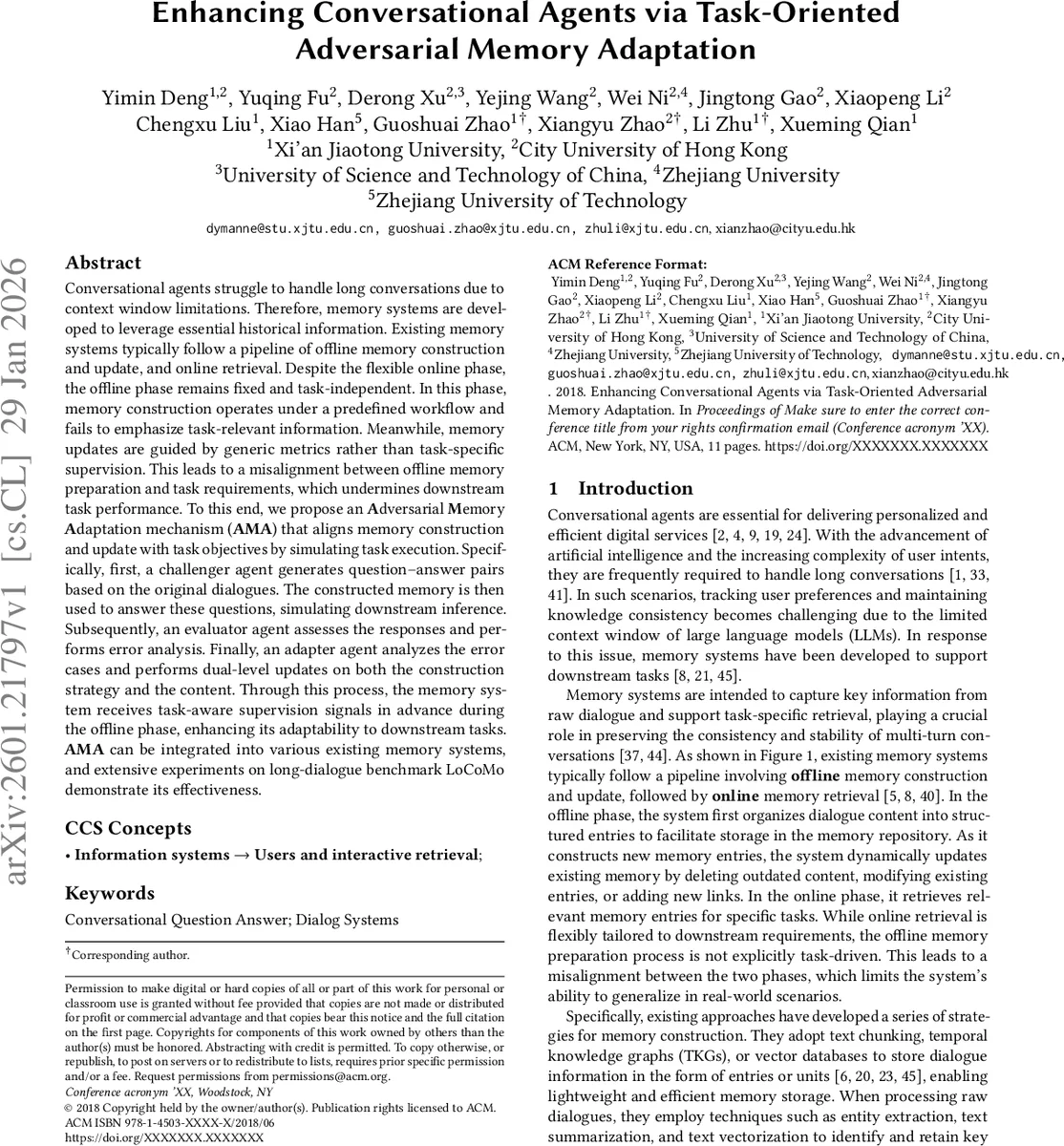
Conversational agents struggle to handle long conversations due to context window limitations. Therefore, memory systems are developed to leverage essential historical information. Existing memory systems typically follow a pipeline of offline memory construction and update, and online retrieval. Despite the flexible online phase, the offline phase remains fixed and task-independent. In this phase, memory construction operates under a predefined workflow and fails to emphasize task relevant information. Meanwhile, memory updates are guided by generic metrics rather than task specific supervision. This leads to a misalignment between offline memory preparation and task requirements, which undermines downstream task performance. To this end, we propose an Adversarial Memory Adaptation mechanism (AMA) that aligns memory construction and update with task objectives by simulating task execution. Specifically, first, a challenger agent generates question answer pairs based on the original dialogues. The constructed memory is then used to answer these questions, simulating downstream inference. Subsequently, an evaluator agent assesses the responses and performs error analysis. Finally, an adapter agent analyzes the error cases and performs dual level updates on both the construction strategy and the content. Through this process, the memory system receives task aware supervision signals in advance during the offline phase, enhancing its adaptability to downstream tasks. AMA can be integrated into various existing memory systems, and extensive experiments on long dialogue benchmark LoCoMo demonstrate its effectiveness.
💡 Research Summary
The paper addresses a fundamental limitation of large language models (LLMs) in handling long conversations: the finite context window. Existing memory‑augmented systems mitigate this by extracting and storing salient dialogue information in an offline phase (memory construction and update) and retrieving it online for downstream tasks. While online retrieval can be tuned to a specific task, the offline phase is typically static and task‑agnostic, relying on generic pipelines such as chunking, temporal knowledge graphs, or vector databases. Consequently, the constructed memory may omit task‑relevant facts or retain irrelevant noise, leading to sub‑optimal performance on tasks that require precise temporal reasoning, multi‑hop inference, or other specialized capabilities.
To bridge this gap, the authors propose an Adversarial Memory Adaptation (AMA) framework that injects task‑oriented supervision into the offline phase by simulating task execution. AMA consists of three interacting agents:
-
Challenger Agent – Given the raw dialogue and a carefully crafted instruction prompt, a large language model generates a set of question‑answer (QA) pairs that target key facts needed for the downstream task. These QA pairs serve as a proxy for the task’s information requirements.
-
Evaluator Agent – The constructed memory is used to answer the generated questions. The evaluator compares the model‑generated answers with the ground‑truth answers, producing a binary success flag and a detailed defect description (e.g., missing fact, factual inconsistency, ambiguity). This provides a quantitative, task‑specific quality metric for the memory.
-
Adapter Agent – Using the evaluator’s feedback, the adapter performs a dual‑level update: (i) it amends the memory content by inserting missing entries or correcting erroneous ones, and (ii) it adjusts the memory‑construction strategy (e.g., prompts, summarization granularity, extraction rules) so that future constructions are better aligned with the task.
The loop iterates until the evaluator’s success rate reaches a predefined threshold, ensuring that the memory is shaped by the task before any online retrieval occurs.
The authors integrate AMA into three representative memory systems (text‑chunk, temporal knowledge graph, and vector store) and test two backbone models (a full‑size LLM and a lightweight variant) on the LoCoMo benchmark, which contains long‑turn dialogues requiring various reasoning abilities. Experiments show that AMA consistently improves QA accuracy, dialogue consistency scores, and memory‑efficiency ratios. Notably, on temporal reasoning and multi‑hop inference subsets, AMA yields 8–12 % absolute F1 gains over baselines without adaptation.
Key contributions are: (1) a formal articulation of the misalignment between offline memory preparation and downstream task needs; (2) the AMA framework that introduces task‑driven supervision via adversarial simulation, enabling simultaneous updates to memory content and construction policy; (3) extensive empirical validation demonstrating that AMA is model‑agnostic and can be plugged into existing memory pipelines.
Future work suggested includes extending AMA to multimodal conversations, leveraging real‑time user feedback for continual adaptation, and automating the adapter’s meta‑learning of optimal construction hyper‑parameters. Overall, the paper presents a compelling approach to making long‑term conversational agents more task‑aware and memory‑efficient.
Comments & Academic Discussion
Loading comments...
Leave a Comment