Preliminary Results of a Scoping Review on Assistive Technologies for Adults with ADHD
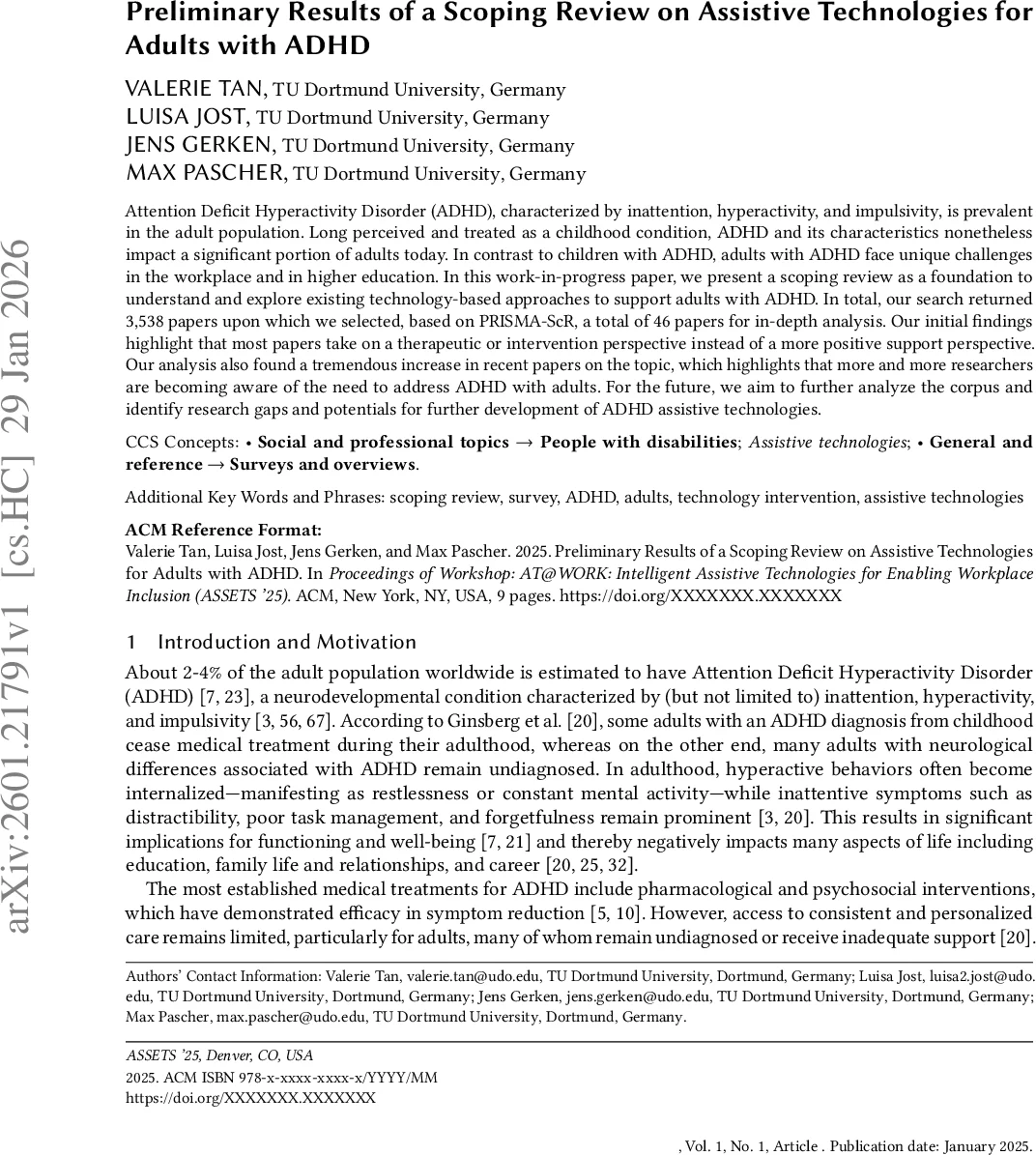
Attention Deficit Hyperactivity Disorder (ADHD), characterized by inattention, hyperactivity, and impulsivity, is prevalent in the adult population. Long perceived and treated as a childhood condition, ADHD and its characteristics nonetheless impact a significant portion of adults today. In contrast to children with ADHD, adults with ADHD face unique challenges in the workplace and in higher education. In this work-in-progress paper, we present a scoping review as a foundation to understand and explore existing technology-based approaches to support adults with ADHD. In total, our search returned 3,538 papers upon which we selected, based on PRISMA-ScR, a total of 46 papers for in-depth analysis. Our initial findings highlight that most papers take on a therapeutic or intervention perspective instead of a more positive support perspective. Our analysis also found a tremendous increase in recent papers on the topic, which highlights that more and more researchers are becoming aware of the need to address ADHD with adults. For the future, we aim to further analyze the corpus and identify research gaps and potentials for further development of ADHD assistive technologies.
💡 Research Summary
This work‑in‑progress paper presents a PRISMA‑ScR based scoping review that maps the current landscape of assistive technologies aimed at supporting adults with Attention‑Deficit/Hyperactivity Disorder (ADHD). Recognizing that ADHD, once considered a childhood‑only condition, persists into adulthood and adversely affects work, education, and personal life, the authors set out to systematically identify and categorize technology‑based interventions that go beyond traditional pharmacological or psychosocial treatments.
The search strategy combined three major bibliographic databases—ACM Digital Library (712 records), IEEE Xplore (699 records), and Scopus (2 127 records)—using a comprehensive query that merged ADHD terminology, adult‑focused demographic terms, and a wide spectrum of technology descriptors (e.g., mixed reality, wearables, AI, chatbots, neuro‑feedback, etc.). An initial pool of 3 538 records was de‑duplicated, then screened in two stages: title‑abstract screening eliminated 3 097 papers, and full‑text assessment removed an additional 47, leaving a final corpus of 46 papers published between 2007 and 2025. The exclusion reasons were clearly documented (e.g., wrong target group, lack of technological interaction, language barriers).
Temporal analysis shows a sharp increase in recent activity: 29 of the 46 papers (63 %) were published between 2021 and 2025, indicating growing scholarly interest. Publication venues are diverse: 11 papers appeared in ACM conferences, 12 in IEEE venues, and the remaining 23 in psychology, psychiatry, or interdisciplinary journals and workshops, underscoring the multidisciplinary nature of the field.
The authors coded each paper into six primary categories (with sub‑categories) reflecting the underlying design intent:
- Psychotherapy & Psycho‑education (36 %) – Mobile or web‑based platforms delivering educational content, CBT/DBT modules, or chatbot‑based digital therapists.
- Cognitive Training (6 %) – Includes neuro‑feedback (3 papers) and game‑based cognitive exercises (9 papers).
- Other Forms (20 %) – Various non‑game cognitive training prototypes.
- Assistive Tools (22 %) – Applications that aid daily tasks such as scheduling, self‑monitoring, or academic support.
- Behavioral Interventions (9 %) – Real‑time nudging or messaging systems that actively attempt to modify user behavior.
- Passive Agents (4 %) – Social‑presence agents (e.g., robots) that provide companionship without direct intervention.
- (Virtual) Environments (4 %) – VR‑based custom environments designed for ADHD users.
A striking finding is the uneven adoption of user‑centered design (UCD) and usability evaluation across categories. In the largest groups—Psychotherapy & Psycho‑education and Cognitive Training—only 29 % and 0 % of papers, respectively, reported UCD practices, and usability testing was performed in roughly half of the former and none of the latter. Conversely, Behavioral Interventions, Passive Agents, and Virtual Environments showed higher rates of usability assessment (75 %–100 %) but represent a much smaller portion of the literature. Effectiveness testing (e.g., symptom reduction, performance gains) was reported in only a minority of studies overall, with the highest frequency in the Cognitive Training and Assistive Tools categories.
The authors critique the prevailing “deficit‑focused” narrative: most technologies aim to remediate symptoms rather than empower users or augment everyday functioning. This aligns with prior critical reviews (e.g., Spiel et al.) that warn such approaches can be stigmatizing and “ableist,” reinforcing a view of ADHD individuals as problems to be corrected rather than as people with unique strengths needing support.
Based on these observations, the paper outlines several research gaps and future directions:
- Shift from treatment to support – Design interventions that enhance executive functions, self‑regulation, and task completion in real‑world contexts rather than solely reducing symptom severity.
- Participatory design – Involve adult ADHD users throughout the design lifecycle to ensure relevance, accessibility, and acceptability.
- Standardized usability and effectiveness metrics – Develop common evaluation frameworks to enable cross‑study comparisons and meta‑analyses.
- Context‑aware solutions – Tailor technologies to specific work or academic environments, leveraging sensors, wearables, and AI to provide adaptive assistance.
- Inter‑category synthesis – Explore hybrid systems that combine psycho‑educational content with real‑time behavioral nudges or immersive environments, potentially increasing impact.
The authors plan to extend the current descriptive analysis with open coding to uncover deeper thematic patterns and to map inter‑category relationships. They also invite the broader research community to contribute to the evolving corpus, emphasizing the need for inclusive, empowering, and evidence‑based assistive technologies for adults with ADHD.
In summary, this scoping review provides the first systematic snapshot of assistive technology research for adult ADHD, highlights a rapid growth trend, exposes a dominance of therapeutic‑oriented designs, and calls for a paradigm shift toward user‑centered, supportive, and context‑sensitive solutions.
Comments & Academic Discussion
Loading comments...
Leave a Comment