Epistemic Context Learning: Building Trust the Right Way in LLM-Based Multi-Agent Systems
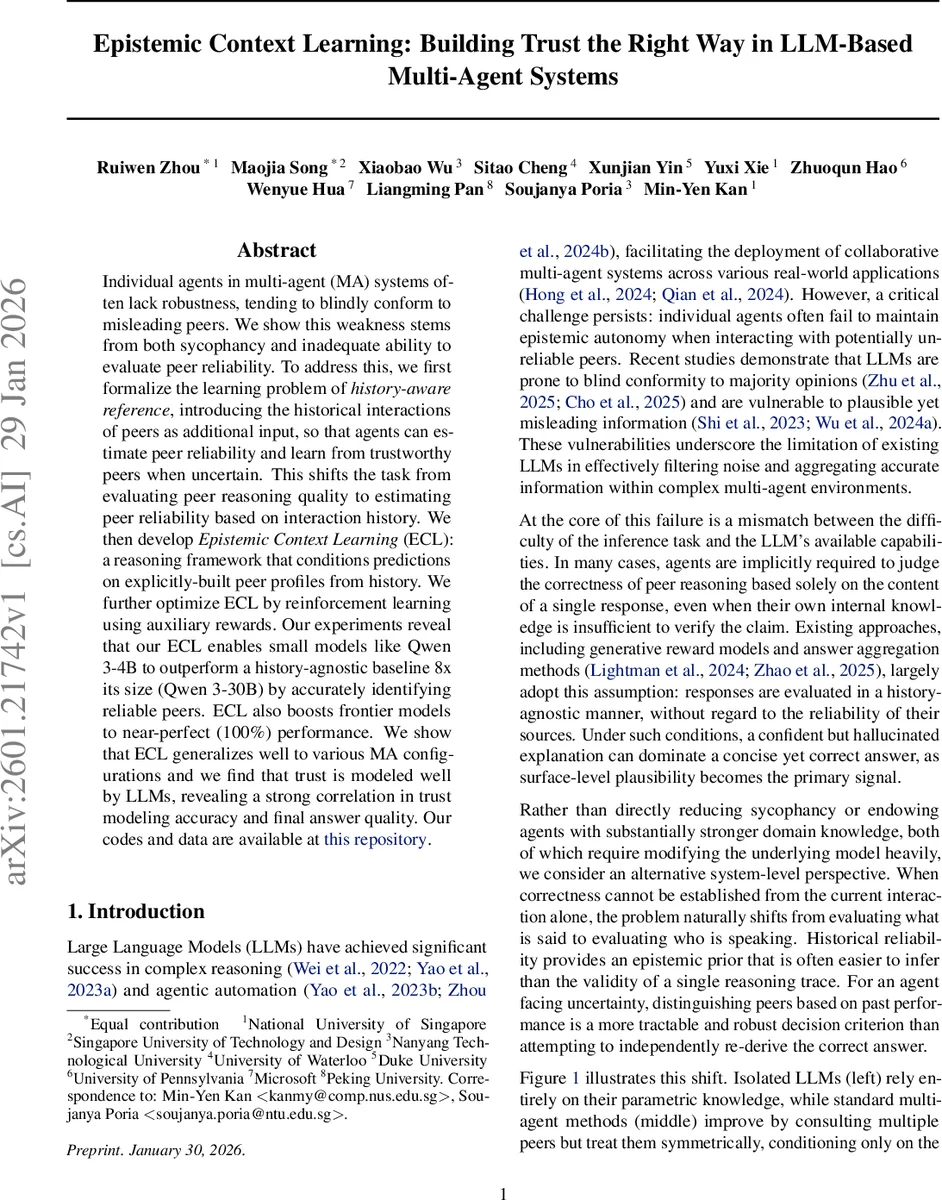
Individual agents in multi-agent (MA) systems often lack robustness, tending to blindly conform to misleading peers. We show this weakness stems from both sycophancy and inadequate ability to evaluate peer reliability. To address this, we first formalize the learning problem of history-aware reference, introducing the historical interactions of peers as additional input, so that agents can estimate peer reliability and learn from trustworthy peers when uncertain. This shifts the task from evaluating peer reasoning quality to estimating peer reliability based on interaction history. We then develop Epistemic Context Learning (ECL): a reasoning framework that conditions predictions on explicitly-built peer profiles from history. We further optimize ECL by reinforcement learning using auxiliary rewards. Our experiments reveal that our ECL enables small models like Qwen 3-4B to outperform a history-agnostic baseline 8x its size (Qwen 3-30B) by accurately identifying reliable peers. ECL also boosts frontier models to near-perfect (100%) performance. We show that ECL generalizes well to various MA configurations and we find that trust is modeled well by LLMs, revealing a strong correlation in trust modeling accuracy and final answer quality.
💡 Research Summary
The paper tackles a fundamental weakness in large‑language‑model (LLM) based multi‑agent (MA) systems: agents often blindly follow peers, leading to sycophancy and poor robustness when faced with misleading or over‑confident collaborators. The authors argue that this problem stems not from a lack of domain knowledge but from an inability to assess peer reliability using historical interaction data. To remedy this, they introduce the concept of history‑aware reference, where each agent receives not only the current query and peer answers but also a structured record of past interactions (queries and each peer’s responses). The goal is to condition the current agent’s output on this history, effectively estimating a prior trustworthiness for each peer before aggregating their current answers.
Building on this formulation, the authors propose Epistemic Context Learning (ECL), a two‑stage reasoning pipeline. In the first stage, a dedicated “trust model” consumes the interaction history and produces a trust score for every peer. This stage is deliberately separated from the second stage, where the current agent integrates the peer answers weighted by the trust scores and combines them with its own internal reasoning (self‑thinking) to produce the final answer. By decoupling trust estimation from answer aggregation, ECL forces the model to rely on historical evidence rather than superficial cues in the current round.
To train the system, the authors augment standard reinforcement learning (RL) with auxiliary rewards that explicitly encourage accurate trust estimation, alignment between trust scores and actual peer performance, and diversity of opinions to curb blind conformity. The primary reward remains answer accuracy, but the auxiliary signals provide denser supervision that guides the model toward the desired behavior.
The experimental evaluation spans several LLM families (Qwen 3‑4B, Llama 3.2‑3B, and larger frontier models) and two benchmark domains: Math500 (mathematical reasoning) and LiveCode (code generation). Diagnostic experiments are designed to isolate the effect of historical trust. In the “Flip” setting, a historically reliable peer is forced to give a wrong answer while the unreliable peer gives a correct one; a model that truly uses history should suffer a performance drop. In the “All‑Wrong” setting, all peers answer incorrectly, testing the model’s reliance on internal reasoning versus peer aggregation. Standard outcome‑based RL models show little performance change in the Flip condition and collapse dramatically in All‑Wrong, indicating a lack of historical trust and heavy conformity.
ECL, however, markedly improves both metrics. A 4‑billion‑parameter Qwen model equipped with ECL outperforms a baseline 30‑billion‑parameter Qwen model, achieving up to 86.5% accuracy where the baseline lags at 73% on Math500. Larger models reach near‑perfect (≈100%) scores. The trust scores produced by ECL correlate strongly with final answer quality, confirming that the system is indeed leveraging historical reliability. Additional analyses demonstrate that ECL generalizes across varying numbers of peers, different task difficulties, and even across domains, suggesting that the approach is not tied to a specific dataset or model size.
The paper also discusses limitations: handling very long histories may be computationally expensive; adversarial agents could manipulate trust signals; and the current framework assumes structured, text‑only histories, leaving multimodal or unstructured logs for future work. Nonetheless, the authors argue that ECL provides a principled, scalable method for embedding trust estimation into LLM‑based multi‑agent pipelines, opening the door for robust deployment in high‑stakes settings such as scientific discovery, medical diagnosis, or legal reasoning where selective reliance on trustworthy collaborators is essential.
Comments & Academic Discussion
Loading comments...
Leave a Comment