When Life Gives You AI, Will You Turn It Into A Market for Lemons? Understanding How Information Asymmetries About AI System Capabilities Affect Market Outcomes and Adoption
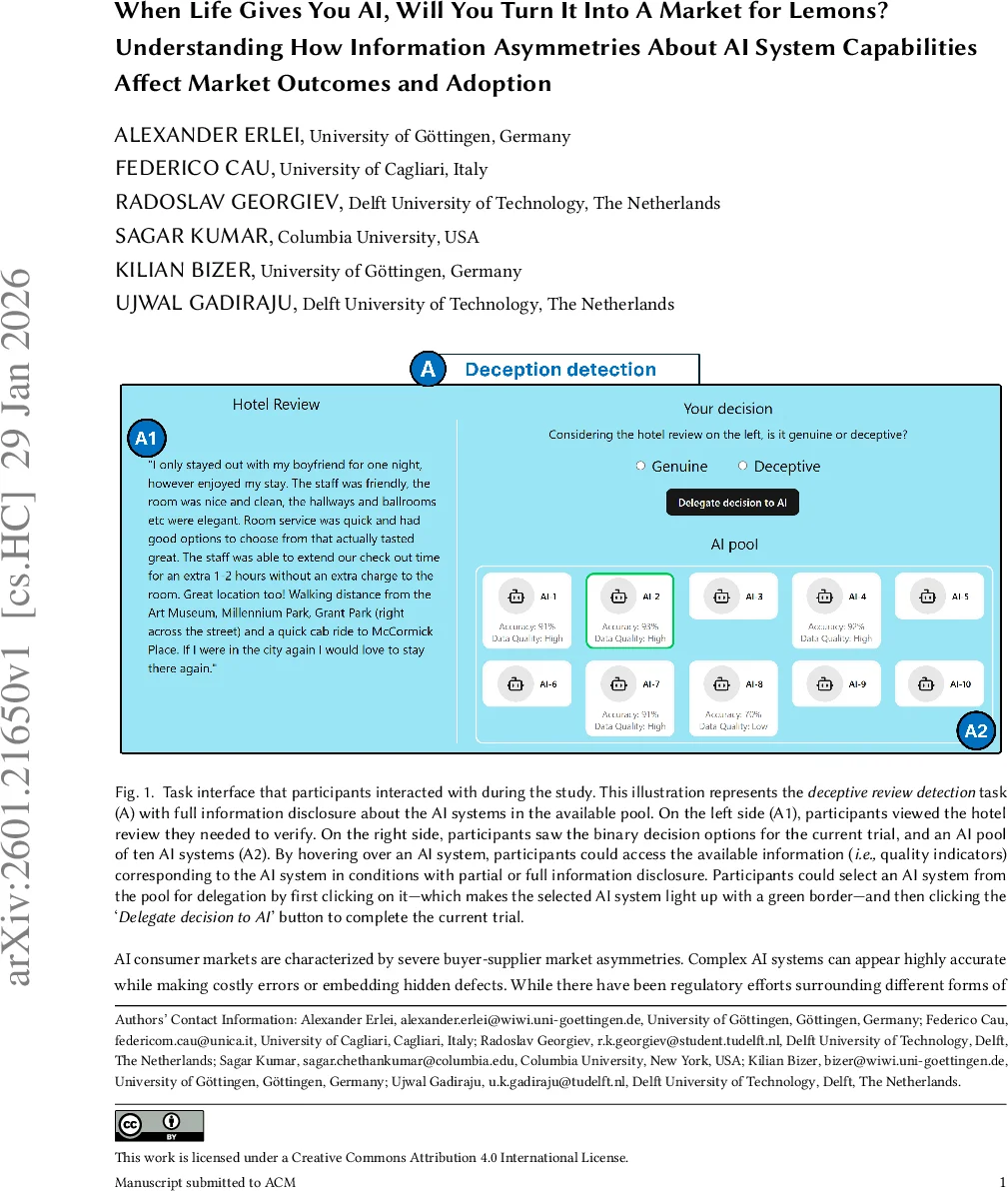
AI consumer markets are characterized by severe buyer-supplier market asymmetries. Complex AI systems can appear highly accurate while making costly errors or embedding hidden defects. While there have been regulatory efforts surrounding different forms of disclosure, large information gaps remain. This paper provides the first experimental evidence on the important role of information asymmetries and disclosure designs in shaping user adoption of AI systems. We systematically vary the density of low-quality AI systems and the depth of disclosure requirements in a simulated AI product market to gauge how people react to the risk of accidentally relying on a low-quality AI system. Then, we compare participants’ choices to a rational Bayesian model, analyzing the degree to which partial information disclosure can improve AI adoption. Our results underscore the deleterious effects of information asymmetries on AI adoption, but also highlight the potential of partial disclosure designs to improve the overall efficiency of human decision-making.
💡 Research Summary
The paper investigates how information asymmetries in AI consumer markets affect user adoption, reliance, and overall market efficiency. Drawing on Akerlof’s classic “market for lemons” model, the authors design a controlled laboratory experiment that manipulates two key variables: the density of low‑quality AI systems (referred to as “lemons”) and the depth of information disclosure about each system’s capabilities. Participants perform a series of decision‑making tasks (e.g., verifying hotel reviews) across ten rounds. In each round they may either solve the task themselves or delegate it to one of ten AI agents drawn from a simulated market pool.
The experimental design follows a 3 × 2 between‑subjects factorial structure (low, medium, high lemon density × no disclosure vs. partial disclosure) with an additional benchmark condition of high density combined with full disclosure (both accuracy and data‑quality scores). AI quality is operationalized through two metrics: an accuracy score (probability of a correct prediction) and a data‑quality score (proxy for generalizability). In the partial‑disclosure condition participants see only the accuracy score; in the full‑disclosure condition they see both metrics.
Key findings:
-
No Disclosure – When participants receive no quality information, they tend to under‑use AI when lemons are scarce, missing out on potential performance gains. Conversely, when lemons dominate the market, participants over‑delegate, leading to substantial losses. Learning across rounds is modest, indicating that users struggle to infer market composition from outcomes alone.
-
Partial Disclosure (Accuracy Only) – Providing a single, easily interpretable cue dramatically improves decision efficiency. Participants are able to avoid low‑quality agents at high rates, especially in low‑ and medium‑density markets, resulting in performance gains that rival those observed under full disclosure with a high lemon density. However, as lemon density rises, the discriminative power of the accuracy cue diminishes, and the benefits taper off.
-
Full Disclosure (Accuracy + Data Quality) – Even when both signals are available, participants exhibit a pronounced reluctance to delegate. While they successfully steer clear of lemons, overall delegation rates remain low, and the average loss relative to an optimal “always delegate to a 90 % accurate AI” benchmark is about 20 %. This suggests that richer information does not automatically translate into better outcomes; risk aversion, bounded rationality, and trust‑calibration dynamics still limit adoption.
An especially striking result is that partial disclosure can offset the negative impact of doubling the proportion of lemons in the market, achieving comparable performance to the full‑disclosure high‑density condition while requiring far less information. Moreover, partial disclosure primarily improves the quality of delegated decisions rather than the quantity of delegations, indicating that lightweight, action‑oriented transparency can be more effective than exhaustive reporting.
The authors discuss implications for policy and design. They argue that regulatory frameworks such as the EU AI Act should prioritize simple, standardized labels (e.g., accuracy scores) that are quickly interpretable by end‑users, rather than demanding exhaustive model cards that may overwhelm or be strategically gamed by providers. The study also highlights the persistent role of cognitive biases—over‑reliance, under‑reliance, anchoring, and base‑rate neglect—in shaping AI adoption, even under optimal information conditions.
Limitations include the focus on accuracy and data quality as the sole dimensions of AI performance, the relatively low‑stakes experimental tasks, and the short‑term nature of the interaction. Future work is suggested to incorporate additional quality dimensions (fairness, robustness, uncertainty), higher‑stakes decision contexts, and longitudinal designs that capture deeper learning and market dynamics.
In sum, the paper provides the first experimental evidence that information asymmetries critically shape AI market outcomes, and that carefully designed partial disclosures can substantially improve human‑AI decision making without imposing heavy informational burdens on users or regulators.
Comments & Academic Discussion
Loading comments...
Leave a Comment