Differential Dynamic Causal Nets: Model Construction, Identification and Group Comparisons
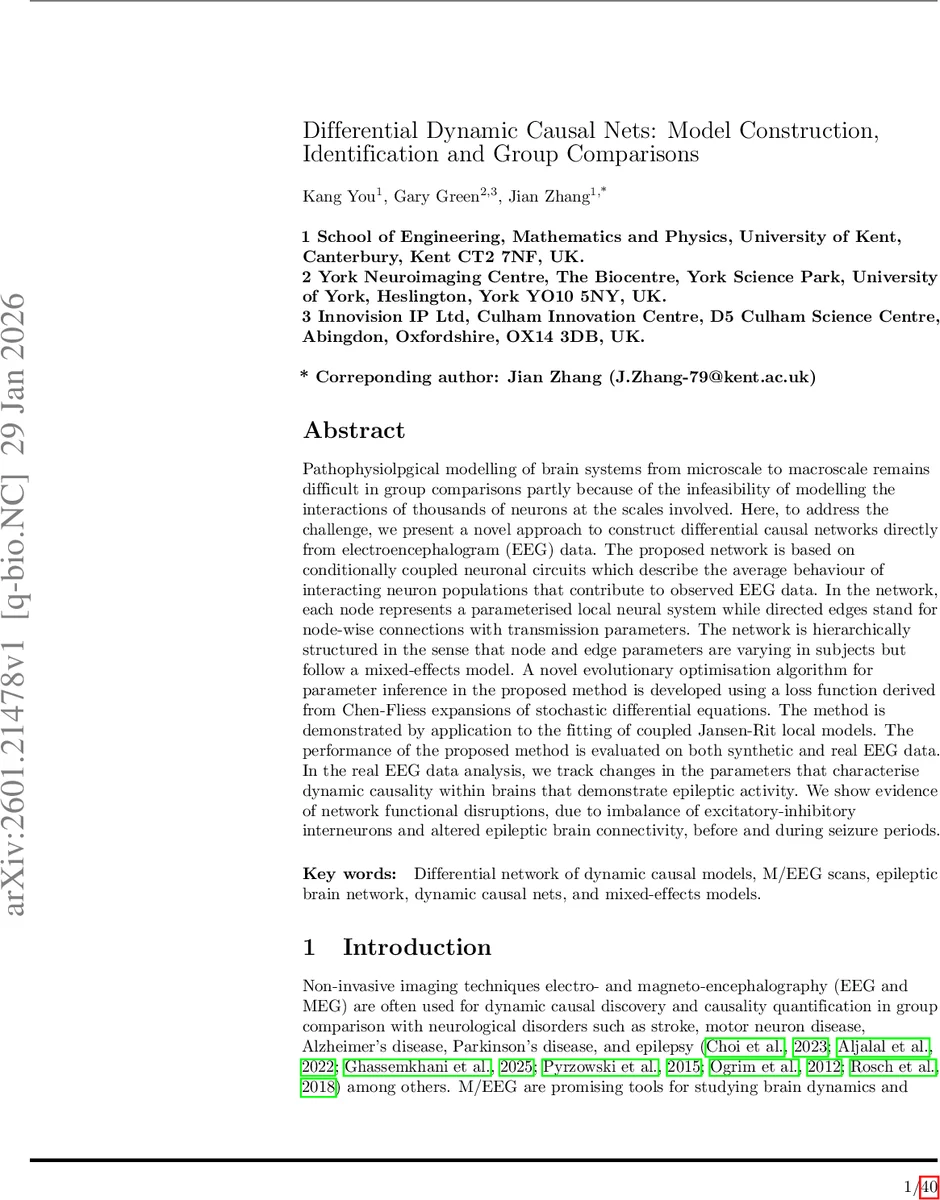
Pathophysiolpgical modelling of brain systems from microscale to macroscale remains difficult in group comparisons partly because of the infeasibility of modelling the interactions of thousands of neurons at the scales involved. Here, to address the challenge, we present a novel approach to construct differential causal networks directly from electroencephalogram (EEG) data. The proposed network is based on conditionally coupled neuronal circuits which describe the average behaviour of interacting neuron populations that contribute to observed EEG data. In the network, each node represents a parameterised local neural system while directed edges stand for node-wise connections with transmission parameters. The network is hierarchically structured in the sense that node and edge parameters are varying in subjects but follow a mixed-effects model. A novel evolutionary optimisation algorithm for parameter inference in the proposed method is developed using a loss function derived from Chen-Fliess expansions of stochastic differential equations. The method is demonstrated by application to the fitting of coupled Jansen-Rit local models. The performance of the proposed method is evaluated on both synthetic and real EEG data. In the real EEG data analysis, we track changes in the parameters that characterise dynamic causality within brains that demonstrate epileptic activity. We show evidence of network functional disruptions, due to imbalance of excitatory-inhibitory interneurons and altered epileptic brain connectivity, before and during seizure periods.
💡 Research Summary
The paper introduces a novel framework called conditionally coupled dynamic causal models (NccDCM) for constructing differential dynamic causal networks directly from EEG recordings, with a focus on group comparisons between epilepsy patients and healthy controls. Traditional dynamic causal modeling (DCM) faces several challenges: (1) solving highly nonlinear neural mass differential equations without resorting to bilinear approximations; (2) dealing with partially observed states at discrete time points; (3) scaling to whole‑brain networks under limited computational resources; (4) accounting for inter‑subject variability; and (5) quantifying excitation‑inhibition imbalance that underlies epileptic dynamics.
To address these issues, the authors model each EEG channel as a node represented by a stochastic Jansen‑Rit neural mass model comprising pyramidal cells, excitatory interneurons, and inhibitory interneurons. Nodes are linked by directed edges whose transmission parameters capture effective connectivity. All node‑wise and edge‑wise parameters are treated as random effects within a hierarchical mixed‑effects model, allowing both subject‑specific and group‑level variations.
A key methodological innovation is the use of Chen‑Fliess series expansions of stochastic differential equations to derive an exact, approximation‑free representation of the system dynamics. From this expansion they construct a loss function equal to minus twice the estimated log‑predictive likelihood. Parameter estimation proceeds via an evolutionary optimization algorithm (mutation, crossover, selection) that minimizes this loss, thereby jointly estimating neural mass parameters (synaptic gains A, B, time constants a, b, intra‑node coupling C) and inter‑node transmission coefficients K.
After fitting NccDCM to each subject’s EEG segments (pre‑seizure, ictal, inter‑ictal), a post‑hoc multivariate analysis of variance (permANOVA) is applied to the estimated parameters to identify statistically significant differences between the patient and control groups. The resulting differential causal nets highlight altered pathways and excitation‑inhibition imbalances associated with seizure generation.
The methodology is validated on synthetic data where ground‑truth parameters are accurately recovered even under substantial noise, demonstrating robustness and identifiability. In real data, a publicly available pediatric epilepsy dataset is analyzed. Findings include: (i) a marked increase in excitatory gain A and a decrease in inhibitory gain B during pre‑seizure periods compared with controls; (ii) specific directed connections (e.g., frontal → temporal, temporal → parietal) showing significant modulation of transmission parameters K during seizure onset; (iii) overall network metrics indicating reduced global efficiency and increased clustering during seizures, consistent with a more segregated functional state.
The authors argue that NccDCM overcomes the limitations of conventional DCM by (a) preserving the full nonlinearity of neural mass models, (b) providing a principled loss function that bypasses the need for data augmentation of hidden states, (c) scaling to whole‑brain networks through hierarchical mixed‑effects modeling, and (d) enabling rigorous statistical comparison of causal networks across groups. Limitations include the stochastic nature of the evolutionary optimizer, which may converge to local minima and depends on initialization, and the computational cost associated with repeated simulations of stochastic differential equations. Future work is suggested to integrate Bayesian variational inference or Hamiltonian Monte Carlo for more robust posterior estimation, to explore GPU‑accelerated implementations, and to extend the framework to other neural mass formulations (e.g., Wilson‑Cowan).
In conclusion, the paper presents a comprehensive, data‑driven approach for constructing and comparing differential dynamic causal networks from EEG, offering new insights into the mechanistic underpinnings of epilepsy and a scalable tool for broader neuroimaging applications.
Comments & Academic Discussion
Loading comments...
Leave a Comment