Interference Detection and Exploitation for Multi-User Radar Sensing
Integrated sensing and communication is a key feature in next-generation wireless networks, enabling joint data transmission and environmental radar sensing on shared spectrum. In multi-user scenarios, simultaneous transmissions cause mutual interference on overlapping frequencies, leading to spurious target detections and degraded sensing accuracy. This paper proposes an interference detection and exploitation algorithm for sensing using spectrally interleaved orthogonal frequency division multiplexing. A statistically rigorous procedure is introduced to detect interference while controlling the familywise error rate. We propose an algorithm that estimates the angle by exploiting interference, while estimating the delay by avoiding the interference. Numerical experiments demonstrate that the proposed method reliably detects interference, and that the delay and angle estimation error approaches the Cramér-Rao lower bound.
💡 Research Summary
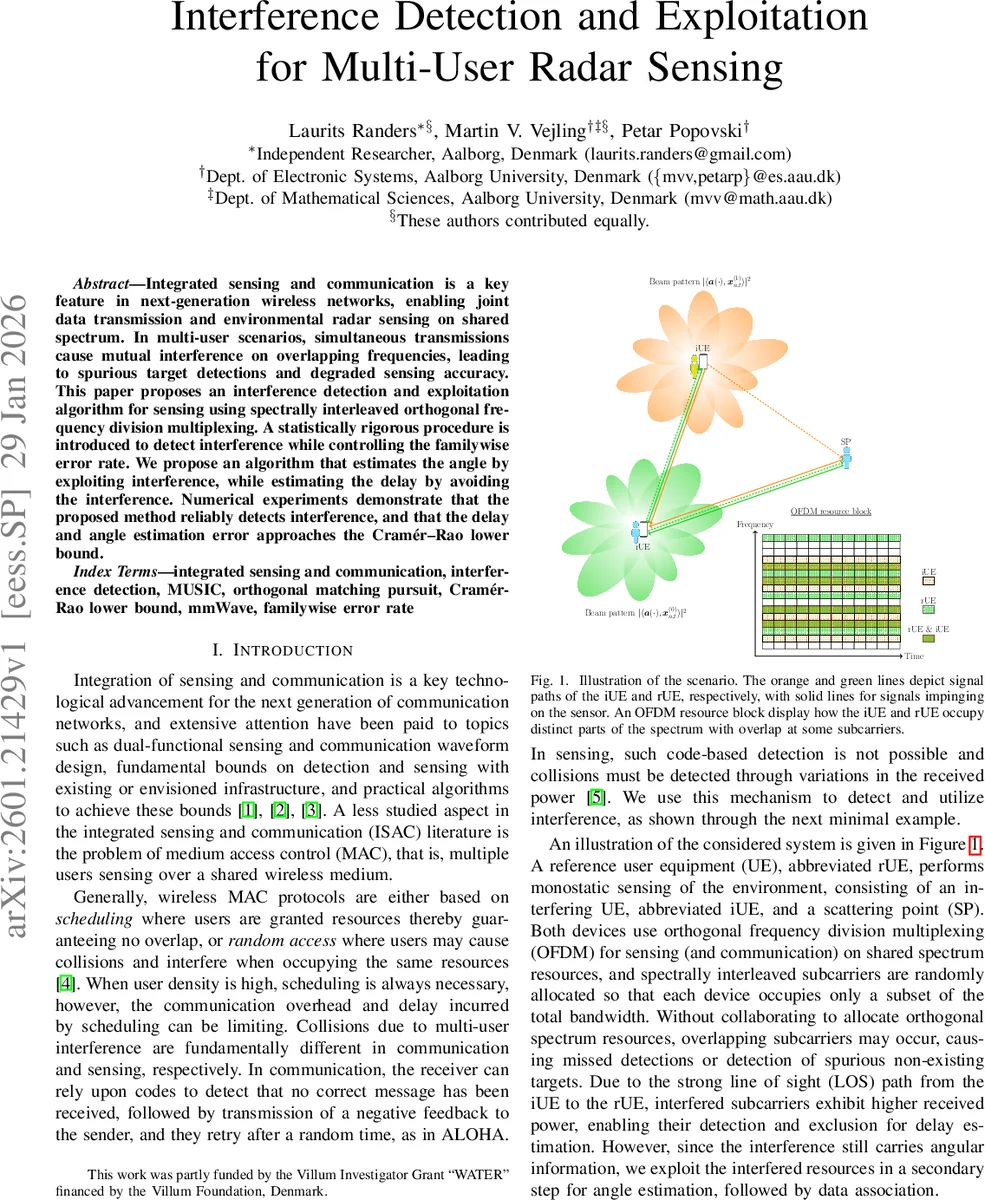
This paper addresses a critical challenge in integrated sensing and communication (ISAC) systems: how to handle mutual interference when multiple users simultaneously perform radar sensing on shared spectrum. The authors consider a scenario with a reference user equipment (rUE) that performs monostatic radar sensing and an interfering user equipment (iUE). Both devices employ OFDM waveforms with spectrally interleaved subcarriers, meaning each user occupies only a subset of the total bandwidth. Overlap of subcarriers leads to interference, which can cause spurious target detections or missed detections.
The core contribution is a statistically rigorous interference detection and exploitation framework. First, the authors propose a simple power‑based test: for each subcarrier (and each time slot) they sum the received power across all antennas and OFDM symbols, obtaining a scalar γₙ (or γ̃ₜ). By ordering these powers and comparing each to the smallest observed power multiplied by a factor β, they flag those resources as interfered. The novelty lies in the theoretical justification: under the global null hypothesis (no interference) the γ values follow a Gamma distribution with shape parameter ρ = T⁽⁰⁾N_u, and the ratio of the maximum to the minimum does not depend on the unknown channel variance. Consequently, the familywise error rate (FWER) can be controlled offline by selecting β to satisfy P(γ_(N) > γ_(1)β) ≤ δ for a desired significance level δ. The paper proves this independence (Proposition 1) and validates it numerically, showing that a β as low as 1.561 achieves δ = 0.01.
After detecting interfered resources, the authors estimate target parameters in three stages. (i) Angle‑of‑arrival (AoA) estimation is performed with the MUSIC algorithm using all OFDM resources, because MUSIC is robust to unknown interference and the interfered subcarriers still contain angular information. (ii) Joint delay‑of‑arrival (ToA) and AoA estimation is carried out with Orthogonal Matching Pursuit (OMP) only on the non‑interfered resources, avoiding the bias introduced by the interference. (iii) A data‑association step matches the angles obtained from MUSIC with the (delay, angle) pairs from OMP by solving a binary assignment problem that minimizes angular discrepancy. This yields refined angle estimates that benefit from the interfered subcarriers while preserving accurate delay estimates.
The authors also derive the Cramér‑Rao lower bound (CRLB) for the joint delay‑angle estimation problem in the presence of interference. Their Fisher‑information analysis shows that interfered subcarriers contribute negligibly to delay information but provide useful angle information, especially for the interferer’s direction. This theoretical insight explains why the proposed two‑stage approach can approach the CRLB for both parameters.
Extensive Monte‑Carlo simulations evaluate the method under varying signal‑to‑noise ratios, interference densities, and numbers of users. Results demonstrate that (a) the interference detection procedure reliably identifies interfered subcarriers while maintaining the prescribed FWER, (b) the combined MUSIC‑OMP estimator achieves mean‑square errors close to the CRLB for both delay and angle, and (c) exploiting interfered resources for angle estimation yields a noticeable performance gain compared to discarding them entirely.
In summary, the paper presents a complete pipeline—statistically sound interference detection with FWER control, dual‑stage parameter estimation that leverages both interfered and clean resources, and a rigorous CRLB analysis—demonstrating that interference in multi‑user radar sensing can be turned from a detrimental effect into a source of useful information. The work opens avenues for more efficient medium‑access strategies in future ISAC deployments, where scheduling overhead can be reduced without sacrificing sensing accuracy.
Comments & Academic Discussion
Loading comments...
Leave a Comment