Leaders in multi-type TASEP
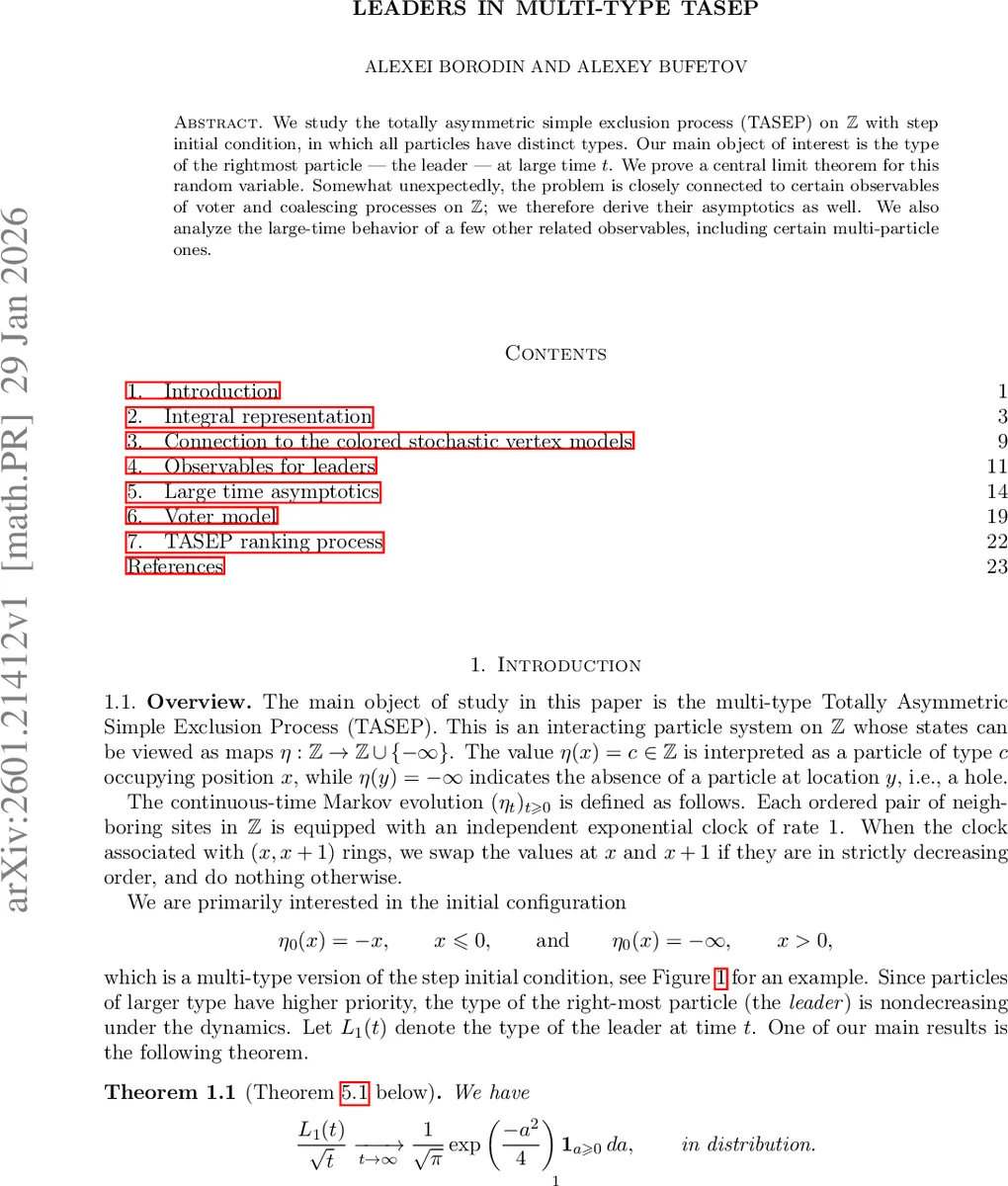
We study the totally asymmetric simple exclusion process (TASEP) on $\mathbb{Z}$ with step initial condition, in which all particles have distinct types. Our main object of interest is the type of the rightmost particle – the leader – at large time $t$. We prove a central limit theorem for this random variable. Somewhat unexpectedly, the problem is closely connected to certain observables of voter and coalescing processes on $\mathbb{Z}$; we therefore derive their asymptotics as well. We also analyze the large-time behavior of a few other related observables, including certain multi-particle ones.
💡 Research Summary
The paper investigates the totally asymmetric simple exclusion process (TASEP) on the integer lattice ℤ when each particle carries a distinct integer “type” (or colour) and the system starts from a multi‑type step initial condition: particles occupy all sites x ≤ 0 with type –x, while sites x > 0 are empty. Because jumps are only to the right and a particle may overtake a particle of lower type, the type of the right‑most particle – called the leader – is a non‑decreasing function of time. The authors focus on the stochastic behavior of this leader type, denoted L₁(t), and on the number of times the leader’s type changes up to time t, denoted S(t).
The first main result is a central limit theorem for L₁(t). After scaling by √t, the distribution of L₁(t) converges to a half‑Gaussian law: \
Comments & Academic Discussion
Loading comments...
Leave a Comment