Mam-App: A Novel Parameter-Efficient Mamba Model for Apple Leaf Disease Classification
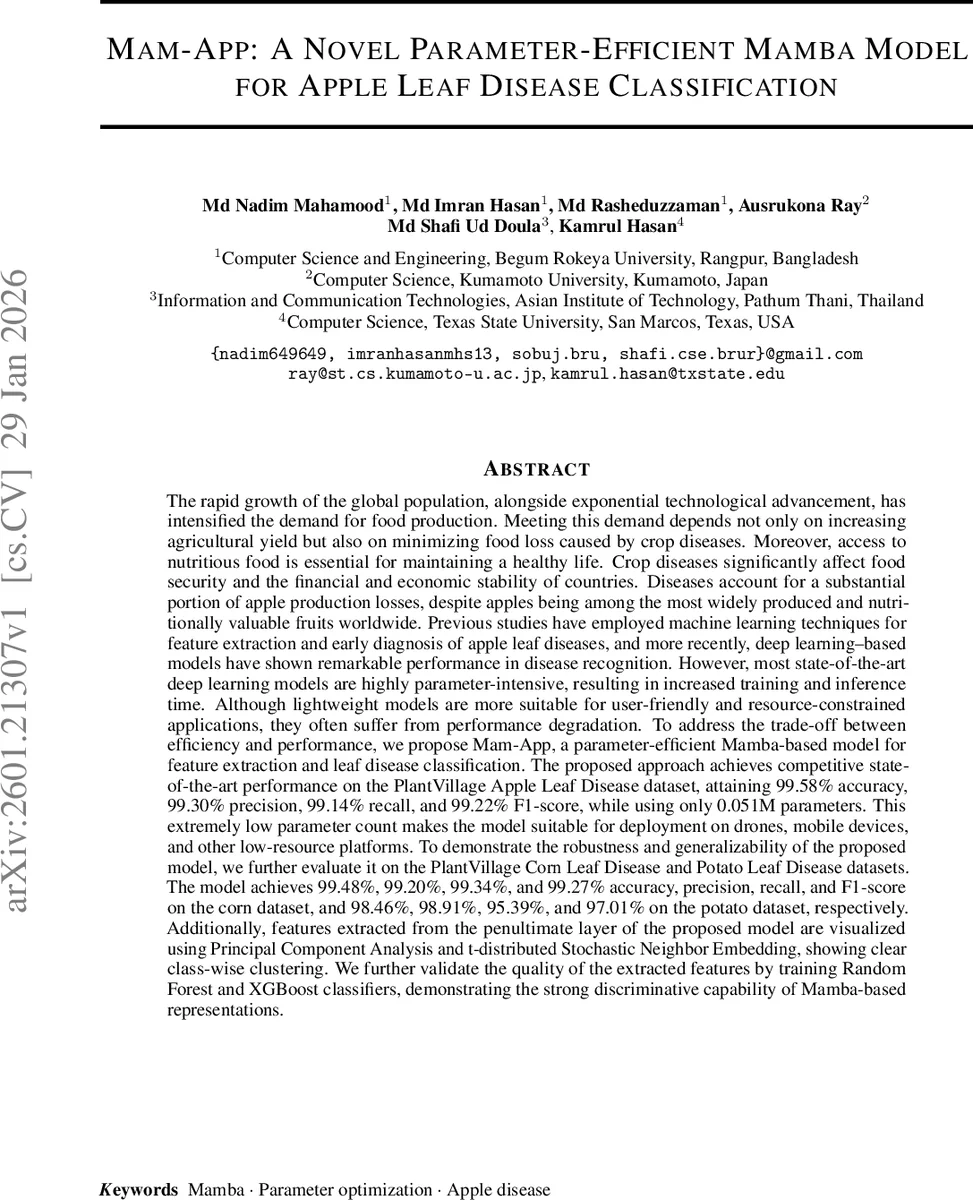
The rapid growth of the global population, alongside exponential technological advancement, has intensified the demand for food production. Meeting this demand depends not only on increasing agricultural yield but also on minimizing food loss caused by crop diseases. Diseases account for a substantial portion of apple production losses, despite apples being among the most widely produced and nutritionally valuable fruits worldwide. Previous studies have employed machine learning techniques for feature extraction and early diagnosis of apple leaf diseases, and more recently, deep learning-based models have shown remarkable performance in disease recognition. However, most state-of-the-art deep learning models are highly parameter-intensive, resulting in increased training and inference time. Although lightweight models are more suitable for user-friendly and resource-constrained applications, they often suffer from performance degradation. To address the trade-off between efficiency and performance, we propose Mam-App, a parameter-efficient Mamba-based model for feature extraction and leaf disease classification. The proposed approach achieves competitive state-of-the-art performance on the PlantVillage Apple Leaf Disease dataset, attaining 99.58% accuracy, 99.30% precision, 99.14% recall, and a 99.22% F1-score, while using only 0.051M parameters. This extremely low parameter count makes the model suitable for deployment on drones, mobile devices, and other low-resource platforms. To demonstrate the robustness and generalizability of the proposed model, we further evaluate it on the PlantVillage Corn Leaf Disease and Potato Leaf Disease datasets. The model achieves 99.48%, 99.20%, 99.34%, and 99.27% accuracy, precision, recall, and F1-score on the corn dataset and 98.46%, 98.91%, 95.39%, and 97.01% on the potato dataset, respectively.
💡 Research Summary
The paper addresses the pressing need for efficient, accurate disease detection in apple orchards, a critical component of meeting the growing global food demand. While traditional machine‑learning pipelines rely on handcrafted features and recent deep‑learning models achieve high accuracy, the latter often contain millions of parameters, making them unsuitable for deployment on resource‑constrained platforms such as drones, smartphones, or edge devices. To bridge this gap, the authors propose Mam‑App, a novel, parameter‑efficient model built upon the Mamba state‑space architecture, which replaces the quadratic‑complexity self‑attention mechanism of Transformers with a linear‑time recurrent formulation.
Mam‑App’s architecture consists of three main parts: a Stem Block (two 3×3 convolutional layers) that captures low‑level spatial cues, a series of Mamba layers that process the image as a sequence of patches using a state‑space model, and a lightweight classification head (global average pooling followed by a fully connected layer). The entire network contains only 0.051 million parameters, a reduction of two orders of magnitude compared with typical CNN or Vision‑Transformer backbones.
Experiments were conducted on the PlantVillage Apple Leaf Disease dataset (four classes: healthy, scab, rust, cedar rust). Using AdamW optimizer with cosine‑annealing learning‑rate schedule for 30 epochs, Mam‑App achieved 99.58 % accuracy, 99.30 % precision, 99.14 % recall, and a 99.22 % F1‑score. These results are on par with, and in some cases surpass, much larger models such as EfficientNet‑B0 (≈5 M parameters) and Vision‑Transformer variants, demonstrating that the Mamba backbone can retain discriminative power despite extreme compression.
To test robustness and generalizability, the same architecture was evaluated on PlantVillage corn and potato leaf disease datasets without any architectural changes. The model obtained 99.48 % accuracy on corn and 98.46 % accuracy on potato, with similarly high precision, recall, and F1 scores, indicating that the learned representations transfer well across different crops and disease types.
Feature analysis further validates the quality of the learned embeddings. Visualizations of the penultimate layer using Principal Component Analysis and t‑Distributed Stochastic Neighbor Embedding reveal clear, well‑separated clusters for each disease class. When these embeddings are fed to conventional classifiers (Random Forest and XGBoost), they achieve >98 % accuracy, confirming that Mam‑App extracts highly discriminative features.
The authors acknowledge limitations: all evaluations rely on publicly available, well‑controlled datasets, and real‑world field images with variable lighting, background clutter, and occlusions were not directly tested. Moreover, the state‑space parameters are fixed, limiting domain‑specific fine‑tuning. Future work is suggested to incorporate more aggressive data augmentation, domain adaptation techniques, lightweight variants of the state‑space module, and multi‑scale pyramid designs to handle more complex disease manifestations.
In summary, Mam‑App demonstrates that a Mamba‑based, ultra‑lightweight network can deliver state‑of‑the‑art performance for apple leaf disease classification while using a fraction of the parameters required by conventional deep models, making it a promising candidate for deployment on low‑resource agricultural robotics and mobile health monitoring systems.
Comments & Academic Discussion
Loading comments...
Leave a Comment