On the structure of prime-detecting quasimodular forms in higher levels
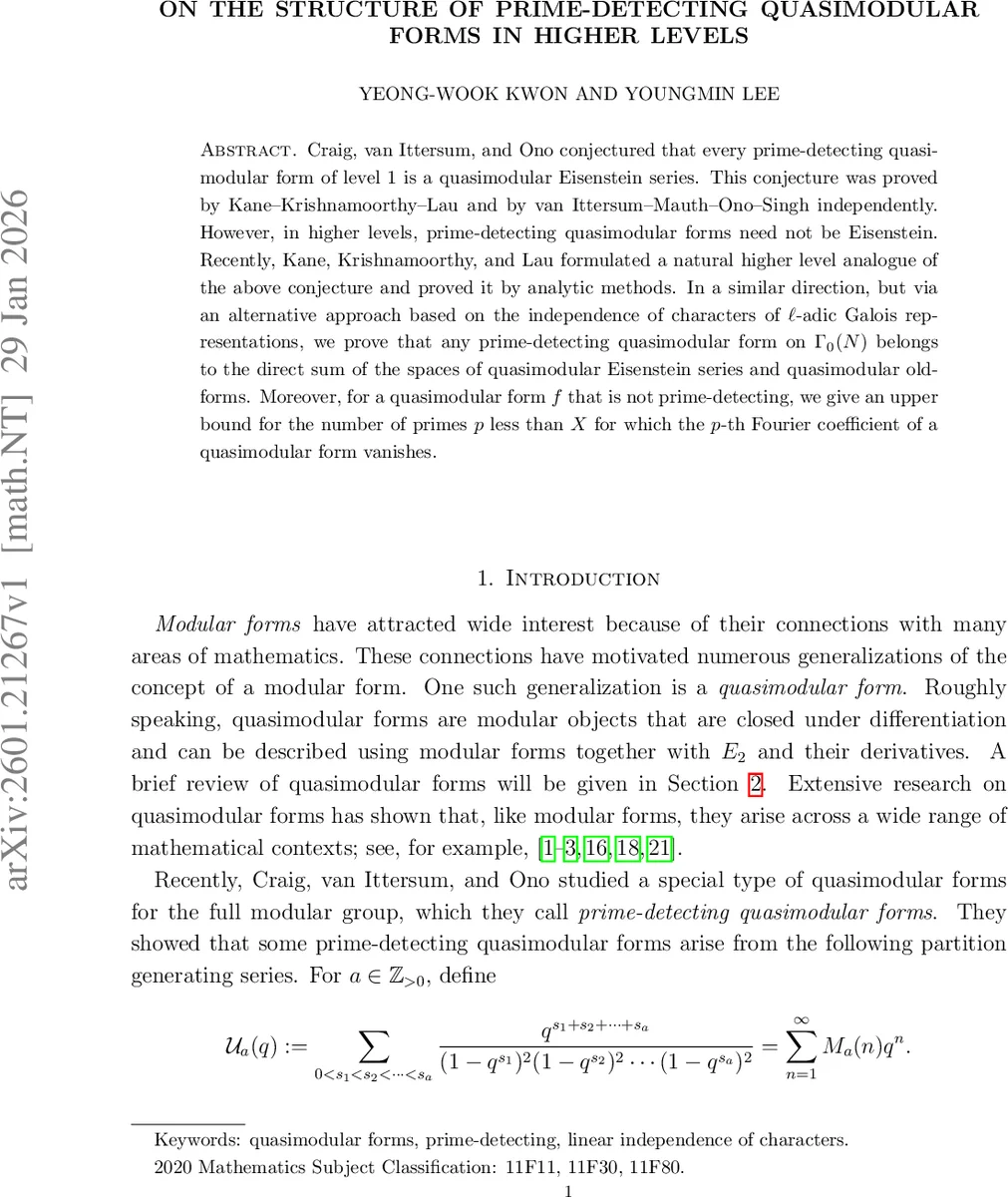
Craig, van Ittersum, and Ono conjectured that every prime-detecting quasimodular form of level $1$ is a quasimodular Eisenstein series. This conjecture was proved by Kane–Krishnamoorthy–Lau and by van Ittersum–Mauth–Ono–Singh independently. However, in higher levels, prime-detecting quasimodular forms need not be Eisenstein. Recently, Kane, Krishnamoorthy, and Lau formulated a natural higher level analogue of the above conjecture and proved it by analytic methods. In a similar direction, but via an alternative approach based on the independence of characters of $\ell$-adic Galois representations, we prove that any prime-detecting quasimodular form on $Γ_{0}(N)$ belongs to the direct sum of the spaces of quasimodular Eisenstein series and quasimodular oldforms. Moreover, for a quasimodular form $f$ that is not prime-detecting, we give an upper bound for the number of primes $p$ less than $X$ for which the $p$-th Fourier coefficient of a quasimodular form vanishes.
💡 Research Summary
The paper investigates the structure of prime‑detecting quasimodular forms on the congruence subgroup Γ₀(N) and establishes that such forms are always a sum of a quasimodular Eisenstein series and a quasimodular oldform. The authors begin by recalling the original conjecture of Craig, van Ittersum, and Ono, which asserted that every prime‑detecting quasimodular form of level 1 is a quasimodular Eisenstein series. This conjecture was proved independently by Kane–Krishnamoorthy–Lau and by van Ittersum–Mauth–Ono–Singh using analytic methods. In higher levels the conjecture fails in its naïve form because prime‑detecting quasimodular forms can have a non‑zero cuspidal component. A concrete example is given using the functions Gₖ(N) and the discriminant Δ, showing that the cuspidal part lies in the old‑subspace.
Motivated by this observation the authors propose a refined conjecture (Conjecture 1.1): for any positive integer N, the set Ω_N of prime‑detecting quasimodular forms on Γ₀(N) should decompose as the direct sum of its Eisenstein part and the old‑subspace of cusp forms. The main result, Theorem 1.1, proves a slightly stronger statement: if eΩ_N denotes the set of quasimodular forms whose Fourier coefficients vanish at every prime p∤N, then
eΩ_N = (eΩ_N ∩ 𝔈(N)) ⊕ 𝔖_old(N).
Here 𝔈(N) is the space of quasimodular Eisenstein series, and 𝔖_old(N) is the space of quasimodular oldforms. Consequently Corollary 1.2 confirms Conjecture 1.1.
The proof of Theorem 1.1 is based on ℓ‑adic Galois representations rather than analytic techniques. Starting with a form f∈eΩ_N, the authors write f = f_E + f_new S + f_old S according to the decomposition of the full quasimodular space f𝔐(N) = 𝔈(N) ⊕ 𝔖_new(N) ⊕ 𝔖_old(N). The goal is to show f_new S = 0. By reducing modulo a suitable prime ℓ and using the fact that the condition a_f(p)=0 for all p∤N translates into a linear relation among traces of Frobenius elements acting on the ℓ‑adic representations attached to the newforms, they invoke the linear independence of characters of G_ℚ. Since the characters of distinct 2‑dimensional irreducible ℓ‑adic representations are ℚ‑linearly independent, the only way the relation can hold is if all coefficients vanish, forcing f_new S = 0. This argument parallels the analytic result of Kane–Krishnamoorthy–Lau (Theorem 1.4 in
Comments & Academic Discussion
Loading comments...
Leave a Comment