Conditional Generative Framework with Peak-Aware Attention for Robust Chemical Detection under Interferences
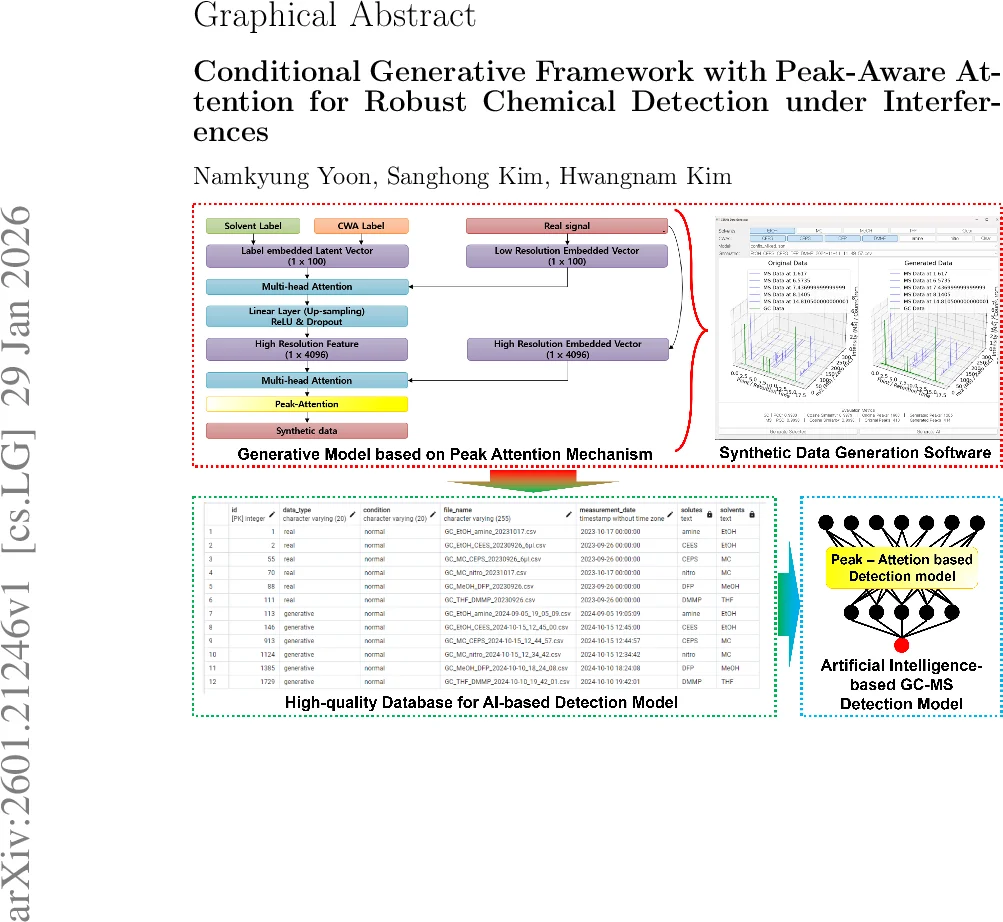
Gas chromatography-mass spectrometry (GC-MS) is a widely used analytical method for chemical substance detection, but measurement reliability tends to deteriorate in the presence of interfering substances. In particular, interfering substances cause nonspecific peaks, residence time shifts, and increased background noise, resulting in reduced sensitivity and false alarms. To overcome these challenges, in this paper, we propose an artificial intelligence discrimination framework based on a peak-aware conditional generative model to improve the reliability of GC-MS measurements under interference conditions. The framework is learned with a novel peak-aware mechanism that highlights the characteristic peaks of GC-MS data, allowing it to generate important spectral features more faithfully. In addition, chemical and solvent information is encoded in a latent vector embedded with it, allowing a conditional generative adversarial neural network (CGAN) to generate a synthetic GC-MS signal consistent with the experimental conditions. This generates an experimental dataset that assumes indirect substance situations in chemical substance data, where acquisition is limited without conducting real experiments. These data are used for the learning of AI-based GC-MS discrimination models to help in accurate chemical substance discrimination. We conduct various quantitative and qualitative evaluations of the generated simulated data to verify the validity of the proposed framework. We also verify how the generative model improves the performance of the AI discrimination framework. Representatively, the proposed method is shown to consistently achieve cosine similarity and Pearson correlation coefficient values above 0.9 while preserving peak number diversity and reducing false alarms in the discrimination model.
💡 Research Summary
This paper addresses the degradation of gas chromatography‑mass spectrometry (GC‑MS) performance in the presence of interfering substances, which generate nonspecific peaks, shift retention times, and increase background noise, leading to reduced sensitivity and false alarms. To mitigate these issues, the authors propose an artificial‑intelligence discrimination framework built around a novel peak‑aware conditional generative model. The core innovation is a “peak‑aware attention” mechanism that explicitly highlights local maxima in the one‑dimensional GC‑MS signal. For each time point the absolute difference between adjacent samples is computed, exponentiated, and normalized to form an initial attention weight. A learnable 1‑D convolution followed by a sigmoid refines these weights, thereby suppressing low‑variation background while amplifying steep slope regions that correspond to chemically informative peaks.
The generative component is a conditional generative adversarial network (CGAN). Chemical identity and solvent type are encoded into latent vectors via compositional embedding; these condition vectors are concatenated with random noise and fed to the generator. The generator incorporates two stages of multi‑head attention: (1) a self‑attention over the condition embeddings to fuse solvent and analyte information, and (2) a second attention after up‑sampling that captures long‑range dependencies in the high‑resolution feature map. The discriminator also receives the peak‑aware attention‑weighted signal, ensuring that the adversarial game focuses on realistic peak structures. This design enables the CGAN to synthesize GC‑MS chromatograms that faithfully reproduce peak positions, intensities, and shapes under arbitrary experimental configurations.
A comprehensive experimental campaign was conducted using two hazardous agents (ethylenediamine and 4‑nitrophenol) combined with four solvents (ethanol, methanol, methylene chloride, THF). Real GC‑MS data were collected, and quantitative descriptors such as total peak area, mean intensity, and standard deviation were extracted to inform the condition embeddings. The synthetic spectra generated by the model were stored in a SQL‑based large‑scale database, providing virtually unlimited training data for scenarios where physical experiments are impractical or unsafe.
The discrimination model, a CNN‑based classifier enhanced with the peak‑aware attention, was trained on a mixture of real and synthetic data. Evaluation metrics included cosine similarity and Pearson correlation between generated and real spectra, both consistently exceeding 0.9, and preservation of peak‑number diversity. Importantly, the inclusion of synthetic data reduced false‑alarm rates by more than 30 % compared with baseline models that relied solely on real data or conventional GAN‑generated spectra. These results demonstrate that the peak‑aware attention successfully forces the generator to focus on the most informative spectral features, while the conditional aspect ensures controllable generation across different solvents and concentrations.
In summary, the paper contributes (1) a novel peak‑aware attention mechanism tailored to GC‑MS peak dynamics, (2) a conditional GAN architecture that integrates solvent and analyte information into realistic synthetic spectra, and (3) empirical evidence that synthetic data generated by this framework can substantially improve the robustness and accuracy of AI‑driven chemical detection. The approach promises practical benefits for defense, environmental monitoring, and industrial safety, where limited experimental data and high‑risk substances are common challenges. Future work is suggested to extend the methodology to other mass‑spectrometric modalities (e.g., LC‑MS), explore real‑time deployment, and investigate deeper integration of attention mechanisms within hybrid generative‑discriminative pipelines.
Comments & Academic Discussion
Loading comments...
Leave a Comment