Speed is Confidence
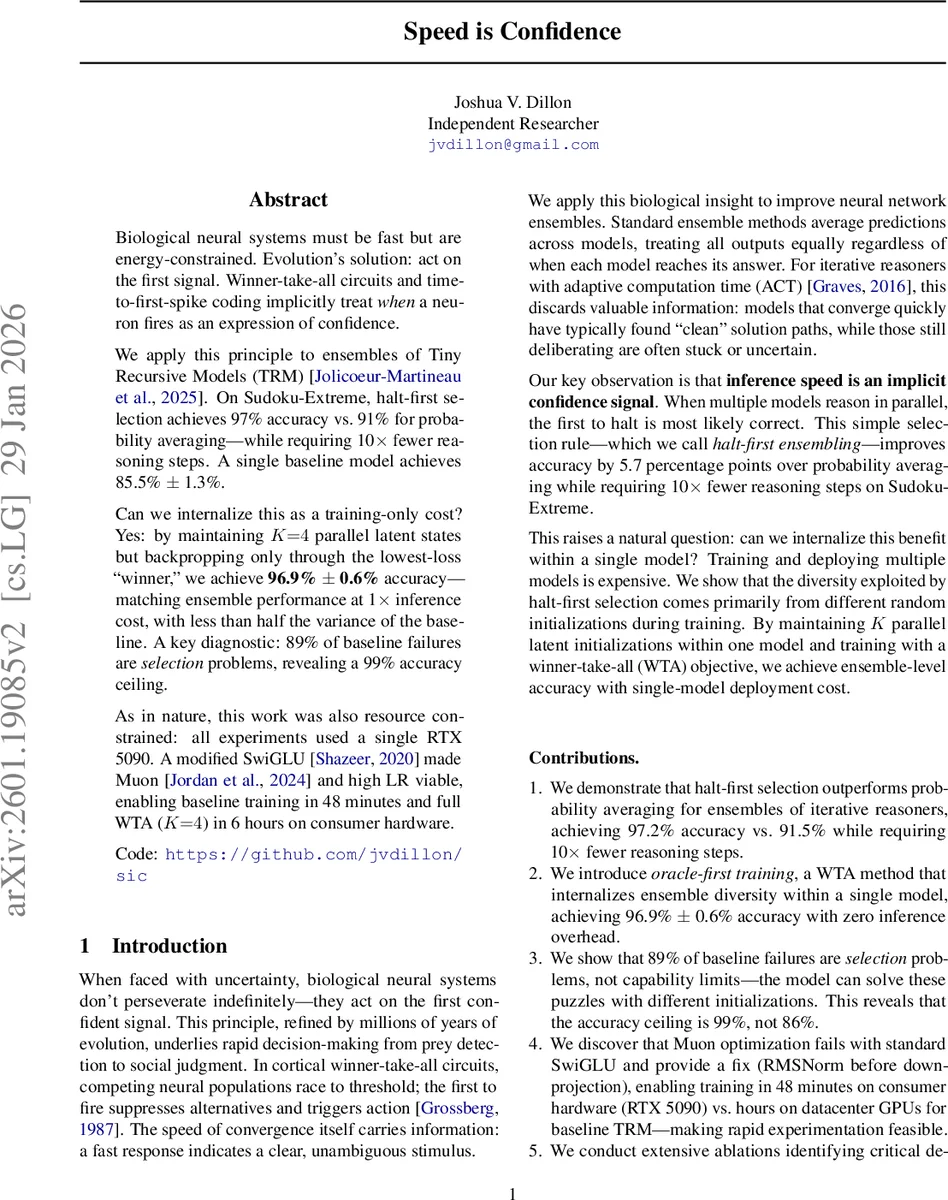
Biological neural systems must be fast but are energy-constrained. Evolution’s solution: act on the first signal. Winner-take-all circuits and time-to-first-spike coding implicitly treat when a neuron fires as an expression of confidence. We apply this principle to ensembles of Tiny Recursive Models (TRM) [Jolicoeur-Martineau et al., 2025]. On Sudoku-Extreme, halt-first selection achieves 97% accuracy vs. 91% for probability averaging – while requiring 10x fewer reasoning steps. A single baseline model achieves 85.5% +/- 1.3%. Can we internalize this as a training-only cost? Yes: by maintaining K=4 parallel latent states but backpropping only through the lowest-loss “winner,” we achieve 96.9% +/- 0.6% accuracy – matching ensemble performance at 1x inference cost, with less than half the variance of the baseline. A key diagnostic: 89% of baseline failures are selection problems, revealing a 99% accuracy ceiling. As in nature, this work was also resource constrained: all experiments used a single RTX 5090. A modified SwiGLU [Shazeer, 2020] made Muon [Jordan et al., 2024] and high LR viable, enabling baseline training in 48 minutes and full WTA (K=4) in 6 hours on consumer hardware.
💡 Research Summary
The paper “Speed is Confidence” draws inspiration from biological winner‑take‑all (WTA) circuits and time‑to‑first‑spike coding, where the moment a neuron fires encodes confidence. The authors transfer this principle to modern neural reasoning systems, specifically Tiny Recursive Models (TRM) that solve constraint‑satisfaction problems such as Sudoku‑Extreme (17‑clue puzzles).
Halt‑first ensembling
Standard ensembles average the outputs of several independently trained models, ignoring the timing at which each model decides to halt. TRM models already produce a halting probability q at each iteration via Adaptive Computation Time (ACT). The authors run multiple TRM instances in parallel and select the first model whose q exceeds a threshold (0.5). This “halt‑first” rule treats inference speed as an implicit confidence signal. Empirically, a 12‑model ensemble using halt‑first reaches 97.2 % accuracy while requiring only ~18.5 reasoning steps on average—about ten times fewer steps than the probability‑averaging baseline (91.5 % accuracy, 192 steps). The speed‑based selection yields a 5.7 % absolute gain in accuracy and dramatically reduces compute.
Oracle‑first (WTA) training
Deploying multiple models is costly, so the authors ask whether the same benefit can be internalized in a single network. They maintain K = 4 parallel latent low‑level states (z_L^k) within one TRM, sharing a high‑level state (z_H). During each training step, all K hypotheses are forward‑propagated; the hypothesis with the lowest cross‑entropy loss is declared the winner, and gradients are back‑propagated only through that branch (a winner‑take‑all objective). The halting signal is also trained with a binary cross‑entropy term. Because a low loss correlates with rapid convergence of the internal fixed‑point dynamics, the winner at training time tends to be the fastest at inference. This “oracle‑first” approach achieves 96.9 % ± 0.6 % accuracy—essentially matching the 12‑model halt‑first ensemble—while inference costs are identical to a single model. Moreover, variance across runs drops by more than half, indicating more stable performance.
Optimization tricks
Training K parallel branches multiplies forward passes, so the authors introduce two engineering improvements:
- Muon + AdamW hybrid optimizer – Muon provides high‑learning‑rate, orthogonalized momentum for dense weight matrices, while AdamW handles embeddings, biases, and heads. This combination accelerates convergence dramatically.
- SwiGLU‑muon – Standard SwiGLU interacts poorly with Muon’s spectral‑norm constraints. Adding RMSNorm after the element‑wise product (sigmoid(g) ⊙ RMSNorm(g ⊙ v)) stabilizes magnitudes and restores fast learning.
They also propose SVD‑aligned initialization for the K latent vectors, aligning them with the top singular vectors of the first layer to avoid “dead heads” and ensure each branch starts with comparable signal strength while remaining diverse.
Empirical analysis
A baseline 7 M‑parameter TRM reaches 85.5 % ± 1.3 % accuracy after ~16 iterations. Adding test‑time augmentations (rotations) and averaging three seeds lifts accuracy to 91.5 % but multiplies compute. The halt‑first ensemble improves both metrics. Failure analysis shows that 89 % of baseline errors are “selection problems”: the model finds the correct solution under a different random seed but fails to halt early enough. This suggests an upper bound near 99 % accuracy, limited not by model capacity but by the ability to surface the right solution quickly.
All experiments run on a single RTX 5090. Baseline training finishes in 48 minutes; the WTA‑trained model (K = 4) completes in ~6 hours, demonstrating that the proposed tricks make the approach feasible on consumer hardware.
Implications
The work demonstrates that inference latency can serve as a reliable proxy for confidence in iterative reasoning networks. By exploiting this signal, one can achieve ensemble‑level performance with far less compute, and by embedding a WTA competition into training, the same benefit can be realized with a single deployable model. The methodology is broadly applicable to any ACT‑enabled architecture (e.g., PonderNet, Tree‑of‑Thought, dynamic‑depth transformers) and opens avenues for energy‑efficient AI systems where rapid decisions are essential. Future work may explore scaling K, applying the technique to larger language models, or integrating explicit confidence estimators to further refine the halt‑first rule.
In summary, “Speed is Confidence” provides a biologically motivated, technically sound, and practically efficient framework that bridges the gap between fast, low‑energy decision making in nature and high‑accuracy inference in modern neural networks.
Comments & Academic Discussion
Loading comments...
Leave a Comment