AsterNav: Autonomous Aerial Robot Navigation In Darkness Using Passive Computation
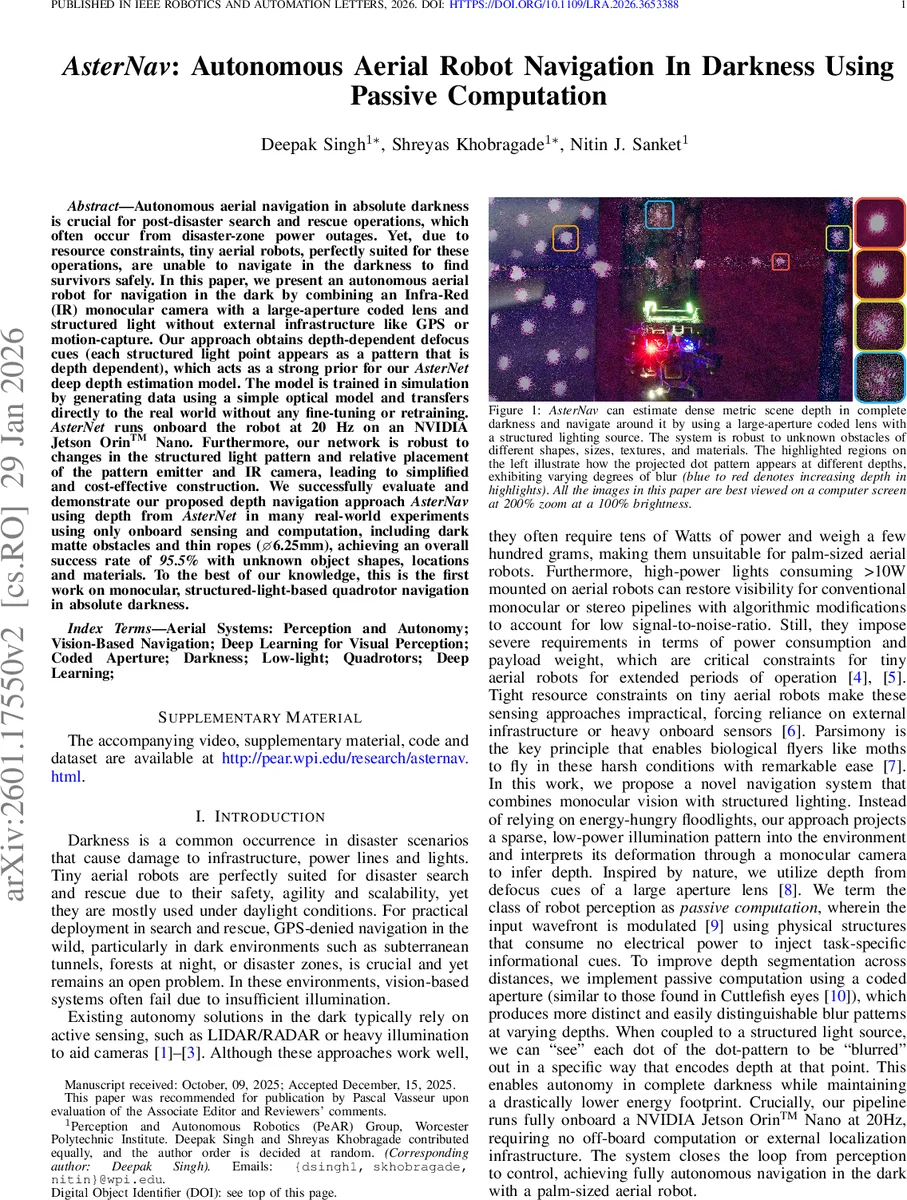
Autonomous aerial navigation in absolute darkness is crucial for post-disaster search and rescue operations, which often occur from disaster-zone power outages. Yet, due to resource constraints, tiny aerial robots, perfectly suited for these operations, are unable to navigate in the darkness to find survivors safely. In this paper, we present an autonomous aerial robot for navigation in the dark by combining an Infra-Red (IR) monocular camera with a large-aperture coded lens and structured light without external infrastructure like GPS or motion-capture. Our approach obtains depth-dependent defocus cues (each structured light point appears as a pattern that is depth dependent), which acts as a strong prior for our AsterNet deep depth estimation model. The model is trained in simulation by generating data using a simple optical model and transfers directly to the real world without any fine-tuning or retraining. AsterNet runs onboard the robot at 20 Hz on an NVIDIA Jetson Orin$^\text{TM}$ Nano. Furthermore, our network is robust to changes in the structured light pattern and relative placement of the pattern emitter and IR camera, leading to simplified and cost-effective construction. We successfully evaluate and demonstrate our proposed depth navigation approach AsterNav using depth from AsterNet in many real-world experiments using only onboard sensing and computation, including dark matte obstacles and thin ropes (diameter 6.25mm), achieving an overall success rate of 95.5% with unknown object shapes, locations and materials. To the best of our knowledge, this is the first work on monocular, structured-light-based quadrotor navigation in absolute darkness.
💡 Research Summary
The paper introduces AsterNav, a novel autonomous navigation system for tiny quadrotors operating in complete darkness, such as disaster‑zone environments where power outages eliminate ambient illumination. The core idea is to combine a passive optical element—a large‑aperture coded aperture lens—with an active, low‑power structured‑light projector and an infrared (IR) monocular camera. The coded aperture creates depth‑dependent blur patterns (point spread functions, PSFs) that vary dramatically with distance, providing a strong visual cue even when the scene is otherwise invisible. By projecting a sparse dot pattern onto the environment, each dot appears as a uniquely blurred shape whose size and texture encode metric depth.
To exploit this cue, the authors develop AsterNet, a lightweight encoder‑decoder convolutional neural network trained exclusively on synthetic data. The synthetic dataset is generated by first capturing real PSFs at a set of discrete depths using the actual lens‑aperture assembly, then convolving these PSFs with randomly generated obstacle masks and COCO background images. This “PSF‑bank” approach faithfully reproduces the optical distortions, diffraction, and sensor noise of the real hardware without requiring any real‑world depth labels. The network is trained with a combination of L1 and SSIM losses, encouraging both accurate depth values and sharp edge preservation.
AsterNet runs on an NVIDIA Jetson Orin Nano at 20 Hz (≈8 ms per inference) while consuming less than 5 W, making it suitable for palm‑sized aerial platforms. The authors also present a classical depth‑from‑defocus baseline for comparison, showing that the learned model achieves roughly twice the accuracy and five times the speed.
Extensive experiments validate the system. Bench‑top tests across depths of 0.5 m to 4 m and various surface reflectivities yield an average absolute depth error below 3 cm and RMSE under 5 cm. Real‑world flight trials in a completely dark indoor arena involve obstacles of unknown shape, matte black panels, and ultra‑thin ropes (6.25 mm diameter). Out of 20 autonomous navigation runs, 19 succeed, giving a 95.5 % success rate; the single failure occurs when the structured‑light dots are fully absorbed by a highly non‑reflective surface. Robustness tests demonstrate that variations in dot density, illumination intensity, and relative pose between projector and camera degrade performance by less than 10 %, confirming the system’s tolerance to manufacturing tolerances and field‑deployment uncertainties.
The paper discusses limitations: the current pipeline assumes a static scene and may struggle with fast‑moving obstacles or sudden external illumination changes. Low‑reflectivity surfaces can diminish the structured‑light signal, increasing depth error. Future work is proposed on integrating temporal depth‑from‑defocus with optical flow for dynamic obstacle avoidance, adding reflectivity estimation, and extending the approach to multi‑modal sensing.
In summary, AsterNav showcases how passive computation (coded aperture) combined with minimal active illumination can provide dense, metric depth perception in absolute darkness, enabling real‑time, onboard autonomous navigation for resource‑constrained aerial robots. This contribution opens new possibilities for search‑and‑rescue, underground exploration, and night‑time surveillance where traditional vision or lidar solutions are infeasible.
Comments & Academic Discussion
Loading comments...
Leave a Comment