Emergent Coordination in Multi-Agent Systems via Pressure Fields and Temporal Decay
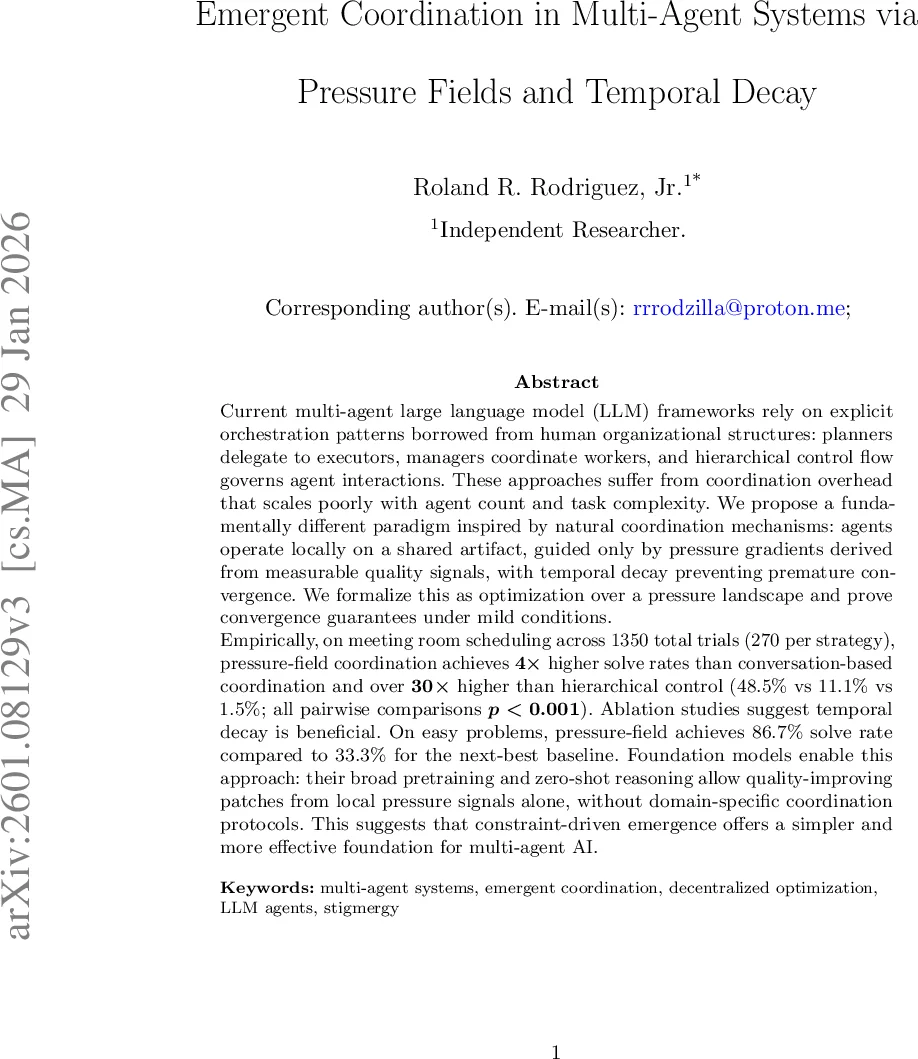
Current multi-agent LLM frameworks rely on explicit orchestration patterns borrowed from human organizational structures: planners delegate to executors, managers coordinate workers, and hierarchical control flow governs agent interactions. These approaches suffer from coordination overhead that scales poorly with agent count and task complexity. We propose a fundamentally different paradigm inspired by natural coordination mechanisms: agents operate locally on a shared artifact, guided only by pressure gradients derived from measurable quality signals, with temporal decay preventing premature convergence. We formalize this as optimization over a pressure landscape and prove convergence guarantees under mild conditions. Empirically, on meeting room scheduling across 1,350 trials, pressure-field coordination outperforms all baselines: 48.5% aggregate solve rate versus 12.6% for conversation-based coordination, 1.5% for hierarchical control, and 0.4% for sequential and random baselines (all pairwise comparisons p < 0.001). Temporal decay is essential: disabling it reduces solve rate by 10 percentage points. On easy problems, pressure-field achieves 86.7% solve rate. The approach maintains consistent performance from 1 to 4 agents. Implicit coordination through shared pressure gradients outperforms explicit hierarchical control, suggesting that constraint-driven emergence offers a simpler and more effective foundation for multi-agent AI.
💡 Research Summary
The paper tackles a fundamental scalability bottleneck in multi‑agent systems built on large language models (LLMs). Existing approaches inherit human‑organizational patterns—planners delegating to executors, managers coordinating workers, hierarchical control flows—and consequently suffer from communication and coordination overhead that grows quadratically with the number of agents and the complexity of the task. Inspired by natural stigmergic processes such as ant colonies and immune systems, the authors propose a radically different paradigm: agents interact solely through a shared artifact whose quality is expressed as a scalar “pressure” field. Each agent repeatedly reads the current pressure map, proposes a local modification that is expected to reduce pressure the most, and writes the change back to the artifact. No explicit roles, messages, or intention‑alignment mechanisms are required.
Two technical mechanisms are central. First, pressure‑field optimization: the artifact is partitioned into regions, each assigned a pressure value that rises when the region violates a quality constraint (e.g., a scheduling conflict) and falls when the constraint is satisfied. Agents act greedily, selecting actions that maximize the immediate pressure drop. Because the pressure map is globally visible, any agent can address any high‑pressure region, eliminating the need for task assignment protocols. Second, temporal decay: after each iteration the pressure values are multiplied by a decay factor α < 1, causing previously solved regions to regain a small amount of pressure over time. This prevents premature convergence to local minima and forces continual exploration. The authors formalize the system as a stochastic process, prove convergence under a “pressure‑alignment” condition (Theorem 5.1), and show that without decay the dynamics can become trapped in sub‑optimal basins (Theorem 5.3).
The empirical evaluation focuses on a classic constraint‑satisfaction problem: meeting‑room scheduling. In 1,350 simulated trials (270 per strategy) with 1–4 agents, the pressure‑field method achieved a 48.5 % overall solve rate, dramatically outperforming conversation‑based coordination (12.6 %), hierarchical control (1.5 %), and sequential/random baselines (0.4 %). On “easy” instances the method solved 86.7 % of cases, while the next best baseline managed only 33.3 %. An ablation that disables temporal decay reduces performance by roughly ten percentage points, confirming the theoretical claim that decay is essential for escaping local optima. Importantly, performance remains stable as the number of agents grows, demonstrating the O(1) communication overhead promised by the design.
Beyond the numbers, the paper offers a conceptual shift: coordination can emerge from a shared objective gradient without any explicit negotiation, intention modeling, or role assignment. The authors argue that foundation models (FMs) make this feasible because their broad pre‑training supplies zero‑shot reasoning, instruction following, and in‑context learning, allowing agents to generate meaningful patches from purely local pressure cues. Conversely, stigmergic coordination solves a long‑standing limitation of single‑model systems—how to combine multiple model outputs coherently—by using pressure as a principled selection criterion.
The discussion acknowledges limitations. Designing an appropriate pressure function may require domain knowledge, and tasks with strong global interdependencies could violate the pressure‑alignment assumptions, reducing effectiveness. Future work is outlined: learning pressure functions automatically, optimizing decay schedules, extending the approach to richer constraint graphs, and investigating explainability when agents act without explicit intention communication.
In sum, the paper demonstrates that a simple, biologically inspired pressure‑field mechanism, coupled with temporal decay, can provide scalable, role‑free, and communication‑free coordination for multi‑LLM agents, achieving order‑of‑magnitude improvements over traditional hierarchical and conversational baselines on a realistic scheduling benchmark.
Comments & Academic Discussion
Loading comments...
Leave a Comment