Leader-driven or Leaderless: How Participation Structure Sustains Engagement and Shapes Narratives in Online Hate Communities
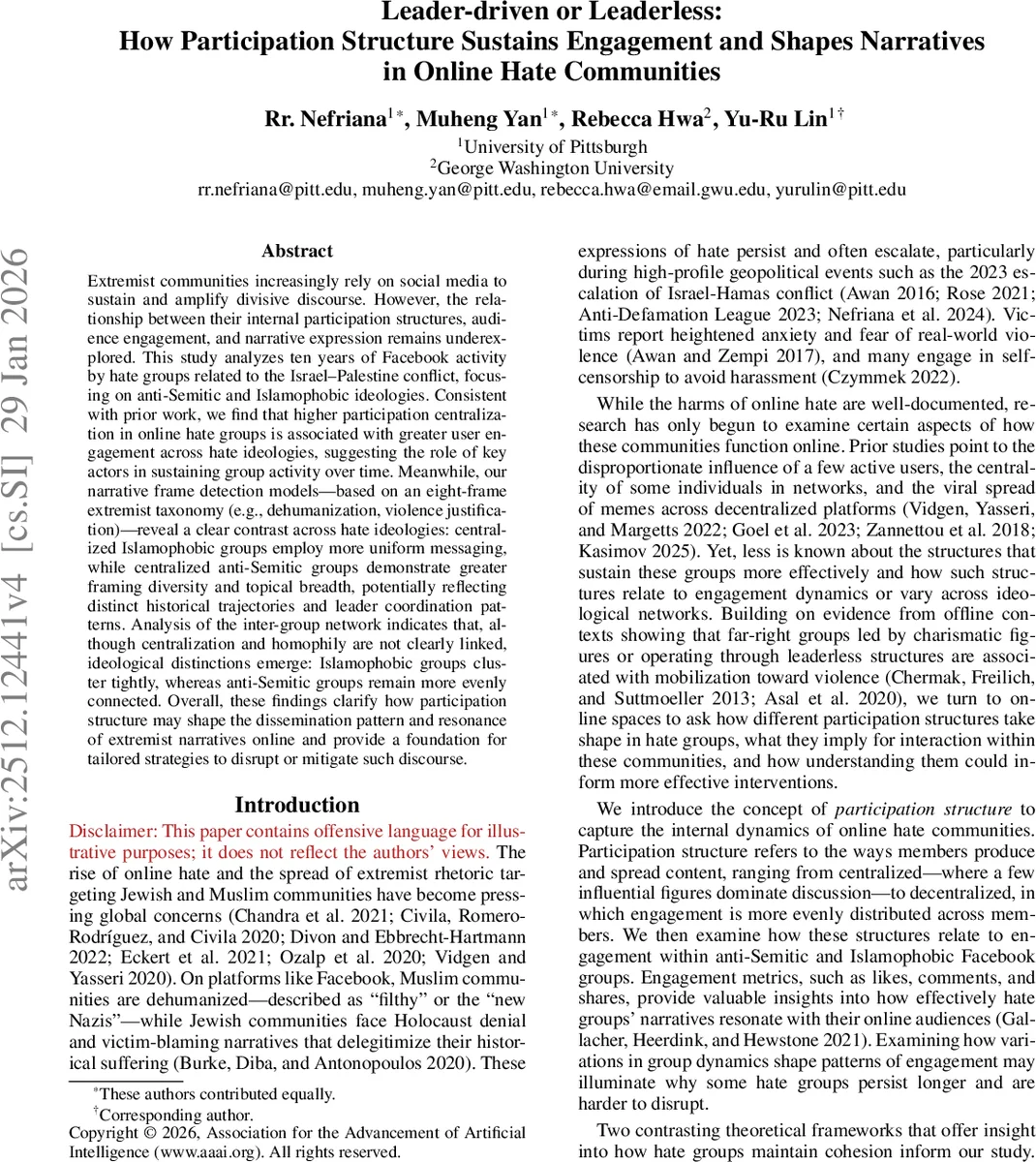
Extremist communities increasingly rely on social media to sustain and amplify divisive discourse. However, the relationship between their internal participation structures, audience engagement, and narrative expression remains underexplored. This study analyzes ten years of Facebook activity by hate groups related to the Israel-Palestine conflict, focusing on anti-Semitic and Islamophobic ideologies. Consistent with prior work, we find that higher participation centralization in online hate groups is associated with greater user engagement across hate ideologies, suggesting the role of key actors in sustaining group activity over time. Meanwhile, our narrative frame detection models–based on an eight-frame extremist taxonomy (e.g., dehumanization, violence justification)–reveal a clear contrast across hate ideologies: centralized Islamophobic groups employ more uniform messaging, while centralized anti-Semitic groups demonstrate greater framing diversity and topical breadth, potentially reflecting distinct historical trajectories and leader coordination patterns. Analysis of the inter-group network indicates that, although centralization and homophily are not clearly linked, ideological distinctions emerge: Islamophobic groups cluster tightly, whereas anti-Semitic groups remain more evenly connected. Overall, these findings clarify how participation structure may shape the dissemination pattern and resonance of extremist narratives online and provide a foundation for tailored strategies to disrupt or mitigate such discourse.
💡 Research Summary
This paper investigates how internal participation structures of online hate communities shape user engagement and narrative expression, focusing on Facebook groups linked to the Israel‑Palestine conflict over a ten‑year period (July 2014 – June 2024). The authors define “participation structure” as the distribution of content creation among members and operationalize it with the Gini coefficient: a high Gini indicates a few dominant users (centralized structure), while a low Gini reflects a more even, decentralized contribution pattern.
Data and Sample
Using the CrowdTangle API, the researchers identified 30 active hate groups, manually labeled them as anti‑Semitic, Islamophobic, “anti‑both,” or other hate, and retained 28 groups after two were banned. After filtering for sufficient longitudinal observations, the final sample comprises 24 groups (13 anti‑Semitic, 11 Islamophobic) with 995,716 posts from 43,971 unique users, yielding 1,820 monthly group observations. English‑language posts (310,532) were used for textual analysis; the remainder were excluded due to language barriers.
Methodology
- Participation Centralization – Monthly Gini coefficients were computed for each group based on users’ post counts.
- Engagement Metrics – Likes, comments, and shares per month served as proxies for audience resonance.
- Narrative Frame Detection – An eight‑frame extremist taxonomy (e.g., dehumanization, violence justification) was trained on a merged dataset of 940 samples (StormFront white‑supremacist texts + the authors’ Facebook data) using a BERT‑based classifier. Each post received a frame label, and frame‑distribution Gini values measured “frame homogeneity.”
- Topic Modeling – Latent Dirichlet Allocation (LDA) identified latent topics; topic‑distribution Gini captured topical breadth.
- Inter‑Group Network – Monthly bipartite networks were built where nodes are groups and edges weight the number of shared users. From these, degree centrality and a homophily index (proportion of edges connecting groups of the same ideology) were derived.
Key Findings
RQ1 – Ideological Variation in Centralization
Islamophobic groups exhibit higher average Gini (≈0.62) than anti‑Semitic groups (≈0.48), indicating that Islamophobic communities rely more heavily on a small set of prolific users.
RQ2 – Centralization and Engagement
A positive, statistically significant relationship exists between a group’s centralization and its subsequent month’s engagement (β = 0.37, p < 0.01). Centralized groups tend to generate more likes, comments, and shares, suggesting that “leader‑type” actors amplify overall activity.
RQ3 – Narrative Framing and Topic Breadth
Centralized Islamophobic groups display high frame‑homogeneity (Gini ≈ 0.71) and low topical diversity (few dominant topics), reflecting uniform messaging—primarily dehumanization and violence justification. Conversely, centralized anti‑Semitic groups show lower frame‑homogeneity (Gini ≈ 0.58) and broader topic coverage (≈12 distinct topics), indicating a richer, more varied narrative ecosystem that includes Holocaust denial, victimhood claims, and conspiracy framing.
RQ4 – Participation Structure and Inter‑Group Connectivity
Homophily is markedly higher among Islamophobic groups (≈0.73), forming a tight cluster, whereas anti‑Semitic groups exhibit moderate homophily (≈0.48) and a more balanced set of connections both within and across ideologies. No significant correlation is found between centralization and homophily (ρ ≈ 0.07, p = 0.31), implying that the concentration of posting activity does not dictate whether groups associate with ideologically similar peers.
Temporal Dynamics
Following the October 2023 Hamas attack, all groups experienced a spike in centralization; the effect was especially pronounced for Islamophobic groups, whose messaging converged sharply on war‑related frames. Anti‑Semitic groups, while also showing increased activity, maintained relatively stable frame diversity, with a modest rise in Holocaust‑denial content.
Interpretation and Implications
The findings suggest two complementary mechanisms: (1) centralized “leader” actors act as engagement engines, sustaining group vitality over time; (2) ideological histories shape how those leaders influence narrative strategy—Islamophobic groups tend toward monolithic, event‑driven propaganda, whereas anti‑Semitic groups leverage a broader historical repertoire. Because centralization does not predict homophily, interventions targeting only central actors may disrupt intra‑group dynamics but will not necessarily fragment the broader ideological network.
Limitations
- Platform specificity: results may not generalize to Twitter, Telegram, or decentralized forums.
- Labeling ambiguity: the operational definition of “anti‑Semitic” includes political criticism of Israel, potentially conflating distinct discourses.
- Frame classifier training data are heavily weighted toward white‑supremacist texts, which may bias detection of Islamophobic frames.
Practical Recommendations
- For Islamophobic clusters, de‑platforming or suspending identified high‑Gini users could significantly reduce overall engagement.
- For anti‑Semitic communities, a dual approach is advised: (a) disrupt prominent contributors and (b) introduce counter‑narratives to dilute frame diversity, thereby weakening the ideological appeal.
- Policymakers should tailor moderation tools to the observed structural differences, employing network‑aware strategies that consider both centralization and inter‑group homophily.
In sum, the study provides a nuanced, data‑driven portrait of how participation structures underpin both the vitality and the rhetorical contours of online hate groups, offering actionable insights for researchers, platform operators, and regulators seeking to curb extremist discourse.
Comments & Academic Discussion
Loading comments...
Leave a Comment