Searching for axion dark matter with magnetic resonance force microscopy
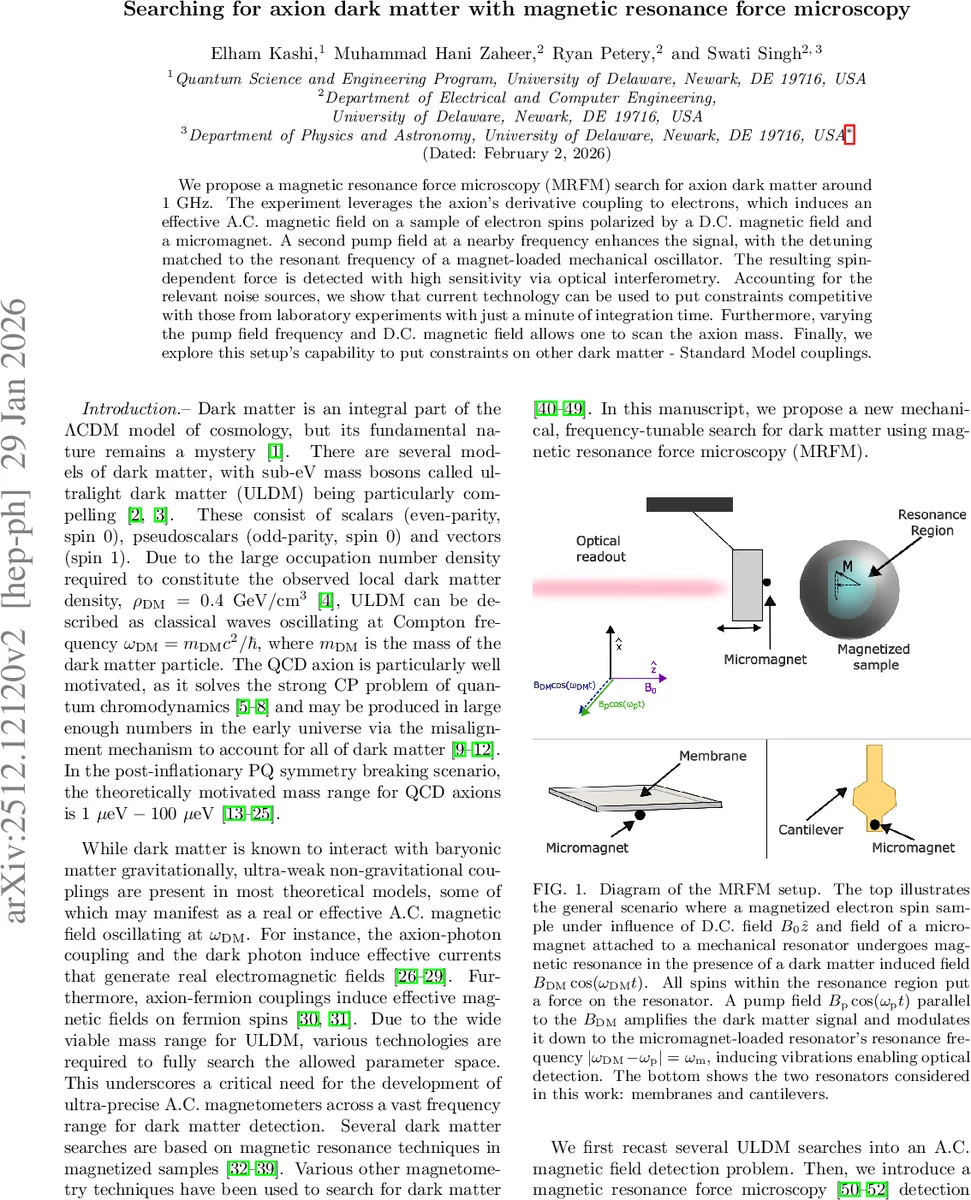
We propose a magnetic resonance force microscopy (MRFM) search for axion dark matter around 1 GHz. The experiment leverages the axion’s derivative coupling to electrons, which induces an effective A.C. magnetic field on a sample of electron spins polarized by a D.C. magnetic field and a micromagnet. A second pump field at a nearby frequency enhances the signal, with the detuning matched to the resonant frequency of a magnet-loaded mechanical oscillator. The resulting spin-dependent force is detected with hih sensitivity via optical interferometry. Accounting for the relevant noise sources, we show that current technology can be used to put constraints competitive with those from laboratory experiments with just a minute of integration time. Furthermore, varying the pump field frequency and D.C. magnetic field allows one to scan the axion mass. Finally, we explore this setup’s capability to put constraints on other dark matter - Standard Model couplings.
💡 Research Summary
The manuscript proposes a magnetic‑resonance‑force‑microscopy (MRFM) scheme to search for ultralight dark‑matter candidates—principally QCD axions and dark photons—in the gigahertz frequency range (≈1 GHz, corresponding to axion masses of a few μeV). The key physical effect exploited is the derivative coupling of the axion field to electrons, which manifests as an effective oscillating magnetic field B₍DM₎ cos(ω₍DM₎ t) acting on a polarized electron‑spin ensemble. By placing the spin sample in a static bias field B₀ and a strong magnetic‑field gradient generated by a micro‑magnet attached to a mechanical resonator, the Larmor frequency ω_L = γ(B₀ + B_z) can be tuned to match the axion Compton frequency ω₍DM₎.
To amplify the exceedingly weak axion‑induced field (typical amplitudes 10⁻¹⁶ T or smaller), a strong pump field Bₚ cos(ω₍p₎ t) is applied parallel to B₍DM₎. The nonlinear Bloch dynamics cause a beat‑note modulation of the longitudinal magnetization m_z at the difference frequency ω_D = |ω₍p₎ − ω₍DM₎|. By choosing ω_D equal to the mechanical resonance frequency ω_m of the cantilever or membrane, the modulated magnetization exerts a time‑varying force on the resonator: \
Comments & Academic Discussion
Loading comments...
Leave a Comment