A single optically detectable tumbling spin in silicon
We demonstrate single spin spectroscopy of a fluorescent tumbling defect in silicon called the G center, behaving as a pseudo-molecule randomly reorienting itself in the crystalline matrix. Using high-resolution spin spectroscopy, we reveal a fine magnetic structure resulting from the spin principal axes jumping between discrete orientations in the crystal. Modeling the atomic reorientation of the defect shows that spin tumbling induces variations in the coupling to the microwave magnetic field, enabling position-dependent Rabi frequencies to be detected in coherent spin control experiments. By virtue of its pseudo-molecule configuration, the G center in silicon is a unique quantum system to investigate the mutual interaction between optical, spin and rotation properties in a highly versatile material.
💡 Research Summary
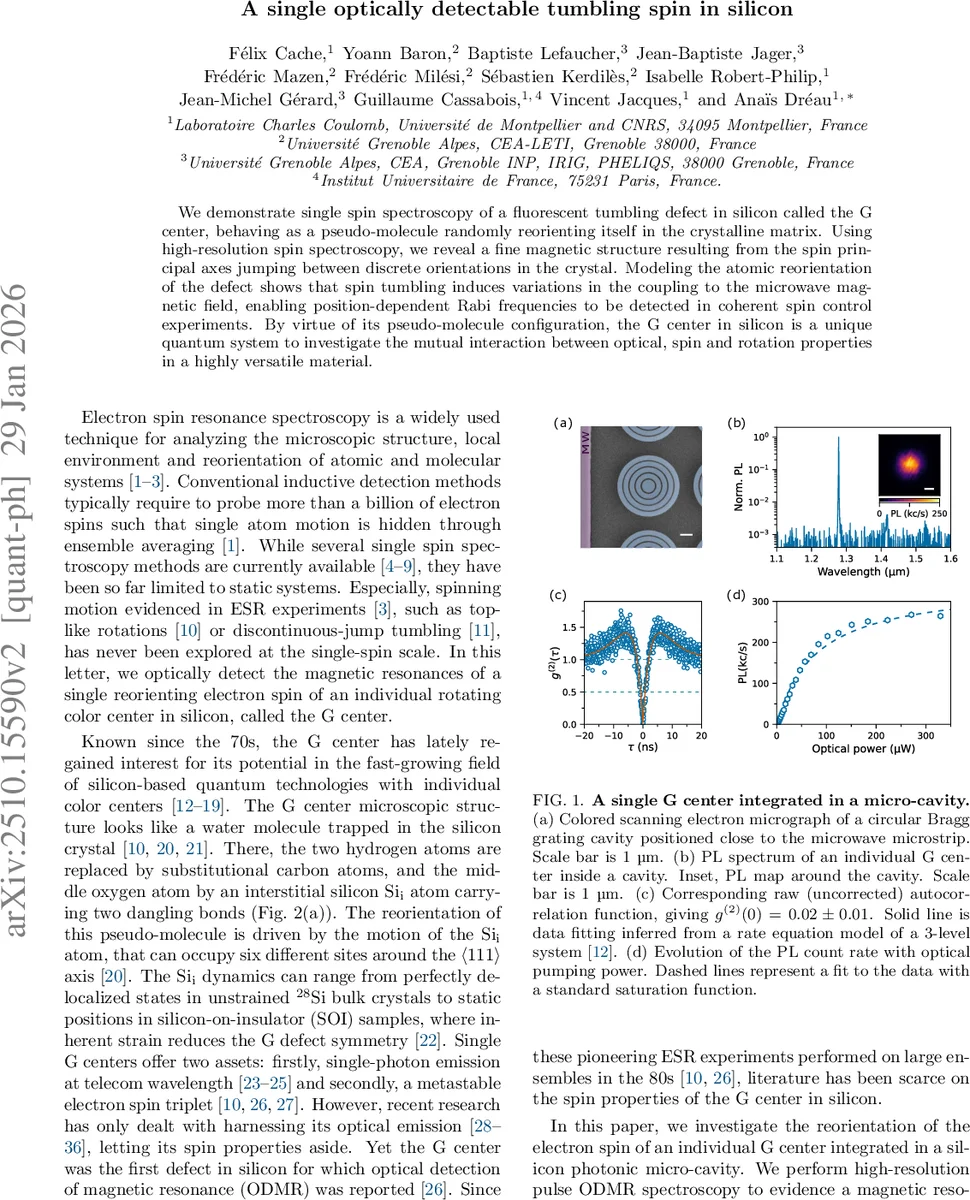
In this work the authors present the first single‑spin optical detection of a “tumbling” electron spin associated with a G‑center defect in silicon. The G‑center, consisting of two substitutional carbon atoms and an interstitial silicon atom (Si_i) that can occupy six equivalent sites around a ⟨111⟩ axis, behaves like a pseudo‑molecule whose orientation changes as Si_i hops between these sites. By integrating a single G‑center into a circular Bragg‑grating cavity fabricated on a silicon‑on‑insulator (SOI) chip, the authors boost the zero‑phonon‑line emission at 1278 nm by three orders of magnitude and achieve high‑purity single‑photon emission (g²(0)≈0.02).
Using pulsed optically detected magnetic resonance (ODMR), they first identify two zero‑field‑splitting (ZFS) transitions at ν₊≈689 MHz and ν₋≈1721 MHz, from which they extract ZFS parameters D≈−1205 MHz and E≈516 MHz, consistent with previous ensemble measurements. However, the single‑spin nature of the experiment reveals a fine magnetic structure hidden in ensemble data. By employing Ramsey interferometry they obtain coherence times T₂* of 0.8–1.1 µs and observe multiple beat frequencies in the Ramsey fringes. Fourier analysis shows four distinct frequency components for the ν₊ transition and five for ν₋, indicating that the spin principal axes are not static but jump among discrete crystal orientations.
High‑resolution ODMR with π‑pulses of duration comparable to T₂* resolves these components directly as separate resonance lines. The authors attribute the multiplicity to spin tumbling: as Si_i moves, the spin operator axes (Ŝₓ, Ŝᵧ) rotate relative to the fixed microwave magnetic field (B_MW) aligned along
Comments & Academic Discussion
Loading comments...
Leave a Comment