Carryless Pairing: Additive Pairing in the Fibonacci Basis
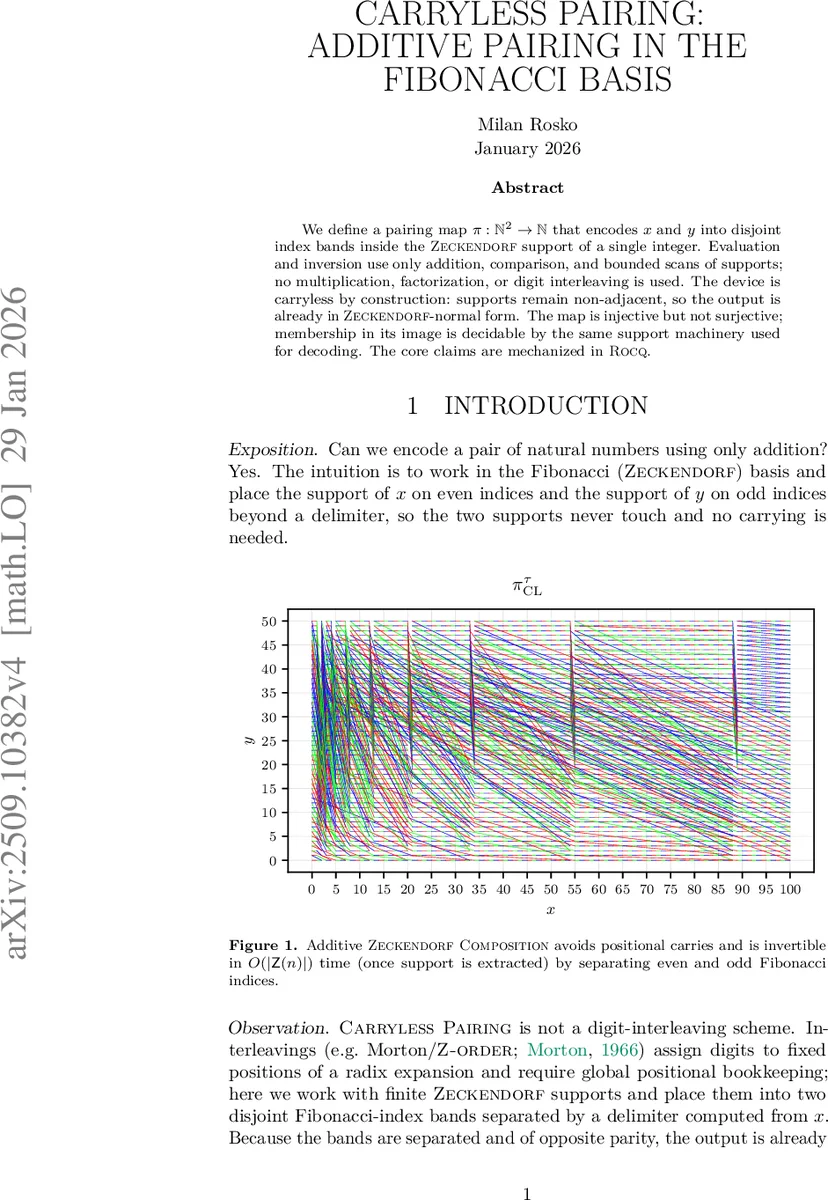
We define a pairing map $π: \mathbb{N}^2\to\mathbb{N}$ that encodes $x$ and $y$ into disjoint index bands inside the Zeckendorf support of a single integer. Evaluation and inversion use only addition, comparison, and bounded scans of supports; no multiplication, factorization, or digit interleaving is used. The device is carryless by construction: supports remain non-adjacent, so the output is already in Zeckendorf-normal form. The map is injective but not surjective; membership in its image is decidable by the same support machinery used for decoding. The core claims are mechanized in Rocq.
💡 Research Summary
The paper introduces a novel pairing function πₜ₍CL₎ that encodes a pair of natural numbers (x, y) into a single natural number n using only addition‑based operations. The construction is grounded in the Zeckendorf representation of integers, which expresses each natural number uniquely as a sum of non‑consecutive Fibonacci numbers. For a given x, the set of Fibonacci indices Z(x) is mapped to even positions 2·e, and a delimiter B(x)=2·r(x) (where r(x) is the smallest index with F₍r(x)₎ > x) is placed to the right of all even‑positioned terms. The indices of y, Z(y), are then shifted into odd positions B(x)+(2·j−1). Because the even band lies entirely below B(x) and the odd band starts strictly above B(x), the combined support contains no adjacent indices; consequently the sum is already in Zeckendorf normal form and no “carry” occurs.
The authors provide explicit algorithms:
-
Pair extracts Z(x) and Z(y), computes B(x), builds the union S = {2·e | e∈Z(x)} ∪ {B(x)+(2·j−1) | j∈Z(y)}, and returns the integer Σₖ∈S Fₖ.
-
Unpair extracts Z(n), separates even indices (dividing by 2) to recover Z(x), reconstructs x, computes B(x), then extracts odd indices ≥ B(x)+1, translates them back by (k−B(x)+1)/2 to obtain Z(y) and reconstruct y.
-
UnpairChecked runs Unpair and verifies that re‑pairing yields the original n, thereby deciding membership in the image of πₜ₍CL₎.
Correctness is proved in Coq: the round‑trip theorem unpair (πₜ₍CL₎ x y) = (x, y) holds for all x, y, establishing injectivity. Surjectivity fails; the image is a proper subset of ℕ, but membership is Δ₀‑decidable via the re‑pairing check.
Complexity analysis shows that, aside from extracting the Zeckendorf support (which costs O(r(n)) or O(|Z(n)|) depending on the implementation), all subsequent steps are linear in the size of the support sets. Thus pairing runs in O(|Z(x)| + |Z(y)|) and unpairing in O(|Z(n)|). This contrasts sharply with Gödel‑style multiplicative encodings that require factorisation, or Cantor’s quadratic pairing that needs multiplication and square‑root operations.
The paper also discusses stability: updating x only shifts the odd band by Δ = B(x′)−B(x), while updating y merely toggles a single odd‑band element. Hence local updates avoid recomputing the entire encoding, a property absent in global interleaving schemes like Morton Z‑order.
Potential applications are outlined:
-
Arithmetic consistency – providing an additive coding mechanism usable in weak arithmetic frameworks (e.g., bounded arithmetic) where multiplication is not available.
-
Automated proof checking – the clear separation of supports enables fast, checkable proofs in systems that only need addition.
-
Entropy and structure study – the image of πₜ₍CL₎ exhibits irregular, high‑entropy patterns, offering a new combinatorial object for investigation.
-
Reverse mathematics and coding strength – the existence of such a pairing function raises questions about which induction or comprehension axioms are required to prove its round‑trip property, and how iterated codings (e.g., π(x, π(y, z))) affect the expressive power of weak theories.
A comparative section positions the new method against three families of encodings: multiplicative (Gödel), polynomial (Cantor), and positional interleaving (Morton). The carryless pairing avoids global position bookkeeping and carries, achieving locality and additive-only computation.
Finally, the authors formalize all definitions, algorithms, and proofs in Coq (Gallina), providing both an abstract interface for Zeckendorf extraction and a concrete greedy implementation. The development, including example computations, is publicly available (Proofcase T001). The paper concludes that carryless pairing offers a fully additive, reversible encoding with decidable image, expanding the toolkit for arithmetic coding in both theoretical and practical contexts.
Comments & Academic Discussion
Loading comments...
Leave a Comment