Non-Identical Diffusion Models in MIMO-OFDM Channel Generation
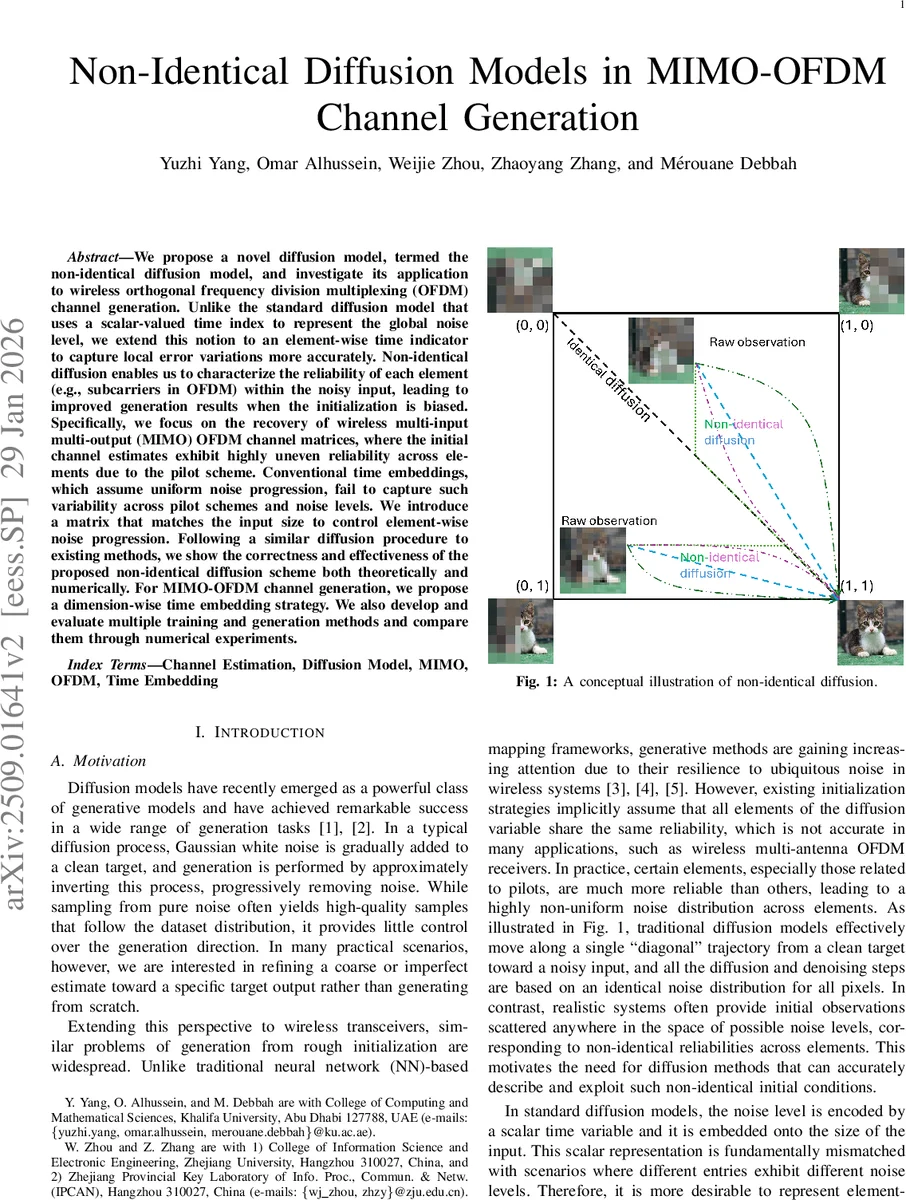
We propose a novel diffusion model, termed the non-identical diffusion model, and investigate its application to wireless orthogonal frequency division multiplexing (OFDM) channel generation. Unlike the standard diffusion model that uses a scalar-valued time index to represent the global noise level, we extend this notion to an element-wise time indicator to capture local error variations more accurately. Non-identical diffusion enables us to characterize the reliability of each element (e.g., subcarriers in OFDM) within the noisy input, leading to improved generation results when the initialization is biased. Specifically, we focus on the recovery of wireless multi-input multi-output (MIMO) OFDM channel matrices, where the initial channel estimates exhibit highly uneven reliability across elements due to the pilot scheme. Conventional time embeddings, which assume uniform noise progression, fail to capture such variability across pilot schemes and noise levels. We introduce a matrix that matches the input size to control element-wise noise progression. Following a similar diffusion procedure to existing methods, we show the correctness and effectiveness of the proposed non-identical diffusion scheme both theoretically and numerically. For MIMO-OFDM channel generation, we propose a dimension-wise time embedding strategy. We also develop and evaluate multiple training and generation methods and compare them through numerical experiments.
💡 Research Summary
The paper introduces a novel diffusion framework called the “non‑identical diffusion model” designed specifically for MIMO‑OFDM channel generation, where the reliability of each element (sub‑carrier, antenna) can vary dramatically due to pilot placement and interference. Traditional diffusion models encode the noise level with a single scalar time variable, implicitly assuming that every element experiences the same amount of noise. This assumption breaks down in wireless channel estimation, where pilot‑based measurements provide high‑confidence values on a sparse set of entries while the remaining entries are highly uncertain.
To address this, the authors replace the scalar time index t with a vector (or matrix) α_t that has the same dimensionality as the diffusion variable. Each component of α_t follows a monotonic decreasing schedule from 1 to 0, and the corresponding β_t = √(1−α_t²) controls the amount of injected Gaussian noise per element. By formulating the diffusion dynamics as an Itô stochastic differential equation (SDE) with element‑wise coefficients, they prove (via the Fokker‑Planck equation) that the distribution of the state at any time t is exactly the same as α_t ⊙ H₀ + β_t ⊙ ξ, where H₀ is the clean channel and ξ∼𝒩(0,I). This result shows that the non‑identical diffusion is a direct, mathematically sound extension of the standard DDPM framework.
A major practical challenge is embedding the high‑dimensional time matrix into a neural network. The paper proposes a “column‑wise and row‑wise time embedding” that leverages the natural three‑dimensional organization of MIMO‑OFDM CSI (time slots, antennas, sub‑carriers). One‑dimensional embeddings are learned for the antenna and sub‑carrier dimensions, then combined (e.g., via outer product or concatenation) to reconstruct an element‑wise time tensor that can be added to the input of an MLP‑Mixer backbone. This design preserves the efficiency of existing diffusion networks while providing the required per‑element timing information.
Two training/inference strategies are explored. The first, “non‑identical initialization,” randomly samples element‑wise noise levels during training so the model learns to denoise a wide variety of heterogeneous noise patterns. The second, “automatic time‑step estimation,” measures the empirical variance of a real‑world coarse channel estimate, maps it to an appropriate initial time step t₀, and starts the reverse diffusion from that state rather than from pure Gaussian noise. The latter reduces the number of required sampling steps by roughly 30 % without sacrificing performance, which is crucial for real‑time channel refinement.
Extensive simulations compare the proposed method against a conventional scalar‑time diffusion baseline. Metrics include normalized mean‑square error (NMSE), symbol error rate (SER), and the fidelity of reconstructed spatial‑frequency correlation. The non‑identical diffusion consistently outperforms the baseline, achieving 1.5–2 dB NMSE gains, especially under scenarios with narrow‑band interference that degrades only a subset of sub‑carriers. The automatic time‑step approach further improves robustness when pilot density is low, demonstrating that the model can effectively exploit partial, high‑confidence observations.
Beyond wireless communications, the authors argue that the non‑identical diffusion paradigm is applicable to any generative task with spatially or temporally varying uncertainty, such as image in‑painting with known masks, sensor‑network data imputation, and multimodal generation where some modalities are more reliable than others. Future work is suggested in three directions: (i) integrating conditional information (e.g., user location, mobility patterns) into the non‑identical diffusion pipeline, (ii) extending the framework to handle complex‑valued CSI directly with specialized complex‑valued neural architectures, and (iii) developing lightweight, hardware‑friendly implementations for on‑device channel prediction. Overall, the paper provides a solid theoretical foundation, a practical embedding solution, and convincing empirical evidence that non‑identical diffusion is a powerful tool for generating high‑quality wireless channel states from biased, unevenly reliable initial estimates.
Comments & Academic Discussion
Loading comments...
Leave a Comment