Industrial Internet Robot Collaboration System and Edge Computing Optimization
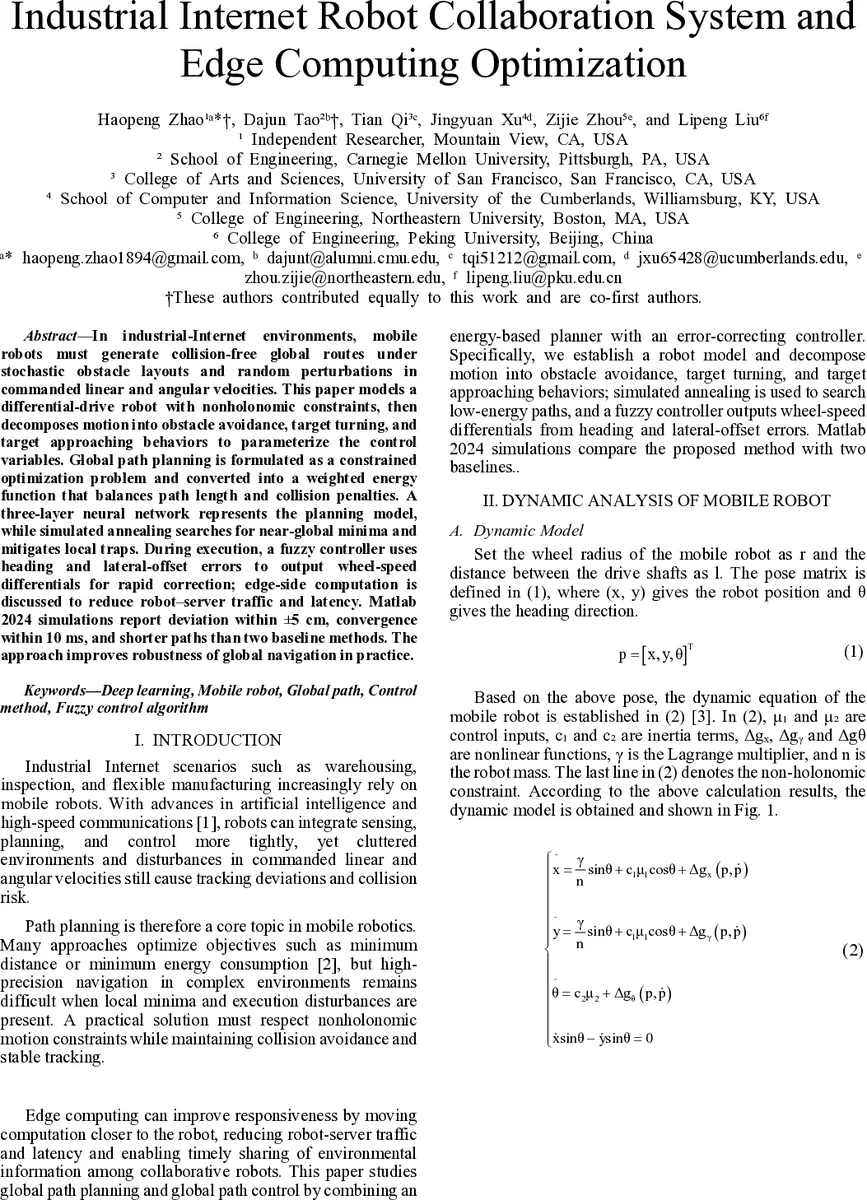
In industrial Internet environments, mobile robots must generate collision-free global routes under stochastic obstacle layouts and random perturbations in commanded linear and angular velocities. This paper models a differential-drive robot with nonholonomic constraints, then decomposes motion into obstacle avoidance, target turning, and target approaching behaviors to parameterize the control variables. Global path planning is formulated as a constrained optimization problem and converted into a weighted energy function that balances path length and collision penalties. A three-layer neural network represents the planning model, while simulated annealing searches for near-global minima and mitigates local traps. During execution, a fuzzy controller uses heading and lateral-offset errors to output wheel-speed differentials for rapid correction; edge-side computation is discussed to reduce robot-server traffic and latency. Matlab 2024 simulations report deviation within +-5 cm, convergence within 10 ms, and shorter paths than two baseline methods. The approach improves robustness of global navigation in practice.
💡 Research Summary
The paper addresses the challenge of generating collision‑free global routes for differential‑drive mobile robots operating in stochastic industrial‑Internet environments where obstacle layouts and commanded linear/angular velocities are uncertain. First, the authors formulate a non‑holonomic dynamic model of the robot, reducing it to kinematic equations with linear velocity v and angular velocity ξ as the primary control variables. They then decompose robot motion into three elementary behaviors—obstacle avoidance, target turning, and target approaching—each described by analytical expressions that relate v and ξ to measurable quantities such as obstacle bearing, deviation angle, and distance to goal. This behavior‑based parameterization enables the conversion of the global path planning problem into a constrained optimization that balances two competing objectives: minimizing total path length and penalizing proximity to obstacles. The authors introduce a weighted energy function F that combines a length term Fₗ and a collision‑penalty term F_z, with a scalar weight δₗ to trade off between them.
To solve the resulting optimization, a three‑layer feed‑forward neural network (64‑ReLU‑64‑ReLU‑2‑Linear) is trained to generate candidate paths. Simulated annealing (SA) is then employed as a meta‑heuristic search: at each temperature step, neighboring paths are sampled, the change in energy ΔF is evaluated, and inferior solutions are occasionally accepted according to the SA acceptance probability. This stochastic acceptance helps the algorithm escape local minima and converge toward a near‑global optimum.
During execution, a fuzzy controller corrects deviations in real time. The controller receives two inputs—heading error (limited to ±10°) and lateral offset error (±100 mm)—and uses triangular membership functions to fuzzify them. Expert‑derived fuzzy rules infer the required wheel‑speed differential, which is then defuzzified to produce a concrete command for the left/right wheels. This fast correction loop reduces tracking error to within ±5 cm and achieves convergence in roughly 10 ms, as reported by the simulations.
The paper also discusses edge computing as a means to reduce robot‑server communication latency and bandwidth usage. By offloading both the neural‑network‑based path planner and the fuzzy inference engine to a nearby edge node, the system can deliver low‑latency control commands while keeping the robot’s onboard computation lightweight.
Experimental validation is performed in MATLAB 2024 with a simulated warehouse‑like environment. Three methods are compared: the proposed deep‑learning‑augmented planner with fuzzy control, a visual‑servo generalized‑constraint planner, and a dynamic/static safety‑field planner. Over 500 SA iterations, the proposed method yields the shortest average path length (106 m) compared with 132 m (visual‑servo) and 130 m (safety‑field). Path deviation remains under ±5 cm, and the control loop settles within 10 ms, outperforming the baselines in both accuracy and speed.
The authors acknowledge several limitations: reliance on accurate robot dynamics parameters, handcrafted fuzzy membership functions and rule bases that may not generalize to highly dynamic or noisy environments, and sensitivity to sensor noise or abrupt obstacle changes. Future work is outlined to incorporate uncertainty‑aware sensing, adaptive or learning‑based tuning of fuzzy parameters, real‑world robot experiments, and multi‑robot coordination with optimized edge‑network traffic. Overall, the paper presents a cohesive framework that integrates behavior‑based modeling, energy‑function optimization via neural networks and simulated annealing, and fast fuzzy correction, demonstrating improved robustness and efficiency for industrial robot navigation.
Comments & Academic Discussion
Loading comments...
Leave a Comment