Augmented Reality Productivity In-the-Wild: A Diary Study of Usage Patterns and Experiences of Working With AR Laptops in Real-World Settings
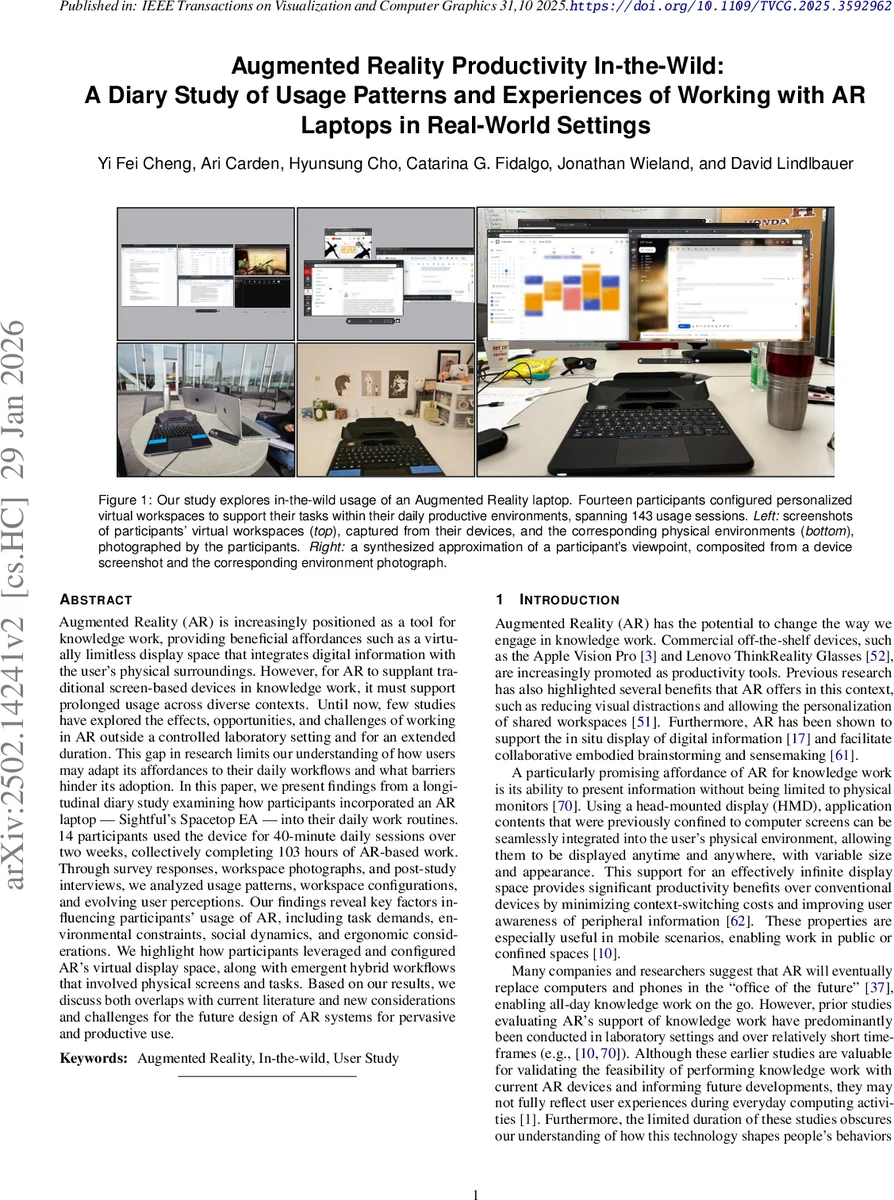
Augmented Reality (AR) is increasingly positioned as a tool for knowledge work, providing beneficial affordances such as a virtually limitless display space that integrates digital information with the user’s physical surroundings. However, for AR to supplant traditional screen-based devices in knowledge work, it must support prolonged usage across diverse contexts. Until now, few studies have explored the effects, opportunities, and challenges of working in AR outside a controlled laboratory setting and for an extended duration. This gap in research limits our understanding of how users may adapt its affordances to their daily workflows and what barriers hinder its adoption. In this paper, we present findings from a longitudinal diary study examining how participants incorporated an AR laptop – Sightful’s Spacetop EA – into their daily work routines. 14 participants used the device for 40-minute daily sessions over two weeks, collectively completing 103 hours of AR-based work. Through survey responses, workspace photographs, and post-study interviews, we analyzed usage patterns, workspace configurations, and evolving user perceptions. Our findings reveal key factors influencing participants’ usage of AR, including task demands, environmental constraints, social dynamics, and ergonomic considerations. We highlight how participants leveraged and configured AR’s virtual display space, along with emergent hybrid workflows that involved physical screens and tasks. Based on our results, we discuss both overlaps with current literature and new considerations and challenges for the future design of AR systems for pervasive and productive use.
💡 Research Summary
This paper presents a longitudinal, in‑the‑wild diary study investigating how knowledge workers adopt an augmented‑reality (AR) laptop for everyday productivity tasks. The device under study is Sightful’s Spacetop EA, an optical see‑through head‑mounted display (85 g, 1920 × 1080 px per eye, 52° field‑of‑view) tethered to a conventional keyboard and trackpad, running a custom OS that allows users to open, resize, and reposition multiple 2‑D application windows (e‑mail, word processor, web browser, etc.) in virtual space.
Fourteen participants (ages 24‑38, varied professional roles) were asked to use the Spacetop EA for a 40‑minute session each workday over a two‑week period, without any constraints on the type of work, physical environment, or social setting. Across 143 sessions, participants logged a total of 103 hours of AR‑based work (≈7 hours per participant). Data collection combined post‑session surveys (capturing perceived usefulness, fatigue, task fit), photographs of both the virtual workspace (device screenshots) and the surrounding physical environment, and a final 30‑minute semi‑structured interview.
The analysis identifies four primary factors shaping AR usage: (1) Task demands – tasks requiring deep focus (coding, writing) led participants to place a central “core” window and surround it with peripheral “support” windows (chat, calendar). Collaborative or multitasking activities prompted more dense multi‑window layouts. (2) Environmental constraints – lighting, ambient noise, and desk space directly affected whether participants relied solely on the AR display or blended it with a physical monitor. Poor lighting or noisy cafés often triggered a hybrid workflow where the AR laptop was used briefly and then switched to a conventional screen. (3) Social dynamics – wearing a head‑mounted display in the presence of colleagues sometimes felt conspicuous; participants responded by adopting “privacy modes” (bringing windows close to the eyes) or by reverting to a physical monitor for sensitive content. (4) Ergonomic considerations – despite the device’s lightweight design, prolonged wear caused neck and visual fatigue, especially due to the limited field‑of‑view and resolution. Users reported increased head movement to keep virtual content within view, which contributed to discomfort and occasional performance degradation in detail‑heavy tasks (e.g., data visualization).
A notable emergent behavior was the formation of hybrid workflows. Rather than abandoning traditional screens, participants frequently used the AR laptop as an “external memory” or peripheral display, while keeping primary documents or reference material on a physical monitor. This pattern mitigated the limited screen real estate of the HMD and reduced context‑switching costs, confirming earlier laboratory findings about the benefits of boundless virtual space while revealing practical adaptations in real‑world settings.
The authors compare their findings with prior short‑term, lab‑based studies, highlighting both convergences (e.g., perceived productivity gains from unlimited display space, challenges in window management) and divergences (e.g., the importance of environmental and social context, the prevalence of mixed‑device workflows). They argue that future AR laptop designs should incorporate context‑adaptive window placement, automatic fatigue detection with proactive alerts, and privacy‑preserving UI cues to address social acceptability. Hardware improvements—larger field‑of‑view, higher resolution, and further weight reduction—remain critical for reducing neck strain and visual fatigue.
In conclusion, the study demonstrates that AR laptops can support genuine work activities and deliver measurable productivity benefits, but their widespread adoption hinges on solving ergonomic, visual, and social barriers. By providing a rich, ecologically valid dataset of 103 hours of real‑world usage, the paper offers a valuable roadmap for researchers and designers aiming to realize the vision of pervasive, productive AR computing.
Comments & Academic Discussion
Loading comments...
Leave a Comment