A New Mode of Teaching Chinese as a Foreign Language from the Perspective of Smart System Studied by Using Rongzhixue
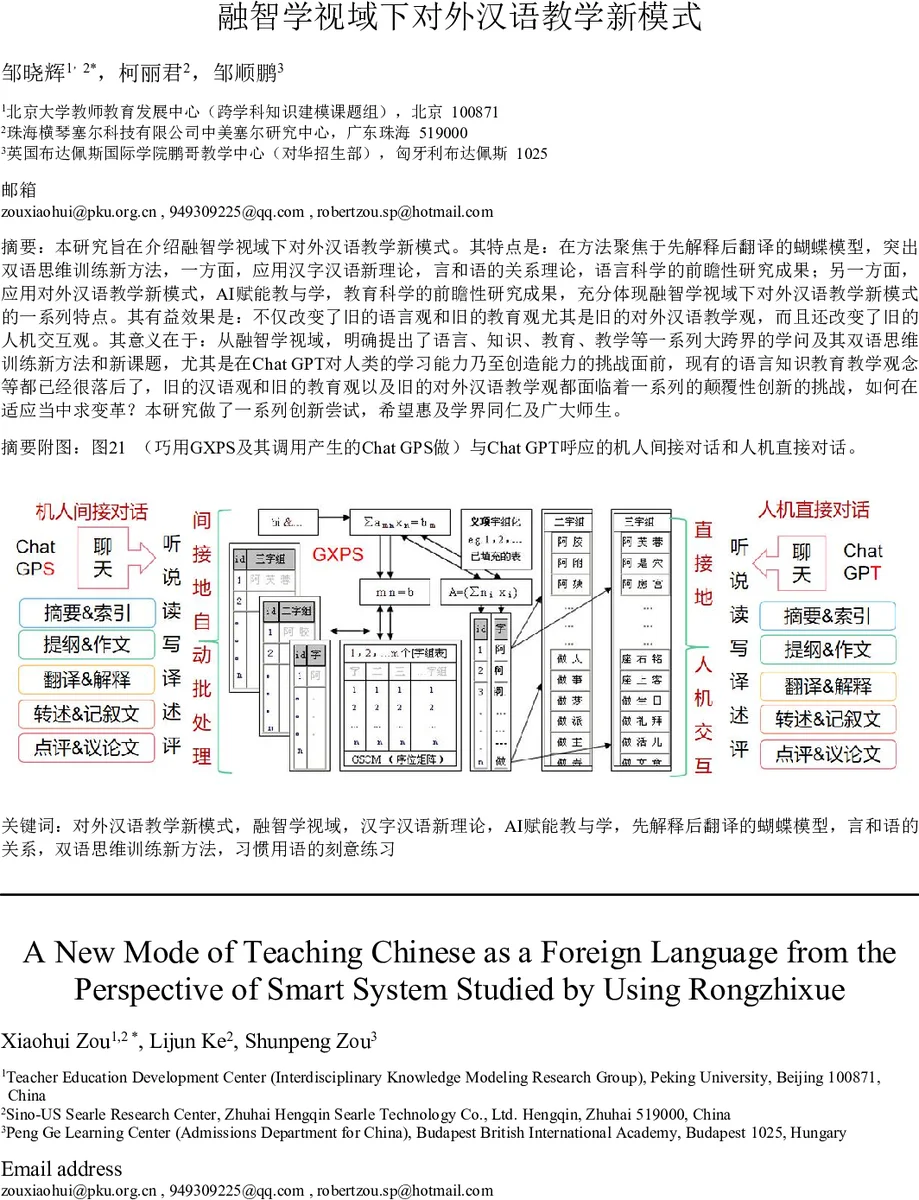
The purpose of this study is to introduce a new model of teaching Chinese as a foreign language from the perspective of integrating wisdom. Its characteristics are as follows: focusing on the butterfly model of interpretation before translation, highlighting the new method of bilingual thinking training, on the one hand, applying the new theory of Chinese characters, the theory of the relationship between language and speech, and the forward-looking research results of language science; On the other hand, the application of the new model of teaching Chinese as a foreign language, AI empowering teaching and learning, and the forward-looking research results of educational science fully reflect a series of characteristics of the new model of teaching Chinese as a foreign language from the perspective of integrating wisdom. Its beneficial effects are: not only the old view of language and education, especially the old view of teaching Chinese as a foreign language, but also the old view of human-computer interaction. Its significance lies in that a series of great cross-border Rongzhixue such as language, knowledge, education and teaching, as well as new methods and new topics of bilingual thinking training are clearly put forward from the perspective of integrating wisdom. Especially in the face of the challenge of Chat GPT to human learning ability and even creativity, the existing concepts of language knowledge education and teaching are already very backward. The old concepts of Chinese language education, and teaching Chinese as a foreign language are all facing a series of subversive innovation challenges. How to seek changes in adaptation? This study has made a series of innovative attempts, hoping to benefit academic colleagues, teachers and students.
💡 Research Summary
The paper proposes a novel paradigm for teaching Chinese as a foreign language (CFL) grounded in the interdisciplinary framework of “Rongzhixue” (integrated wisdom). It argues that traditional CFL instruction is constrained by outdated conceptions of language, pedagogy, and human‑computer interaction, especially in the era of large language models such as ChatGPT that challenge human learning and creativity. To overcome these limitations, the authors introduce a “butterfly model” that places interpretation before translation. Learners first engage in meaning‑focused interpretation between English and Chinese, then produce a translation. This sequence aligns with Krashen’s Input Hypothesis and Affective Filter theory, ensuring that learners receive comprehensible input slightly above their current proficiency (i+1) and that affective factors are optimized for acquisition.
The theoretical backbone integrates several strands of second‑language research. The paper reviews Krashen’s five hypotheses (Acquisition‑Learning, Natural Order, Monitor, Input, Affective Filter) and maps them onto the butterfly workflow. It then delves into bilingual memory models, contrasting the Separate Store and Shared Store approaches, and synthesizing the Word‑Association, Concept‑Mediation, and Asymmetry models into a unified representation of how L2 proficiency reshapes lexical‑conceptual links. Empirical evidence suggests that as learners become more proficient, memory representations shift from word‑association to concept‑mediation, a transition that can be leveraged by AI‑driven vocabulary trainers.
A central technical contribution is the construction of a “language‑language (言‑語) relational database” that encodes the formal relationships between Chinese characters, morphemes, words, phrases, sentences, and higher‑level discourse units. This database underpins the Global Language Positioning System (GLPS), a large‑scale knowledge‑graph that continuously measures a learner’s vocabulary, terminology, and conceptual knowledge. GLPS interfaces with AI tutors (e.g., ChatGPT) to enable both indirect machine‑machine dialogues and direct human‑machine interactions, thereby personalizing the learning trajectory.
The authors also introduce two meta‑learning frameworks: “Seven‑Pass (七遍通)” and “Eight‑Person Group (八人组)”. The Seven‑Pass outlines seven core language activities—listening, speaking, reading, writing, translating, narrating, and evaluating—organized in a cyclical fashion. The Eight‑Person Group arranges eight learners into collaborative clusters that rotate through these activities, fostering peer interaction, social scaffolding, and distributed cognition. This design is intended to combine the strengths of AI (massive data, real‑time feedback) with human social dynamics (motivation, cultural context, metacognition).
In re‑examining the Interlanguage hypothesis, the paper proposes replacing a monolithic interlanguage construct with dynamically generated bilingual pairs, allowing educators to monitor and guide systematic rule changes toward target‑language norms. The overall model emphasizes a symbiotic division of labor: AI supplies abundant, calibrated i+1 input and instant corrective feedback, while humans provide cultural nuance, affective support, and critical reflection.
Empirical illustrations (tables, figures) claim that the proposed system outperforms conventional CFL curricula in cost‑effectiveness, scalability, and learning outcomes. The authors conclude that integrating Rongzhixue’s interdisciplinary insights—spanning linguistics, cognitive science, AI, and systems engineering—creates a sustainable, future‑proof CFL ecosystem capable of adapting to rapid technological advances and the evolving needs of global learners.
Comments & Academic Discussion
Loading comments...
Leave a Comment