A matter-wave Fabry-Pérot cavity in the ultrastrong driving regime
When the length of an optical cavity is modulated, theory predicts exponential concentration of energy around particular space-time trajectories. Viewed stroboscopically, photons in such a driven cavity propagate as if in a curved spacetime, with black hole and white hole event horizons corresponding to unstable and stable fixed points of the evolution. Such phenomena have resisted direct experimental realization due to the difficulty of relativistically accelerating massive cavity mirrors. We report results of an experiment which overcomes this limitation by exchanging the roles of light and matter. A matter wave endowed with quasi-relativistic dispersion is confined between two barriers made of light, one of which is periodically translated at speeds comparable to the matter wave group velocity. In this strongly-modulated cavity we observe the emergence of the predicted bright and dark fixed point trajectories, and demonstrate that changing the modulation waveform can vary the number of fixed points and exchange their stability character. We observe signatures of nontrivial dynamics beyond those predicted for photons, and attribute them to residual curvature in the dispersion relation. In addition to experimentally realizing and characterizing cavity dynamics in the ultra-strong driving regime, these results point the way to implementations of related dynamics in electro-optic materials, with potential applications in pulse generation and signal compression.
💡 Research Summary
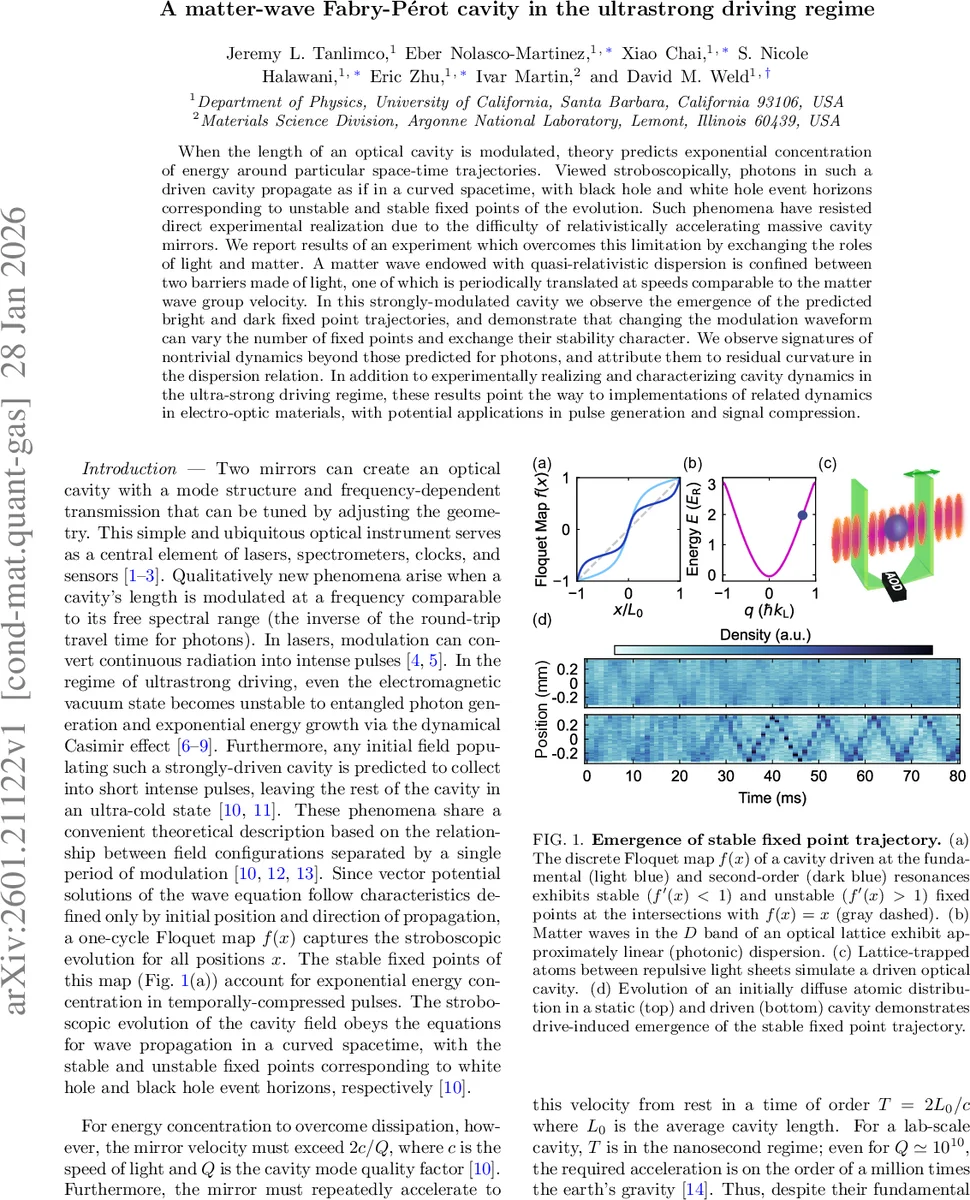
The paper tackles a long‑standing challenge in cavity quantum electrodynamics: achieving the “ultrastrong driving” regime where the cavity length is modulated at a rate comparable to the round‑trip time of light. In a conventional optical cavity this would require relativistic motion of massive mirrors, which is experimentally impossible. The authors circumvent this by swapping the roles of light and matter. They create a matter‑wave cavity using a Bose‑Einstein condensate of ⁷Li atoms loaded into a 532 nm optical lattice. By transferring the atoms to the second excited (D) band of the lattice they engineer a quasi‑relativistic dispersion relation, i.e., a linear relationship between energy and quasimomentum over a sizable range, so that the atoms behave like massless particles with an effective “speed of light” of order 1 m s⁻¹.
Two repulsive light sheets act as mirrors. One mirror is static, the other is driven sinusoidally by an acousto‑optic deflector, moving according to
x₂(t)=x₂,0 + A L₀ cos(Ωt − ϕ).
Here L₀≈680 µm is the average cavity length, Ω is set to the fundamental resonance Ω₀=π v_g/L₀ (v_g being the group velocity of the D‑band atoms), and A is a small fractional amplitude (≈10⁻²). In this configuration the moving mirror can reach speeds comparable to the effective light speed, satisfying the condition for exponential energy concentration without requiring any real relativistic motion of massive objects.
The dynamics are captured by a one‑cycle Floquet map f(x) that transports the field (or matter‑wave packet) from one stroboscopic instant to the next. Fixed points of this map, defined by f(x)=x, are classified by the slope f′(x): f′<1 denotes a stable fixed point (analogous to a white‑hole horizon), while f′>1 denotes an unstable fixed point (black‑hole horizon). Theory predicts that at the fundamental resonance (p=1) a single pair of fixed points appears, and that higher‑order resonances (Ω = p Ω₀) generate p pairs, leading to multiple localized “pulses”.
Experimentally, the authors first demonstrate the fundamental case. Starting from a spatially diffuse atomic cloud, they vary the drive phase ϕ in steps of π/6, effectively sampling a continuum of initial positions. After only a few drive cycles the density collapses onto a single trajectory that coincides with the predicted stable fixed point; simultaneously a depletion zone appears at the unstable point. This convergence is robust across a wide range of initial conditions, confirming the attractor nature of the stable fixed point.
A faint secondary trajectory, not predicted by the ideal photon‑based theory, is also observed. Numerical integration of the time‑dependent Schrödinger equation shows that each collision with the moving mirror blue‑shifts the wave packet to higher quasimomenta. When the packet reaches the edge of the Brillouin zone, Bragg scattering transfers population out of the D band into higher bands whose group velocities are no longer resonant with the drive. This loss mechanism explains the extra, weaker trajectory and highlights the role of residual curvature in the otherwise linear dispersion.
To probe higher‑order resonances, the drive frequency is doubled (Ω≈2 Ω₀) while halving the amplitude to keep the mirror velocity constant. Two stable fixed‑point trajectories emerge, separated by a π phase shift, as seen in the density profiles fitted to a sum of two reflected Gaussians. This confirms the theoretical prediction that p‑fold resonances generate p attractors.
Finally, the authors exploit the flexibility of an all‑optical “mirror” to impose a sudden π phase jump in the drive after four cycles. The Floquet map is thereby inverted: the previously stable point becomes unstable and vice‑versa. An atomic packet initially heading toward the unstable point is reflected back toward the original stable trajectory after the phase jump, demonstrating a stroboscopic time‑reversal of the dynamics. This effect suggests practical schemes for pulse compression, signal decompression, and reversible manipulation of wave packets in engineered spacetime analogues.
In summary, the work provides the first experimental realization of an ultrastrongly driven cavity by using a matter‑wave analogue. It validates the Floquet‑map description, observes both predicted and novel dynamical features, demonstrates higher‑order resonances, and shows controllable time‑reversal via phase jumps. The platform opens new avenues for exploring dynamical Casimir physics, analogue gravity, and ultrafast optical‑signal processing in systems where the “mirrors” are light fields rather than massive mechanical components.
Comments & Academic Discussion
Loading comments...
Leave a Comment