A levitated nano-accelerometer sensitized by quantum quench
We realize a nanoscale accelerometer exploiting the nonequilibrium dynamics of a nanoparticle near the quantum ground state. We explore the dynamics after quenching the trapping potential and find that rapid quenching provides an instance at which the sensitivity is enhanced due to the minimized uncertainty in the position. With rapid quenching, the observed sensitivity is in good agreement with a numerical simulation based on the quantum Langevin equation and approaches to the limit given by the quantum Fisher information. Our results open up a pathway to quantum inertial sensing sensitized by exploiting quench dynamics.
💡 Research Summary
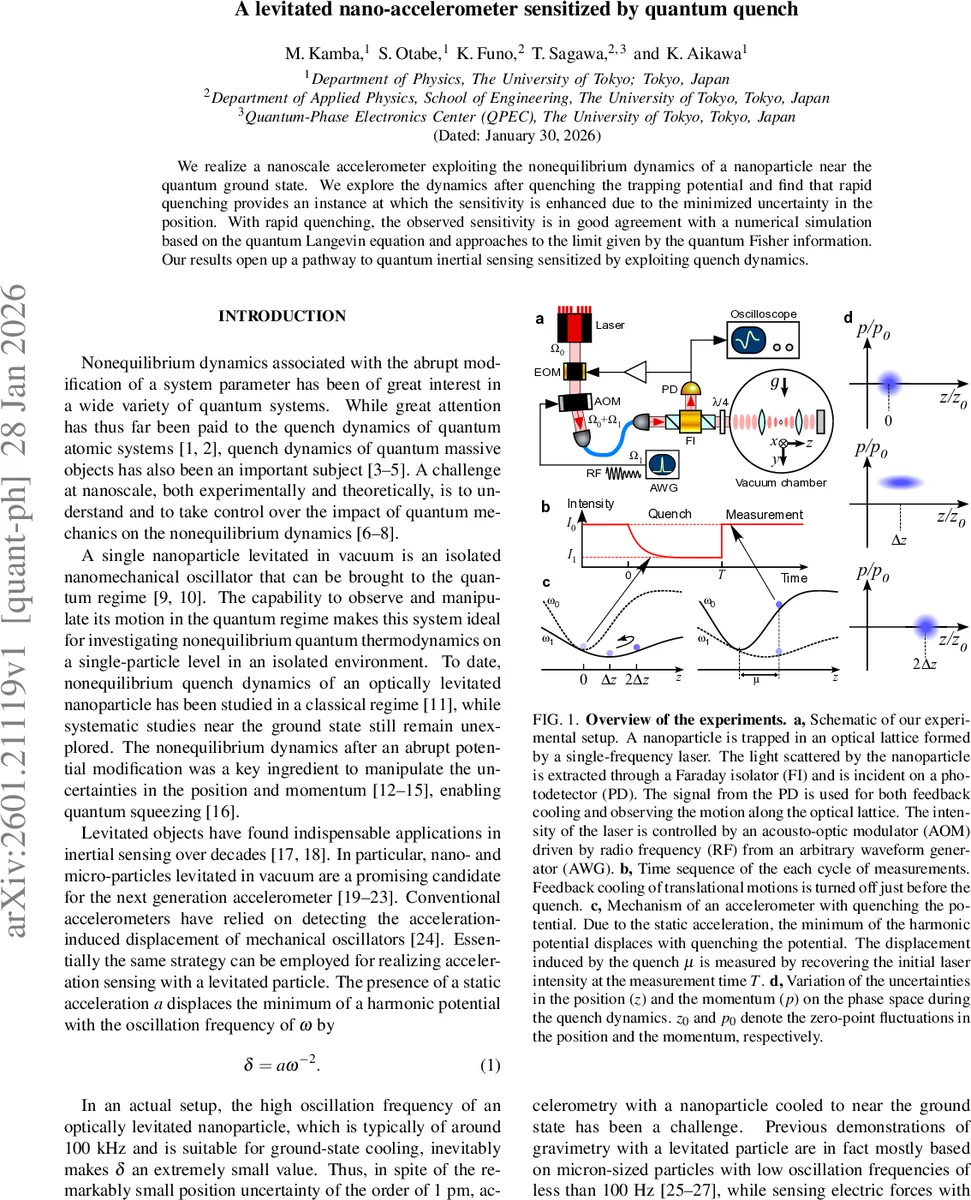
In this work the authors demonstrate a nanoscale accelerometer that exploits the nonequilibrium dynamics of a levitated silica nanoparticle prepared near its quantum ground state. The key idea is to “quench” the optical trapping potential: the trap frequency ω is rapidly reduced from a high value (≈250 kHz) to a much lower one (≈6 kHz) by exponentially lowering the laser intensity with a time constant τ ranging from 1 µs to 50 µs. Because a static acceleration a displaces the minimum of a harmonic potential by Δz = a(ω₀⁻² – ω₁⁻²), the quench instantaneously creates a large relative displacement that would be impossible to resolve in the deep trap. After the quench the particle oscillates in the shallow potential; at a chosen moment the laser intensity is abruptly restored, freezing the particle back into the deep trap where its position can be read out with high precision via scattered light detection.
The experiment records both the mean position µ(t) and its standard deviation σ(t) for many repetitions, allowing the authors to reconstruct the full time‑dependent probability distribution. µ(t) shows coherent oscillations driven by the sudden shift of the potential minimum; the amplitude is slightly modified by an intensity‑dependent phase shift of the optical lattice (up to ~37 pm), which the authors model phenomenologically. σ(t) exhibits two distinct regimes: for fast quenches (τ ≲ 5 µs) the position uncertainty undergoes breathing‑mode oscillations, reaching minima at specific times; for slower quenches σ grows monotonically, reflecting heating from background gas collisions. By fitting the σ dynamics the heating rate is extracted as ≈16 mK s⁻¹, consistent with a residual gas mixture of ~60 % N₂ and 40 % H₂ at 3 × 10⁻⁶ Pa. Photon‑recoil heating is negligible.
Sensitivity is defined as S = (dµ/da)/σ, i.e., the ratio of the acceleration‑induced signal to the measurement noise for a single shot. For each τ the authors determine an optimal measurement time T_opt that maximizes S. The best performance is achieved for the shortest quench (τ ≈ 2 µs) with T_opt ≈ 90 µs, yielding S ≈ 9.9 × 10⁻⁹ s² m⁻¹. This value is within 10 % of the quantum Fisher information (QFI) bound calculated for an ideal sudden quench followed by unitary evolution, indicating that the experiment operates close to the fundamental quantum limit. The remaining gap is fully accounted for by the measured heating rate, confirming that environmental gas collisions are the dominant limitation, while dephasing, technical noise, and other decoherence mechanisms are negligible.
Numerical simulations based on the quantum Langevin equation, incorporating the extracted heating rate, reproduce the observed µ(t) and σ(t) for fast quenches with excellent agreement, validating the theoretical model. For slower quenches the simulations predict higher sensitivity than observed, underscoring the detrimental effect of prolonged exposure to the heated environment.
The study thus establishes that nonequilibrium quench dynamics can be harnessed to enhance inertial sensing beyond the static‑trap limit. By timing the readout to coincide with a minimum of σ, the particle’s position uncertainty is temporarily suppressed, while the displacement induced by the acceleration is amplified by the change in trap stiffness. This “time‑optimized” measurement strategy yields a sensitivity that surpasses what would be achievable with an adiabatic (slow) change of the trap, despite the latter offering higher fidelity in the absence of heating.
Overall, the paper provides a clear pathway toward quantum‑limited accelerometry: (i) prepare a levitated nanoparticle near the ground state, (ii) perform a rapid quench of the trap frequency, (iii) wait for the optimal moment when σ is minimized, (iv) restore the deep trap and read out the position. Future improvements could focus on reducing background pressure to suppress heating, exploring repeated‑quench protocols for continuous monitoring, and extending the technique to multi‑axis sensing or gravimetry. The work opens a promising route for quantum inertial sensors with unprecedented precision at the nanoscale.
Comments & Academic Discussion
Loading comments...
Leave a Comment