Field-Induced Ferroelectric Phase Transition Dynamics in PMN-PT compositions near the Morphotropic Phase Boundary
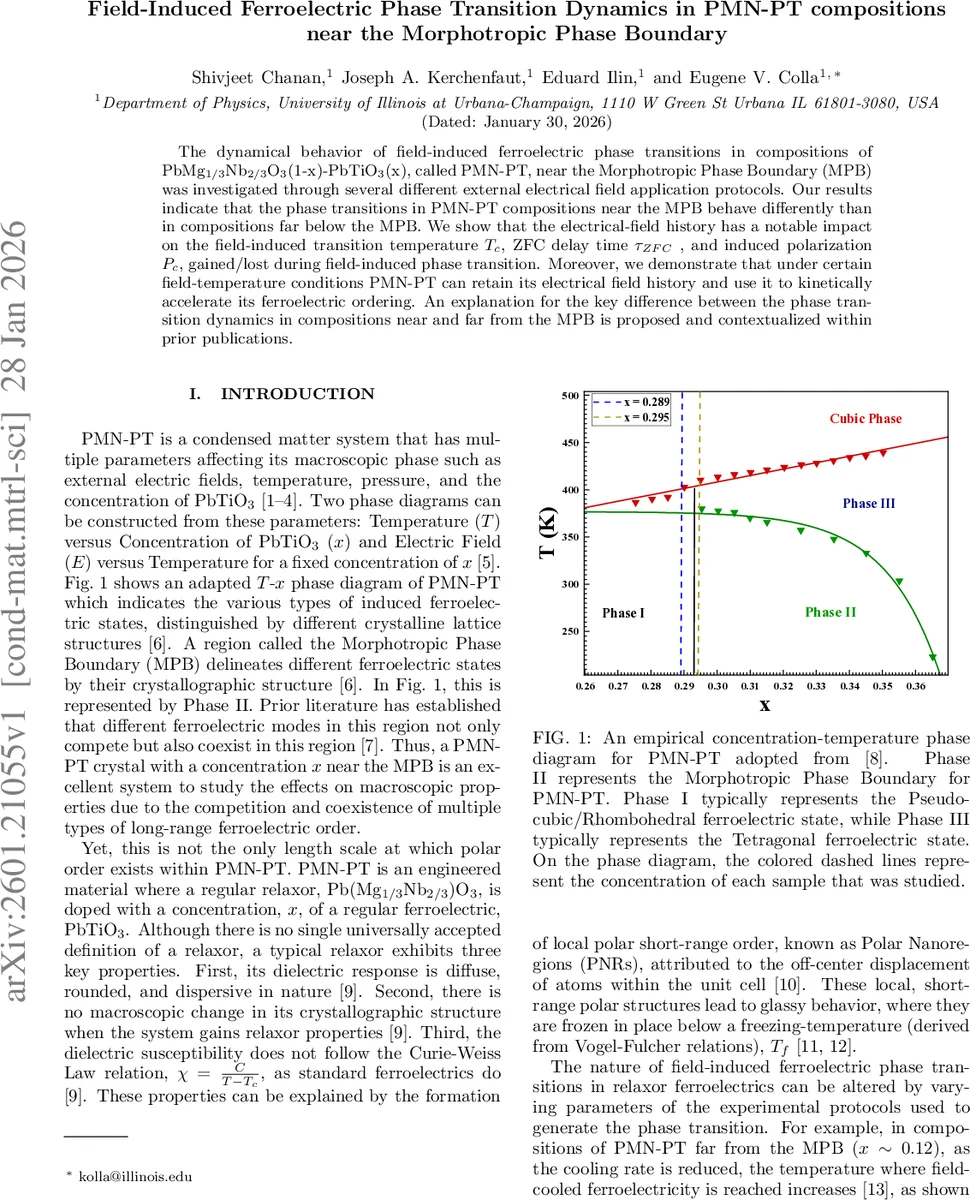
The dynamical behavior of field-induced ferroelectric phase transitions in compositions of PbMg_{1/3}Nb_{2/3}O3(1-x)-PbTiO3(x), called PMN-PT, near the Morphotropic Phase Boundary (MPB) was investigated through several different external electrical field application protocols. Our results indicate that the phase transitions in PMN-PT compositions near the MPB behave differently than in compositions far below the MPB. We show that the electrical-field history has a notable impact on the field-induced transition temperature T_c, ZFC delay time tau_{ZFC}, and induced polarization P_c, gained/lost during field-induced phase transition. Moreover, we demonstrate that under certain field-temperature conditions PMN-PT can retain its electrical field history and use it to kinetically accelerate its ferroelectric ordering. An explanation for the key difference between the phase transition dynamics in compositions near and far from the MPB is proposed and contextualized within prior publications.
💡 Research Summary
This paper investigates the dynamics of electric‑field‑induced ferroelectric phase transitions in Pb(Mg₁/₃Nb₂/₃)O₃‑(1‑x)PbTiO₃ (PMN‑PT) compositions that lie near the Morphotropic Phase Boundary (MPB). Two single‑crystal samples with Ti concentrations x ≈ 0.289 and 0.295 were prepared as parallel‑plate capacitors (Ag/Cr electrodes) and measured in a sealed cryostat. The authors applied a low‑amplitude AC probing field (E_AC = 0.002 kV cm⁻¹) together with a DC bias (E_DC up to 0.4 kV cm⁻¹) while recording dielectric susceptibility, polarization current, and integrated polarization.
Three experimental protocols were employed. (1) Field‑cooling/field‑heating (FC‑FH) cycles at two cooling rates (0.5 K min⁻¹ and 4 K min⁻¹) were used to construct E‑T phase diagrams. For the MPB‑proximate composition, the slower cooling shifted the transition temperature (T_c) to lower values, opposite to the behavior reported for low‑Ti PMN‑PT (x ≈ 0.12) where slower cooling raises T_c. This reversal indicates that the time spent in the relaxor (non‑ferroelectric) state strongly influences the nucleation of long‑range ferroelectric order when the system is near the MPB, where competing tetragonal, rhombohedral, and orthorhombic phases coexist.
(2) An intermediate isothermal “field‑aging” step (FA) was inserted between FC and FH. The FA temperature (T_FA) and dwell time (t_FA) were varied (0–2 h). When T_FA lay between the two melting lines identified in the FC‑FH diagram, T_c decreased markedly with increasing t_FA. The authors interpret this as the formation of a glassy polar nanoregion (PNR) network during the FA step, which raises the kinetic barrier for the subsequent field‑induced transition, thereby damping the dynamics. The magnitude of the T_c shift correlates with both the aging temperature (which controls how quickly the glassy order forms) and the aging duration (which controls its rigidity).
(3) Zero‑field‑cooling (ZFC) experiments probed the delay time τ_ZFC required for the field‑induced transition after the sample was cooled in zero field to a temperature below the freezing line and then a DC field was applied. τ_ZFC depends sensitively on the measurement temperature and field strength, but more importantly, prior FC‑FA history dramatically shortens τ_ZFC, revealing a memory effect. The authors attribute this to residual polarization (P_c) retained after the FA step acting as a nucleation seed for the ferroelectric phase when the field is reapplied.
Additional measurements examined how the induced polarization P_c varies with the “return temperature” (T_ret) – the maximum temperature reached before a new FC‑FH cycle. Lowering T_ret below ~440 K reduces P_c and simultaneously raises T_c, indicating that a fraction of the saturated polarization can be retained even after heating to near the melting lines. This retained order appears to accelerate subsequent field‑induced transitions, providing a kinetic shortcut.
To rationalize the contrasting behavior of MPB‑proximate versus MPB‑distant compositions, the authors propose a free‑energy landscape model. Near the MPB the landscape is shallow with multiple minima corresponding to competing ferroelectric symmetries; external electric fields and thermal histories can reshape the barriers, making the transition highly history‑dependent. Far from the MPB the landscape is dominated by a single deep minimum, so the transition is less sensitive to cooling rate or field history. The interplay between PNR glassiness, residual polarization, and competing structural phases explains the observed kinetic damping, memory, and acceleration phenomena.
The study highlights practical implications: by tailoring field‑temperature cycling, one can program the transition temperature, delay time, and final polarization state of PMN‑PT near the MPB. Such control is valuable for high‑performance piezoelectric actuators, non‑volatile ferroelectric memory, and field‑driven switches, where rapid, reproducible switching and the ability to “store” field history could be exploited. The paper thus provides a comprehensive experimental foundation and a conceptual framework for engineering the dynamic response of relaxor‑ferroelectric systems near morphotropic phase boundaries.
Comments & Academic Discussion
Loading comments...
Leave a Comment