Pre-trained Encoders for Global Child Development: Transfer Learning Enables Deployment in Data-Scarce Settings
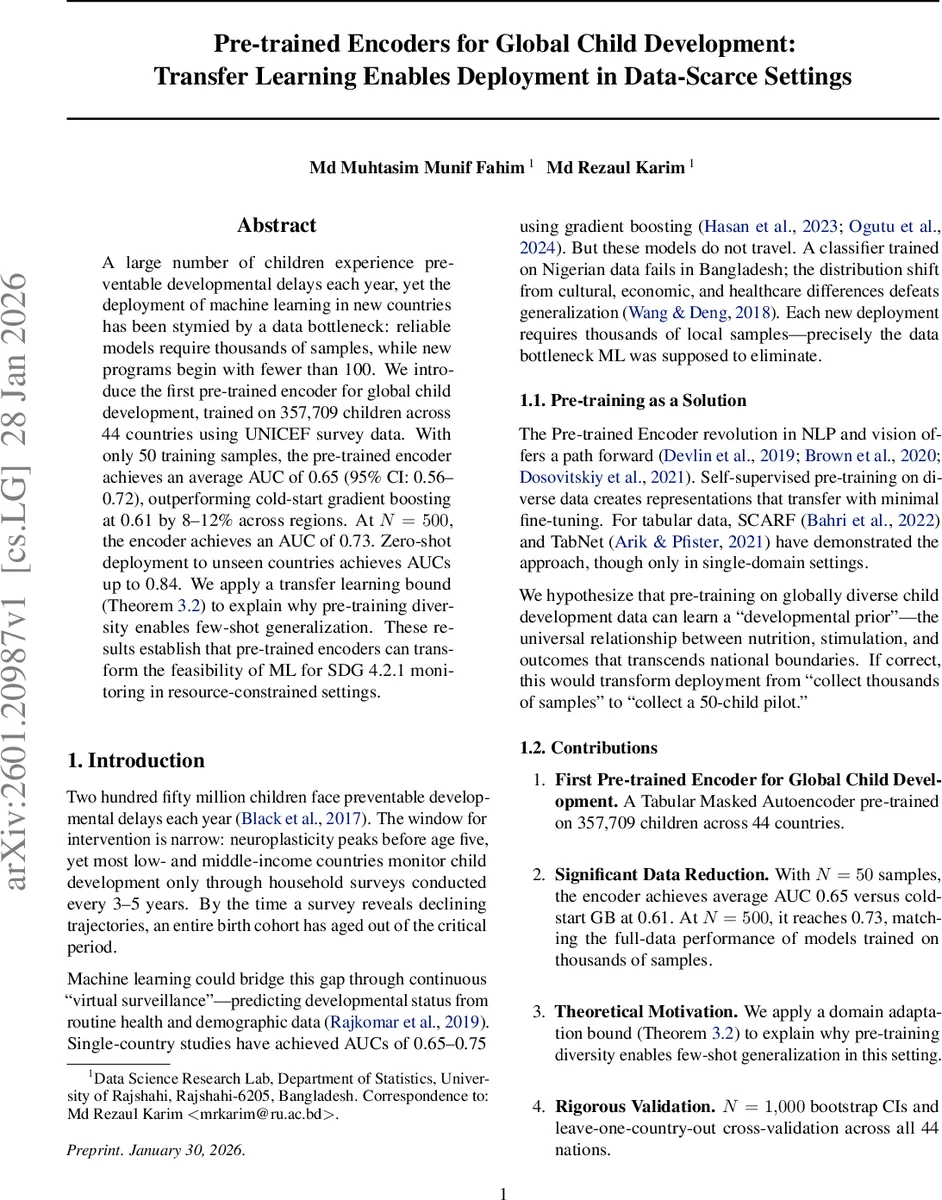
A large number of children experience preventable developmental delays each year, yet the deployment of machine learning in new countries has been stymied by a data bottleneck: reliable models require thousands of samples, while new programs begin with fewer than 100. We introduce the first pre-trained encoder for global child development, trained on 357,709 children across 44 countries using UNICEF survey data. With only 50 training samples, the pre-trained encoder achieves an average AUC of 0.65 (95% CI: 0.56-0.72), outperforming cold-start gradient boosting at 0.61 by 8-12% across regions. At N=500, the encoder achieves an AUC of 0.73. Zero-shot deployment to unseen countries achieves AUCs up to 0.84. We apply a transfer learning bound to explain why pre-training diversity enables few-shot generalization. These results establish that pre-trained encoders can transform the feasibility of ML for SDG 4.2.1 monitoring in resource-constrained settings.
💡 Research Summary
The paper tackles a critical bottleneck in global child‑development monitoring: the scarcity of locally collected data for training reliable machine‑learning models. While many low‑ and middle‑income countries (LMICs) can only gather a few dozen to a hundred observations when a new surveillance program is launched, state‑of‑the‑art classifiers such as gradient‑boosted trees typically require thousands of labeled examples to achieve acceptable performance. To address this, the authors develop the first pre‑trained encoder for global child development, leveraging the UNICEF Multiple Indicator Cluster Surveys (MICS) Round 6, which span 44 countries and contain data on 357,709 children aged 24–59 months.
Data and preprocessing
From an initial pool of 51 candidate country datasets, seven were excluded due to implausible Early Childhood Development Index (ECDI) prevalence, insufficient sample size, or inconsistent coding. The final analytic sample includes 11 features that map onto the WHO Nurturing Care Framework: child age and sex, household wealth, maternal education, urban/rural residence, three nutrition indicators (stunting, underweight, recent diarrhea), fever, and two stimulation variables (books, outings). Continuous variables are standardized, missing values (< 1 %) are imputed with medians, and the binary target is “ECDI on‑track” (meeting age‑appropriate milestones in at least three of four domains).
Model architecture
The authors adopt a Tabular Masked Autoencoder (TMAE) for self‑supervised pre‑training. For each record, 70 % of the features are randomly replaced by a learnable mask token, forcing the network to infer complex inter‑feature relationships. The encoder is a two‑layer MLP (256 → 64 hidden units) that produces a 64‑dimensional latent representation; a symmetric decoder (64 → 256) reconstructs the masked values, minimizing mean‑squared error. Pre‑training runs for 100 epochs on the full 357 k records using Adam (lr = 0.001) and a batch size of 512.
For downstream fine‑tuning, the pre‑trained encoder’s weights initialize a classification head consisting of another two‑layer MLP (256 → 64) followed by a sigmoid output neuron. All layers are updated jointly with Adam (lr = 0.00115, L2 = 0.00143) and early stopping (patience = 10). Hyper‑parameter search (300 trials) optimizes a fairness‑aware objective: mean AUC + 2 × minimum country‑wise AUC, encouraging both overall performance and cross‑country equity. Five models trained with different random seeds are ensembled by averaging predictions, reducing variance and improving calibration.
Theoretical justification
The paper formalizes why pre‑training on a diverse set of source domains (the 43 countries used during pre‑training) enables few‑shot transfer to a new target country. Under a bounded H‑Δ H divergence assumption (δ ≈ small), Theorem 3.2 (a domain‑adaptation bound) shows that target risk R_T is bounded by source risk R_S plus δ and the optimal joint error λ*. Because the encoder is trained on many countries, R_S is driven down, and the biological commonality of child development keeps δ low. Proposition 3.3 further argues that freezing the encoder reduces the hypothesis space from the original feature dimension d = 11 to the latent dimension k = 64, yielding a sample‑complexity reduction from O(d/ε²) to O(k/ε²). This explains the empirical observation that only a few dozen local samples are needed for competitive performance.
Evaluation protocol
Three complementary validation strategies are employed:
- Bootstrap confidence intervals (1 000 resamples, stratified by country) to quantify uncertainty in AUC estimates.
- Leave‑One‑Country‑Out (LOCO) cross‑validation, where each of the 44 countries is held out as a test set while the model is trained on the remaining 43, simulating a true zero‑shot deployment.
- Regional few‑shot adaptation, where an entire geographic region (e.g., Sub‑Saharan Africa) is excluded from pre‑training, then the model is fine‑tuned on N ∈ {50, 100, 200, 500, 1 000, 2 000, 5 000} samples from a single country in that region and evaluated on the other countries of the same region.
Baselines include LightGBM (gradient boosting), a randomly‑initialized MLP of comparable capacity, and three recent tabular deep‑learning models: FT‑Transformer, SCARF (contrastive pre‑training), and TabNet. Logistic regression serves as a transparent benchmark.
Results
- Full‑data scenario: LightGBM attains the highest AUC (0.814). The pre‑trained encoder reaches 0.799, essentially matching the tree‑based model while offering transferability.
- Few‑shot (N = 50): The encoder achieves an average AUC of 0.652 ± 0.057 across regions, outperforming cold‑start gradient boosting (0.608 ± 0.059) by 8–12 % absolute. Region‑specific gains are +8 % (Latin America), +12 % (Southeast Asia), and +10 % (Sub‑Saharan Africa).
- Scaling with data: At N = 500, the encoder’s AUC rises to 0.734, still modestly ahead of gradient boosting (0.719). The performance gap narrows as more local data become available, confirming that the encoder primarily benefits data‑scarce regimes.
- Zero‑shot LOCO: When a country is completely unseen during pre‑training, the encoder still delivers strong AUCs: 0.844 (Sierra Leone), 0.834 (Trinidad & Tobago), 0.745 (Kazakhstan), and 0.625 (Pakistan).
- Small‑island case study: For Tuvalu (population ≈ 500), the locally fine‑tuned GB model with 50 samples yields AUC = 0.58 ± 0.07, whereas the zero‑shot encoder reaches 0.68 ± 0.01 (+17 %). Similar modest gains are observed for Turks & Caicos.
Statistical testing (paired t‑tests on bootstrap resamples) confirms that the observed improvements are significant (p < 0.001).
Discussion and limitations
The study demonstrates that a globally diverse pre‑training corpus can learn a “developmental prior” that transfers across cultural, economic, and health system boundaries. However, several constraints remain: (1) the feature set is limited to 11 variables, potentially omitting locally salient predictors; (2) the masked autoencoder is inherently a black‑box, limiting interpretability for policymakers; (3) the H‑Δ H divergence assumption may break down for countries with markedly different survey instruments or extreme socioeconomic contexts; (4) the pre‑training phase requires substantial compute (TPU clusters), which may be inaccessible to many research groups in LMICs.
Future work should explore (a) multimodal pre‑training that incorporates image or audio data (e.g., child growth photographs), (b) adversarial domain‑alignment techniques to further shrink δ, (c) post‑hoc explainability methods (SHAP, LIME) to surface feature importance, and (d) model compression (quantization, knowledge distillation) for deployment on low‑resource hardware.
Conclusion
By pre‑training a tabular masked autoencoder on a massive, geographically diverse child‑development dataset, the authors show that reliable predictive models can be built with as few as 50 locally collected samples, and even without any local data in zero‑shot scenarios. The theoretical analysis links diversity‑driven reduction in domain divergence to empirical gains, while extensive empirical validation (bootstrap, LOCO, regional few‑shot) confirms robustness across continents and population sizes. This work provides a concrete pathway for scaling SDG 4.2.1 monitoring in data‑scarce settings, turning the promise of AI‑assisted “virtual surveillance” into a practical reality for global health stakeholders.
Comments & Academic Discussion
Loading comments...
Leave a Comment