Topological Acoustic Diode
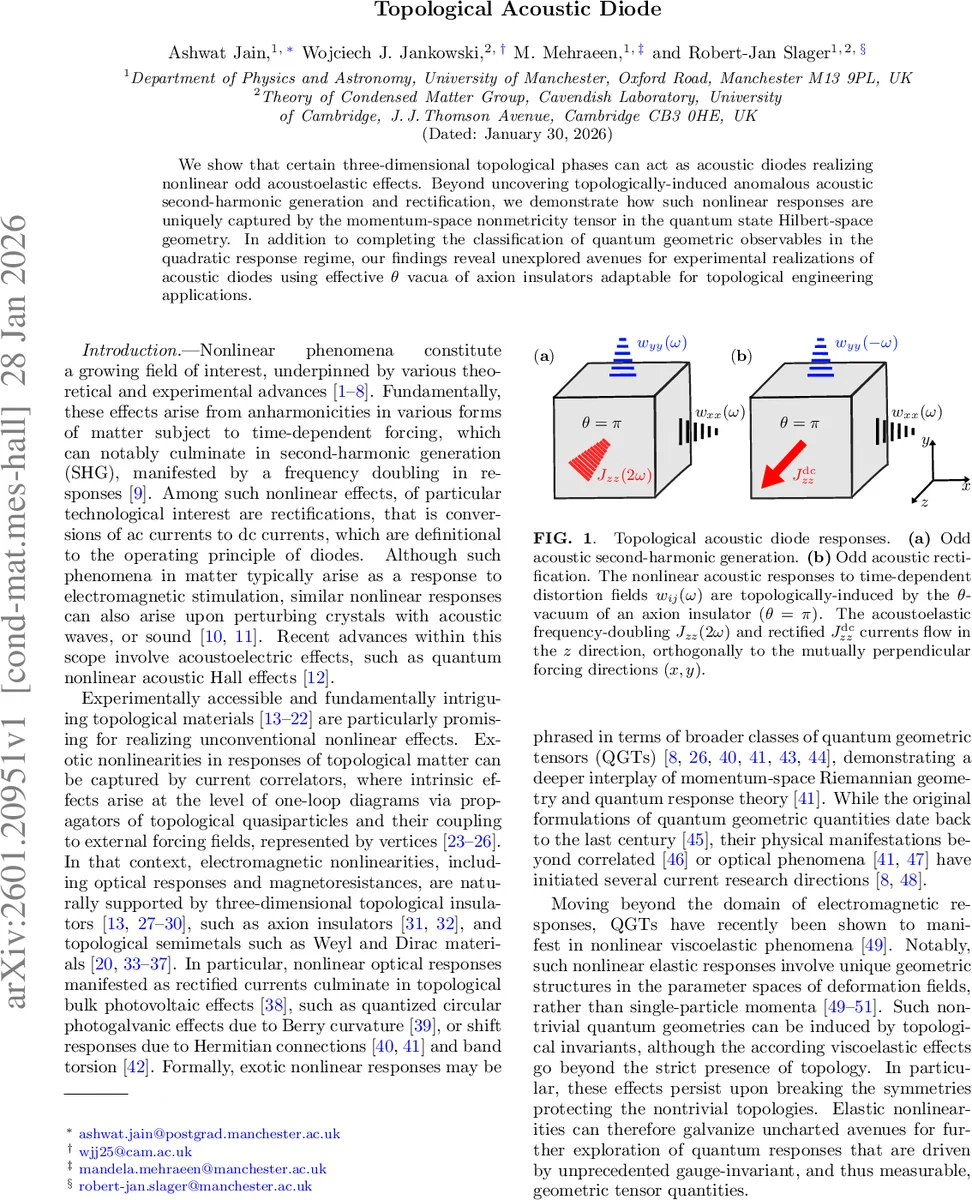
We show that certain three-dimensional topological phases can act as acoustic diodes realizing nonlinear odd acoustoelastic effects. Beyond uncovering topologically-induced anomalous acoustic second-harmonic generation and rectification, we demonstrate how such nonlinear responses are uniquely captured by the momentum-space nonmetricity tensor in the quantum state Hilbert-space geometry. In addition to completing the classification of quantum geometric observables in the quadratic response regime, our findings reveal unexplored avenues for experimental realizations of acoustic diodes using effective $θ$ vacua of axion insulators adaptable for topological engineering applications.
💡 Research Summary
This paper theoretically demonstrates that three-dimensional topological phases, specifically axion insulators, can function as “topological acoustic diodes” by exhibiting nonlinear odd acoustoelastic effects. The core discovery is the prediction of two distinct phenomena in response to time-dependent acoustic deformation fields (sound waves): anomalous acoustic second-harmonic generation (SHG) and acoustic rectification, which are fundamental to diode operation (converting AC to DC).
The authors show that these nonlinear responses are not arbitrary but are fundamentally governed by the quantum geometry of the electron states in the material. They derive comprehensive formulas for the nonlinear response functions, decomposing them into contributions from gauge-invariant quantum geometric tensors. A key theoretical breakthrough is identifying the dominant role of the quantum nonmetricity tensor in the acoustic SHG response. Nonmetricity measures the incompatibility between the Hilbert-space connection and the quantum metric, essentially quantifying how “distances” between quantum states change along momentum-space paths. This finding completes the classification of quantum geometric observables in the second-order response regime, adding nonmetricity to the known roles of Berry curvature, quantum metric, and torsion.
Using a realistic model for an axion insulator (a topological insulator with broken time-reversal symmetry), the study provides numerical evidence for these effects. The calculations reveal that the odd SHG response is primarily a two-band effect dominated by nonmetricity, with Berry curvature playing a negligible role in the considered setup. The rectification response, in contrast, occurs only above the band gap due to resonant conditions. The work also analyzes the tensor symmetries, finding that the rectification response offers up to four independently tunable components, compared to two for SHG, providing a rich parameter space for device engineering.
Beyond fundamental theory, the paper discusses experimental prospects. It suggests that recently identified axion insulator candidates, such as manganese-doped topological insulators (e.g., MnBi₂Te₅), are promising platforms for observing these effects. Potential applications are envisioned in ultrasound focusing, ultrasonography, acoustic switching and logic devices, high-performance sensors, and noise control. By linking the abstract quantum geometry of topological matter to a tangible acoustic functionality, this research opens a new avenue for exploiting topological materials in wave-based electronics and engineering.
Comments & Academic Discussion
Loading comments...
Leave a Comment