Self-dual Higgs transitions: Toric code and beyond
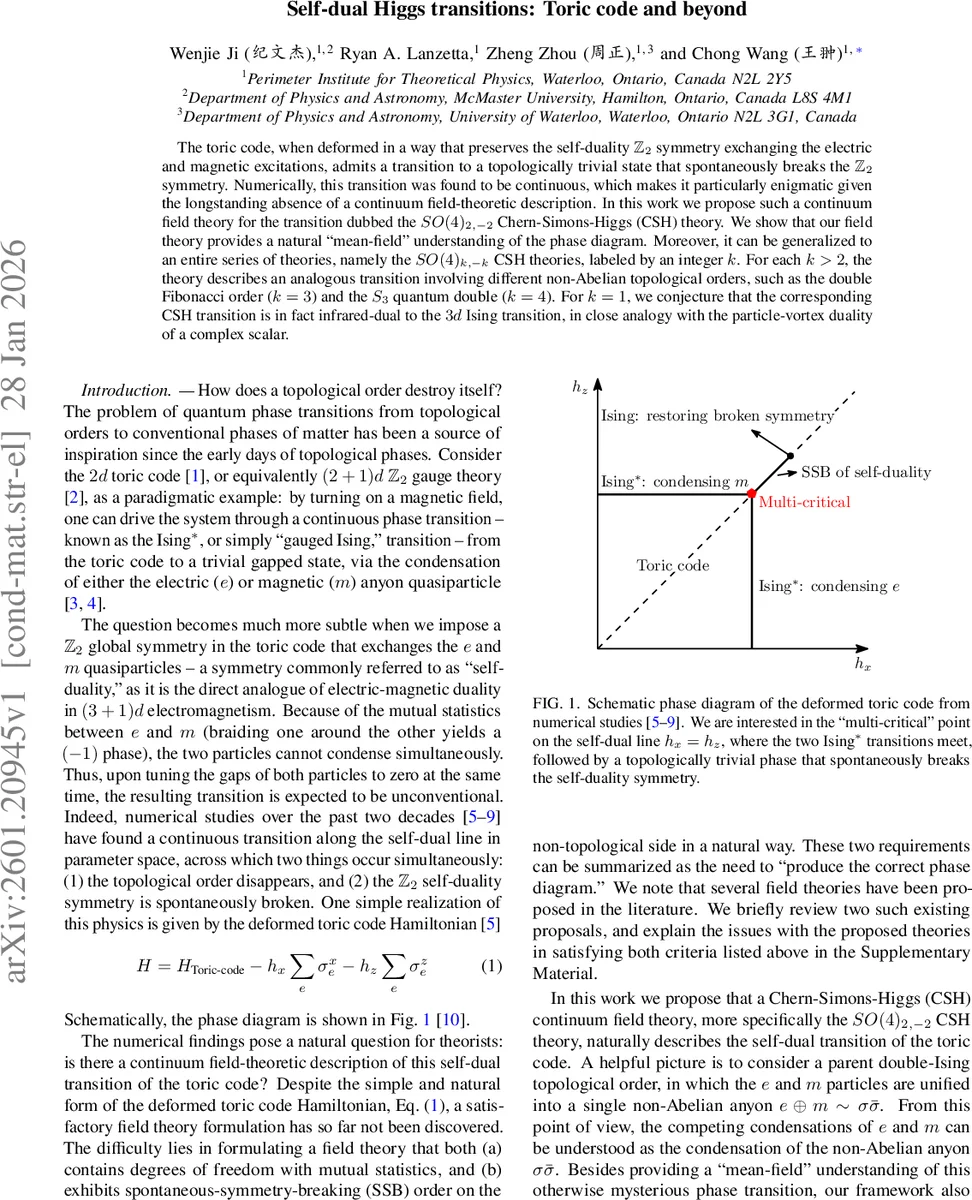
The toric code, when deformed in a way that preserves the self-duality $\mathbb{Z}2$ symmetry exchanging the electric and magnetic excitations, admits a transition to a topologically trivial state that spontaneously breaks the $\mathbb{Z}2$ symmetry. Numerically, this transition was found to be continuous, which makes it particularly enigmatic given the longstanding absence of a continuum field-theoretic description. In this work we propose such a continuum field theory for the transition dubbed the $SO(4){2,-2}$ Chern-Simons-Higgs (CSH) theory. We show that our field theory provides a natural “mean-field” understanding of the phase diagram. Moreover, it can be generalized to an entire series of theories, namely the $SO(4){k,-k}$ CSH theories, labeled by an integer $k$. For each $k>2$, the theory describes an analogous transition involving different non-Abelian topological orders, such as the double Fibonacci order ($k=3$) and the $S_3$ quantum double ($k=4$). For $k=1$, we conjecture that the corresponding CSH transition is in fact infrared-dual to the $3d$ Ising transition, in close analogy with the particle-vortex duality of a complex scalar.
💡 Research Summary
The paper addresses a long‑standing puzzle in (2+1)‑dimensional quantum many‑body physics: how a topologically ordered phase, specifically the toric‑code Z₂ gauge theory, can undergo a continuous transition to a trivial, symmetry‑broken phase while preserving a global Z₂ self‑duality that exchanges electric (e) and magnetic (m) excitations. Numerical studies of a deformed toric‑code Hamiltonian with equal electric and magnetic fields (the self‑dual line) have shown a continuous transition in which the topological order disappears and the Z₂ self‑duality is spontaneously broken. However, a continuum field‑theoretic description of this “self‑dual Higgs” transition has been missing.
The authors propose that the transition is described by a (2+1)‑dimensional Chern‑Simons‑Higgs (CSH) theory with gauge group SO(4) at levels (2, −2). The Lagrangian is
S = ∫ d³x
Comments & Academic Discussion
Loading comments...
Leave a Comment