Chiral interactions and superfluidity in the calcium isotopic chain
We perform ab initio calculations of three-point mass differences in the odd- and even-mass $^{39-49}$Ca isotopes to probe nuclear superfluidity via empirical neutron pairing gaps. We also quantify the sensitivity of those gaps to the parameters of the interaction at mean-field level. Recent studies employing accurate chiral nuclear interactions have found these gaps to be too small. We show that experimental values can be reproduced at mean-field level by substantially increasing the attraction of the singlet $S$-wave two-nucleon contact interaction, but doing so induces an unphysical bound state of the di-neutron. The sensitivity of these predictions to the full calibration of the nuclear interaction is then studied by performing Bayesian posterior sampling in a delta-full chiral effective field theory at third chiral order. We find that pairing gaps remain largely unaffected, leaving the explanation of nuclear superfluidity as a future task for improved many-body modeling and refined interactions at higher chiral orders.
💡 Research Summary
In this work the authors investigate nuclear superfluidity in the calcium isotopic chain (⁴⁰Ca–⁴⁹Ca) by computing three‑point mass differences Δ(3), a standard empirical proxy for the neutron pairing gap, using ab initio methods. The calculations are performed at the mean‑field level with spherical Hartree‑Fock‑Bogoliubov (sHFB) theory, including three‑nucleon forces, and the results are compared to experimental data and to other many‑body approaches (deformed Hartree‑Fock and deformed coupled‑cluster with singles and doubles).
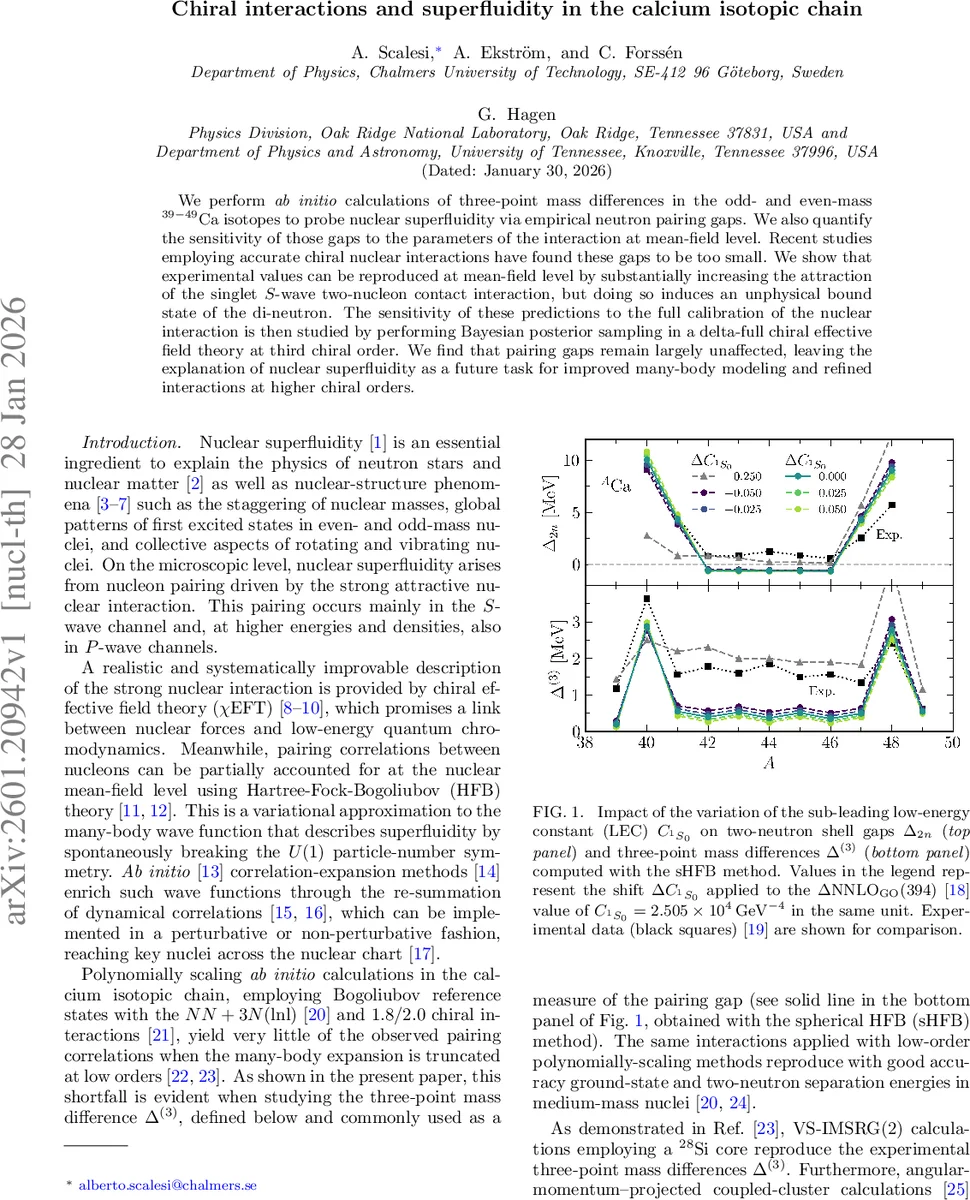
A key focus is the sensitivity of the pairing gap to the low‑energy constant (LEC) C₁ˢ⁰, which governs the short‑range part of the ¹S₀ nucleon‑nucleon contact interaction. By varying C₁ˢ⁰ while keeping all other LECs fixed, the authors find that a roughly 10 % increase in the attraction (i.e., a 10 % reduction of the positive C₁ˢ⁰ value) brings the calculated Δ(3) into close agreement with experiment across the chain up to ⁴³Ca. However, this adjustment also generates an unphysical bound di‑neutron state with a binding energy of about 66 keV, indicating that simply strengthening the singlet‑S contact term is not a physically acceptable solution.
To assess whether the observed discrepancy is merely a consequence of the particular choice of C₁ˢ⁰ or reflects a more general uncertainty in the chiral interaction, the authors perform a Bayesian analysis of a Δ‑full chiral effective‑field‑theory (χEFT) interaction at next‑to‑next‑to‑leading order (NNLO). They start from a large prior ensemble of 8 192 interaction samples that reproduce NN and πN scattering, deuteron properties, and few‑body observables. From this set they retain 164 samples with the highest likelihood after fitting binding energies and charge radii of ³H, ⁴He, and ¹⁶O, as well as the quadrupole moment of the deuteron. For each of these 164 samples they compute Δ₂ₙ (the two‑neutron shell gap) and Δ(3) with sHFB.
Using the experimental Δ₂ₙ values for ⁴⁰Ca and ⁴⁸Ca as calibration data, a normal likelihood with 1 MeV method error and 0.5 MeV EFT‑truncation error is assigned to each model prediction. Importance‑resampling yields posterior weights, and the posterior predictive distribution (PPD) for Δ₂ₙ and Δ(3) across the whole calcium chain is constructed via kernel‑density smoothing. The resulting PPDs show only modest spread around the original ΔNNLO‑GO(394) interaction predictions; the mean and 68 % credible intervals for both observables remain essentially unchanged. This indicates that the full set of LEC uncertainties in the Δ‑full NNLO interaction has a limited impact on the pairing gap at the mean‑field level.
The authors also compare sHFB results with deformed Hartree‑Fock (dHF) and deformed coupled‑cluster (dCCSD) calculations. Differences among these methods are negligible compared with the systematic discrepancy between theory and experiment, reinforcing the conclusion that missing many‑body correlations—not the interaction parameters—are the dominant source of the under‑prediction of pairing gaps in current ab initio calculations.
In summary, the study demonstrates: (i) the singlet‑S contact LEC C₁ˢ⁰ strongly influences the mean‑field pairing gap, but adjusting it to match data creates an unphysical di‑neutron bound state; (ii) when the full set of LECs is varied within a Bayesian framework, the predicted Δ(3) and Δ₂ₙ are remarkably stable, showing that parametric uncertainties of the Δ‑full NNLO interaction do not resolve the pairing‑gap deficit; (iii) therefore, an accurate description of nuclear superfluidity in medium‑mass nuclei like calcium will require (a) beyond‑mean‑field treatments that capture collective pairing fluctuations (e.g., QRPA, GCM, particle‑number projection) and (b) higher‑order chiral interactions (N³LO, N⁴LO) with improved calibration. The paper points toward these future directions as essential for reconciling theory with the experimentally observed neutron pairing gaps, which are crucial for understanding phenomena ranging from nuclear deformation to the equation of state of neutron‑rich matter in astrophysical contexts.
Comments & Academic Discussion
Loading comments...
Leave a Comment