When does a lattice higher-form symmetry flow to a topological higher-form symmetry at low energies?
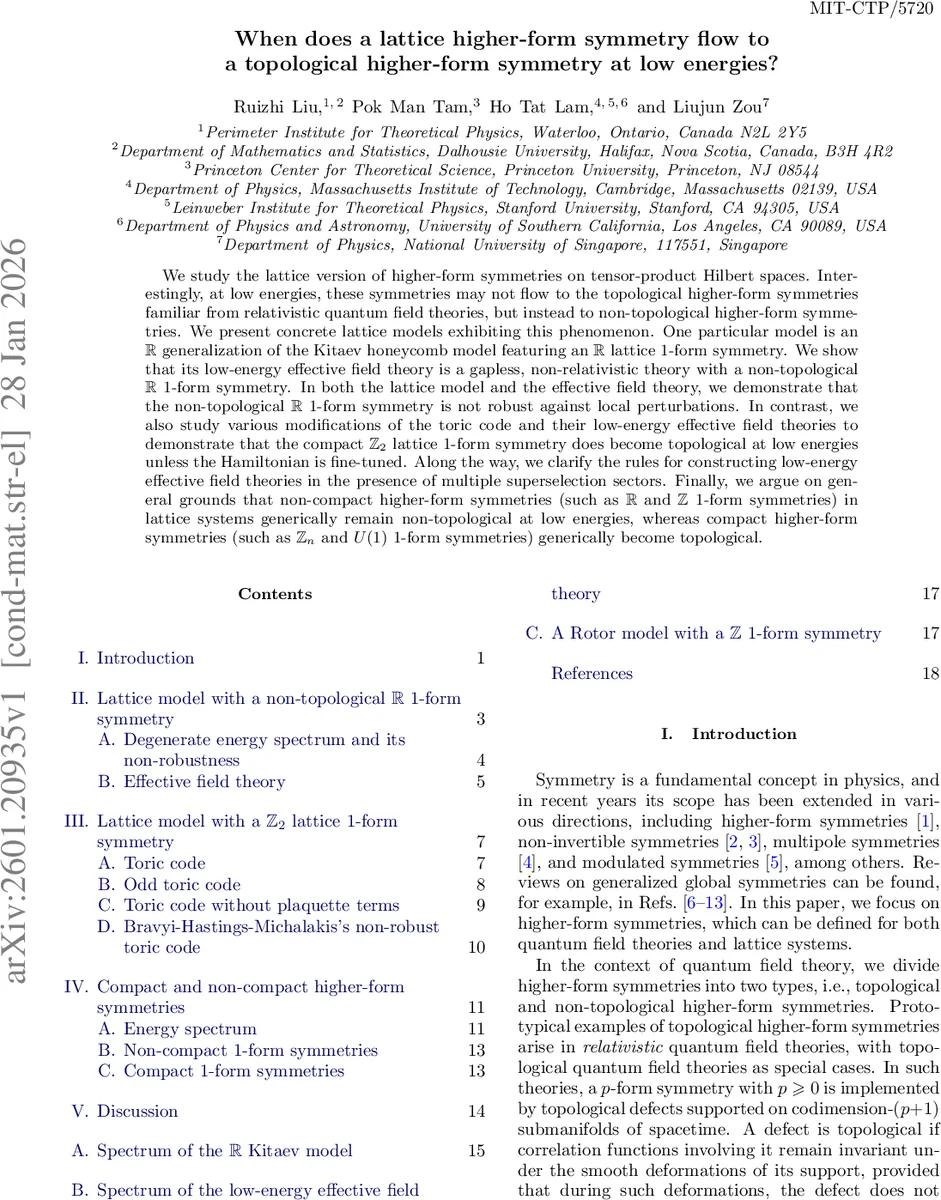
We study the lattice version of higher-form symmetries on tensor-product Hilbert spaces. Interestingly, at low energies, these symmetries may not flow to the topological higher-form symmetries familiar from relativistic quantum field theories, but instead to non-topological higher-form symmetries. We present concrete lattice models exhibiting this phenomenon. One particular model is an $\mathbb{R}$ generalization of the Kitaev honeycomb model featuring an $\mathbb{R}$ lattice 1-form symmetry. We show that its low-energy effective field theory is a gapless, non-relativistic theory with a non-topological $\mathbb{R}$ 1-form symmetry. In both the lattice model and the effective field theory, we demonstrate that the non-topological $\mathbb{R}$ 1-form symmetry is not robust against local perturbations. In contrast, we also study various modifications of the toric code and their low-energy effective field theories to demonstrate that the compact $\mathbb{Z}2$ lattice 1-form symmetry does become topological at low energies unless the Hamiltonian is fine-tuned. Along the way, we clarify the rules for constructing low-energy effective field theories in the presence of multiple superselection sectors. Finally, we argue on general grounds that non-compact higher-form symmetries (such as $\mathbb{R}$ and $\mathbb{Z}$ 1-form symmetries) in lattice systems generically remain non-topological at low energies, whereas compact higher-form symmetries (such as $\mathbb{Z}{n}$ and $U(1)$ 1-form symmetries) generically become topological.
💡 Research Summary
The paper investigates when lattice higher‑form symmetries flow to topological higher‑form symmetries in the low‑energy effective field theory (EFT). The authors focus on 1‑form symmetries in two‑dimensional lattice systems whose Hilbert space factorizes as a tensor product of local degrees of freedom. They first formalize a lattice 1‑form symmetry by three conditions: (i) symmetry operators are supported on closed loops, (ii) operators on contractible loops commute (ensuring abelianity), and (iii) operators on different loops can be related by multiplication with operators on contractible loops. These conditions allow the symmetry to be non‑topological, i.e., the operator may depend on the precise shape of the loop and can act on local operators.
ℝ‑Kitaev model (non‑compact case).
The authors construct an ℝ‑generalization of Kitaev’s honeycomb model. Each site hosts a harmonic‑oscillator degree of freedom (position x_i and momentum p_i). For every elementary hexagon l they define a conserved charge
(Q_l = \alpha(p_1-p_2+p_4-p_5)+\beta(x_1-x_3+x_4-x_6)).
These charges commute, and sums of adjacent Q_l’s cancel interior contributions, leaving only a boundary term; thus they generate an ℝ‑valued 1‑form symmetry. On a torus there are two non‑contractible loop operators Q_η and Q_γ with the commutator (
Comments & Academic Discussion
Loading comments...
Leave a Comment