Double-Bracket Master Equations: Phase-Space Representation and Classical Limit
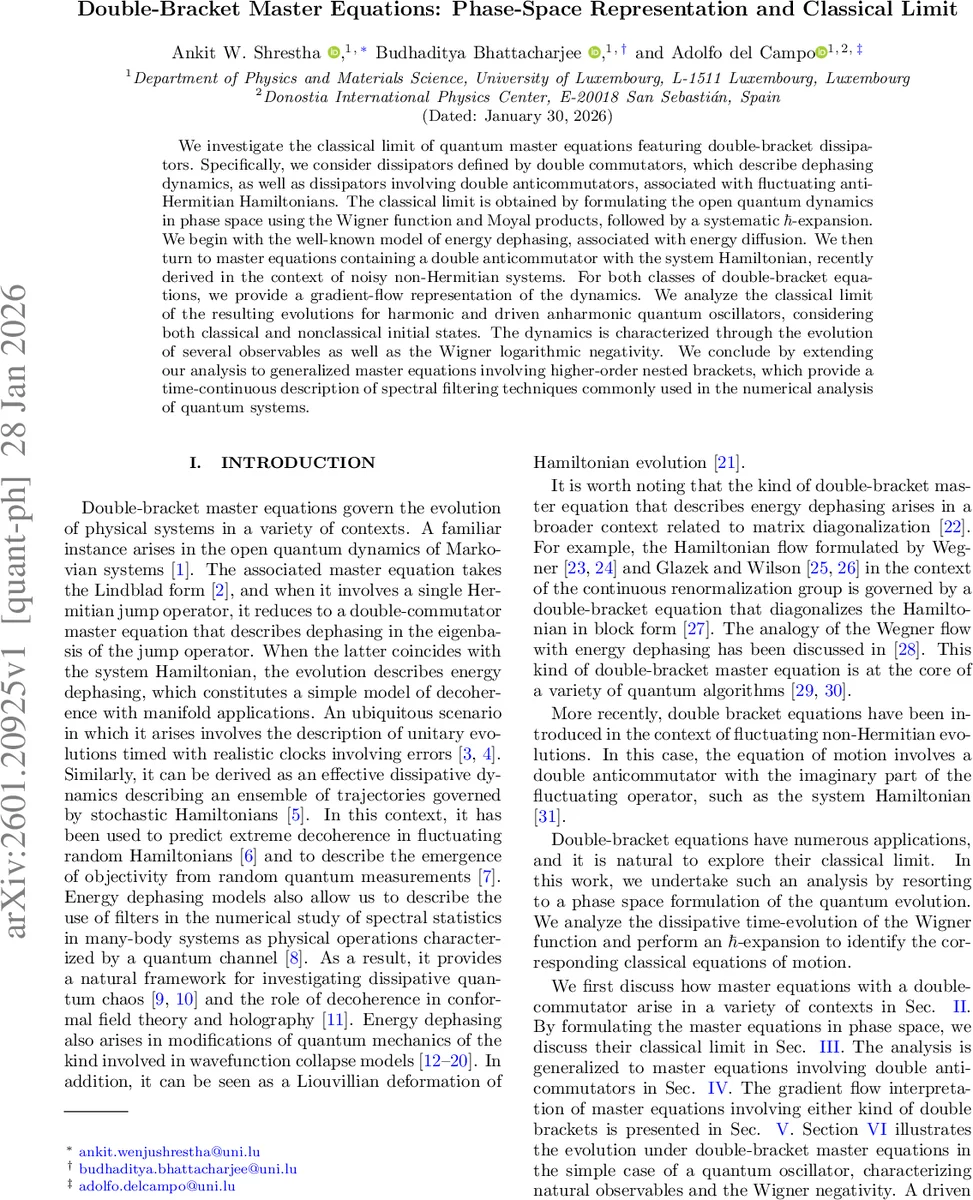
We investigate the classical limit of quantum master equations featuring double-bracket dissipators. Specifically, we consider dissipators defined by double commutators, which describe dephasing dynamics, as well as dissipators involving double anticommutators, associated with fluctuating anti-Hermitian Hamiltonians. The classical limit is obtained by formulating the open quantum dynamics in phase space using the Wigner function and Moyal products, followed by a systematic $\hbar$-expansion. We begin with the well-known model of energy dephasing, associated with energy diffusion. We then turn to master equations containing a double anticommutator with the system Hamiltonian, recently derived in the context of noisy non-Hermitian systems. For both classes of double-bracket equations, we provide a gradient-flow representation of the dynamics. We analyze the classical limit of the resulting evolutions for harmonic and driven anharmonic quantum oscillators, considering both classical and nonclassical initial states. The dynamics is characterized through the evolution of several observables as well as the Wigner logarithmic negativity. We conclude by extending our analysis to generalized master equations involving higher-order nested brackets, which provide a time-continuous description of spectral filtering techniques commonly used in the numerical analysis of quantum systems.
💡 Research Summary
This paper presents a systematic phase‑space analysis of quantum master equations that contain double‑bracket structures, i.e., either a double commutator (
Comments & Academic Discussion
Loading comments...
Leave a Comment