Morphological Stability of Metal Anodes: Roles of Solid Electrolyte Interphases (SEIs) and Desolvation Kinetics
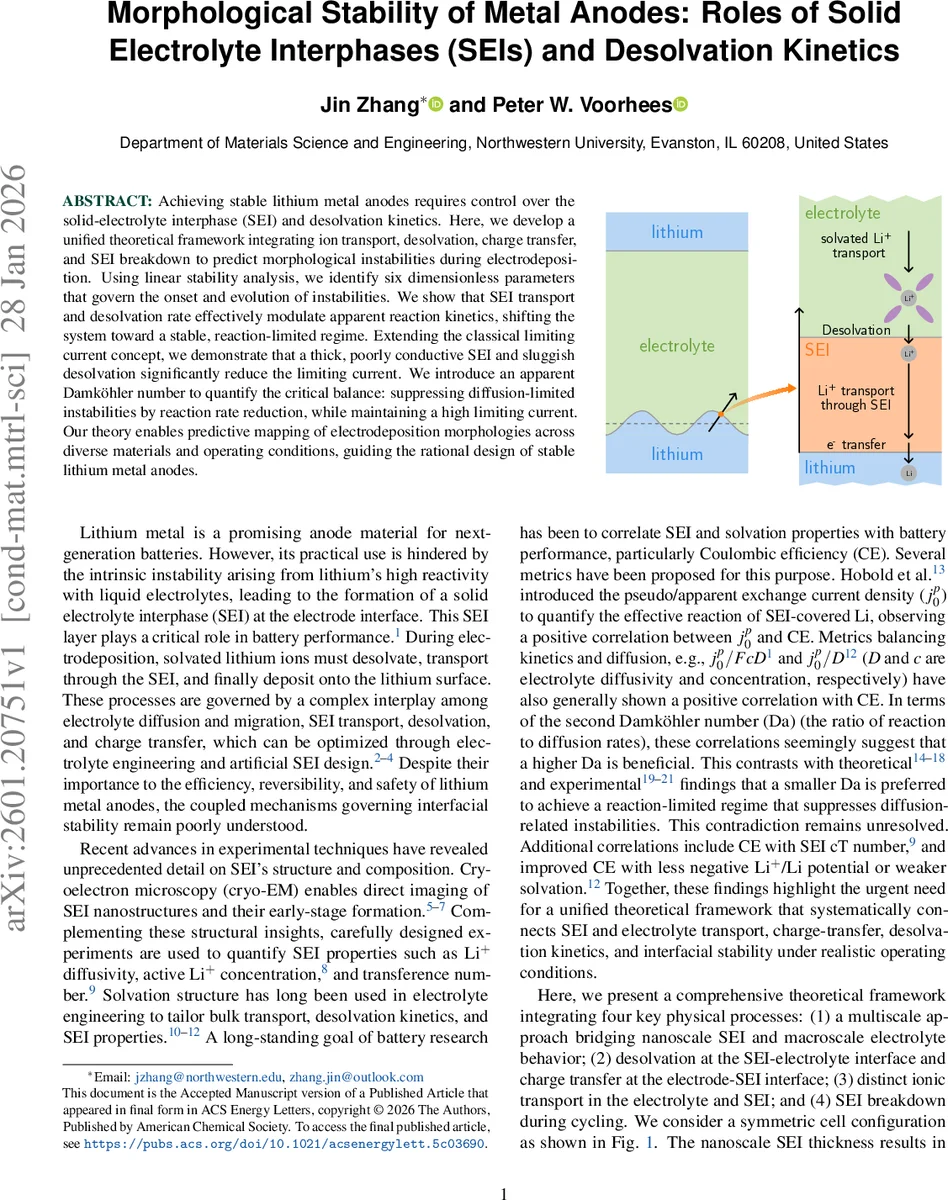
Achieving stable lithium metal anodes requires control over the solid-electrolyte interphase (SEI) and desolvation kinetics. Here, we develop a unified theoretical framework integrating ion transport, desolvation, charge transfer, and SEI breakdown to predict morphological instabilities during electrodeposition. Using linear stability analysis, we identify six dimensionless parameters that govern the onset and evolution of instabilities. We show that SEI transport and desolvation rate effectively modulate apparent reaction kinetics, shifting the system toward a stable, reaction-limited regime. Extending the classical limiting current concept, we demonstrate that a thick, poorly conductive SEI and sluggish desolvation significantly reduce the limiting current. We introduce an apparent Damköhler number to quantify the critical balance: suppressing diffusion-limited instabilities by reaction rate reduction, while maintaining a high limiting current. Our theory enables predictive mapping of electrodeposition morphologies across diverse materials and operating conditions, guiding the rational design of stable lithium metal anodes.
💡 Research Summary
This paper presents a comprehensive theoretical framework that unifies ion transport, desolvation, charge transfer, and solid‑electrolyte interphase (SEI) degradation to predict morphological instabilities during lithium metal electrodeposition. By coupling a nanoscale SEI model with a macroscale symmetric cell description, the authors capture four essential processes: (i) diffusion‑migration of solvated Li⁺ in the bulk electrolyte, (ii) linearized Butler‑Volmer desolvation at the electrolyte‑SEI interface, (iii) Nernst‑Planck transport of Li⁺ through the SEI, and (iv) symmetric Butler‑Volmer charge transfer at the Li‑SEI interface.
A key contribution is the redefinition of the limiting current (j_lim) in the presence of an SEI. Rather than being set solely by bulk electrolyte depletion, j_lim depends on the Li⁺ concentration at the electrode‑SEI interface, which is controlled by both SEI transport and desolvation kinetics. The authors introduce a dimensionless SEI parameter δ = j_c^lim / j_SEI^lim, representing the ratio of electrolyte‑limited to SEI‑limited currents. When δ≫1, the SEI dominates transport and dramatically reduces j_lim; when δ≪1, the SEI is transparent and the system behaves like a bare electrolyte. An analytical expression shows that for infinitely fast desolvation, j_lim = j_c^lim/(1+δ), highlighting the inverse relationship between δ and the attainable current.
The apparent exchange current density j_p0, measurable from the cell voltage of a symmetric cell, is derived as a series combination of intrinsic charge‑transfer, desolvation, and ion‑transport resistances. This formulation reproduces experimental values obtained from ultramicroelectrode measurements and provides a practical route to extract δ from experimental data.
Linear stability analysis is then performed on a perturbed electrode surface h(x,t)=ε e^{ikx+Σt}. The growth rate Σ is nondimensionalized as σ = FΣ/(V_m j_app) and expressed in terms of six dimensionless groups: (1) the applied current normalized by the electrolyte‑limited current (˜j_app = j_app/j_c^lim), (2) the capillary number Ca = V_m γ/(RT L), (3) the classical Damköhler number ˜j_0 = j_0/j_c^lim (intrinsic charge‑transfer), (4) the desolvation Damköhler number ˜j_{0,solv} = j_{0,solv}/j_c^lim, (5) the SEI parameter δ, and (6) the SEI‑breakdown sensitivity β = j_c^lim dδ/dj. The resulting dispersion relation (Eq. 5) shows that σ_max (the maximum growth rate) is most sensitive to β, while the critical wavenumber ˜k_c (which defines the stability boundary) depends primarily on ˜j_app, Ca, and the effective δ_m = 1+δ exp(−˜η_{solv}/2).
The analysis reveals several important physical insights:
- As the applied current approaches the limiting current, ˜k_c diverges, meaning that even short‑wavelength perturbations become unstable. This explains why high‑current operation yields fine, rapidly growing dendrites.
- Increasing δ (thicker, less conductive SEI) or slowing desolvation (lower ˜j_{0,solv}) reduces j_lim and shifts the stability boundary toward lower currents, promoting diffusion‑limited instabilities.
- SEI breakdown, captured by β>0, reduces δ locally, temporarily raising j_lim but simultaneously amplifying σ_max, leading to abrupt dendrite bursts observed experimentally at a critical current (~4.5 mA cm⁻²).
- When β≈0, σ_max correlates positively with Coulombic efficiency, reconciling earlier experimental observations that linked higher apparent exchange currents to better efficiency.
To guide practical design, the authors propose an “apparent” Damköhler number Da_p = j_p0/(F c D), which quantifies the balance between reaction kinetics and mass transport in the presence of an SEI and desolvation barrier. A small Da_p indicates a reaction‑limited regime that suppresses diffusion‑driven instabilities while still allowing a high limiting current if δ and β are optimized.
The paper concludes with actionable recommendations: engineer thin, highly Li⁺‑conductive SEI layers (δ ≈ 1), accelerate desolvation through solvent selection or additives (increase ˜j_{0,solv}), and mitigate SEI mechanical degradation (minimize β) by using robust SEI chemistries or protective coatings. Together, these strategies shift the system into a stable, reaction‑limited regime with a high j_lim, thereby suppressing dendritic growth and enhancing the safety and cyclability of lithium metal batteries.
Overall, the work delivers a unified, dimensionless description of metal‑anode morphology that bridges fundamental electrochemical theory with experimentally measurable parameters, offering a powerful tool for rational electrolyte and interphase design in next‑generation high‑energy storage devices.
Comments & Academic Discussion
Loading comments...
Leave a Comment