An inductive Ext non-vanishing theorem for the $p$-adic general linear group
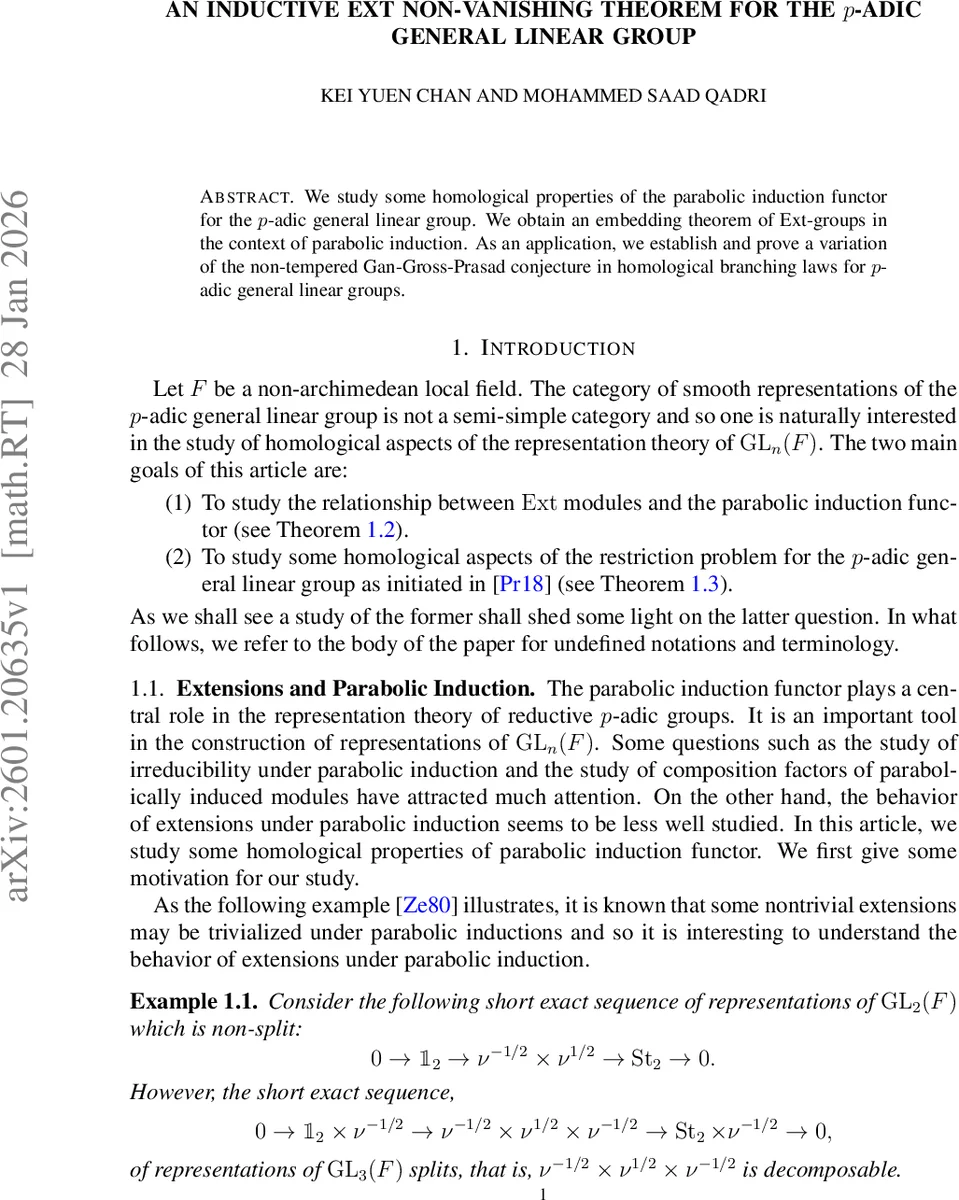
We study some homological properties of the parabolic induction functor for the $p$-adic general linear group. We obtain an embedding theorem of Ext-groups in the context of parabolic induction. As an application, we establish and prove a variation of the non-tempered Gan-Gross-Prasad conjecture in homological branching laws for $p$-adic general linear groups.
💡 Research Summary
The paper investigates homological aspects of smooth representations of the p‑adic general linear group GLₙ(F), focusing on two intertwined problems: (1) the behavior of Ext‑groups under parabolic induction, and (2) the non‑vanishing of Ext‑groups in branching laws for Arthur‑type representations.
The authors first introduce a subcategory C_ω consisting of finite‑length representations whose cuspidal supports are either contained in the cuspidal support of a fixed Speh representation ω or lie outside the “augmented” support csupp Z(ω) \ csupp(ω). Within this controlled setting they prove Theorem 1.2: for any non‑negative integer i and any τ₁, τ₂ ∈ C_ω there is an injective map
φ_i : Extⁱ_{GL_m(F)}(τ₁, τ₂) ↪ Extⁱ_{GL_{m+k}(F)}(ω × τ₁, ω × τ₂).
Thus, vanishing of Extⁱ for τ₁, τ₂ forces vanishing after parabolic induction by ω. The proof relies on a detailed analysis of Bernstein blocks, the equivalence between a block and modules over an affine Hecke algebra of type A, and a new full‑faithfulness result for the parabolic induction functor on finitely generated representations (Section 4). By constructing projective resolutions inside the Hecke algebra framework, the authors show that the derived functor of induction embeds Ext‑groups as claimed. Remarks illustrate that the map need not be surjective in general, and that the hypothesis on cuspidal support is essential.
The second main result, Theorem 1.3, addresses an Ext analogue of the non‑tempered Gan‑Gross‑Prasad (GGP) conjecture for GLₙ(F). The authors define “strong Ext relevance” for a pair (π, π′) of Arthur‑type representations of GLₙ(F) and GL_{n‑1}(F). This notion refines the original GGP relevance by incorporating the Aubert–Zelevinsky involution and a duality theorem of Nori–Prasad. Assuming strong Ext relevance, they prove that there exists some integer i ≥ 0 with Extⁱ_{GL_{n‑1}(F)}(π, π′) ≠ 0. The proof uses Theorem 1.2 to lift extensions via ω, together with the fact that restrictions of irreducible representations to GL_{n‑1}(F) are locally finitely generated (each Bernstein component is finitely generated). The authors also rely on a key proposition from Nori–Prasad concerning the behavior of Ext under Aubert–Zelevinsky involution.
The paper is organized as follows: Section 2 reviews Bernstein decomposition, types, and affine Hecke algebras of type A, including their generators, relations, and centers. Section 3 recalls the classification of irreducible GLₙ(F) representations and introduces Bernstein–Zelevinsky derivatives. Section 4 extends a full‑faithfulness result for parabolic induction to finitely generated representations, a crucial technical tool. Section 5 contains the proof of the Ext‑embedding theorem (Theorem 1.2). Section 6 defines strong Ext relevance, and Section 7 proves the non‑vanishing theorem (Theorem 1.3). Throughout, the authors provide illustrative examples and counterexamples (e.g., Ext⁶ calculations) to clarify the limits of their results.
In summary, the work establishes a robust link between parabolic induction and higher Ext‑groups, showing that under suitable cuspidal‑support conditions extensions survive induction. This link is then exploited to obtain partial progress toward an Ext‑version of the non‑tempered GGP conjecture for p‑adic GLₙ, offering new tools for studying homological branching laws of Arthur‑type representations. The results are expected to have further applications to the study of unitary and Arthur‑type representations, as well as to the broader program of understanding non‑semisimple phenomena in p‑adic representation theory.
Comments & Academic Discussion
Loading comments...
Leave a Comment