Revisiting the Interpretations of Quantum Mechanics: From FAPP Solutions to Contextual Ontologies
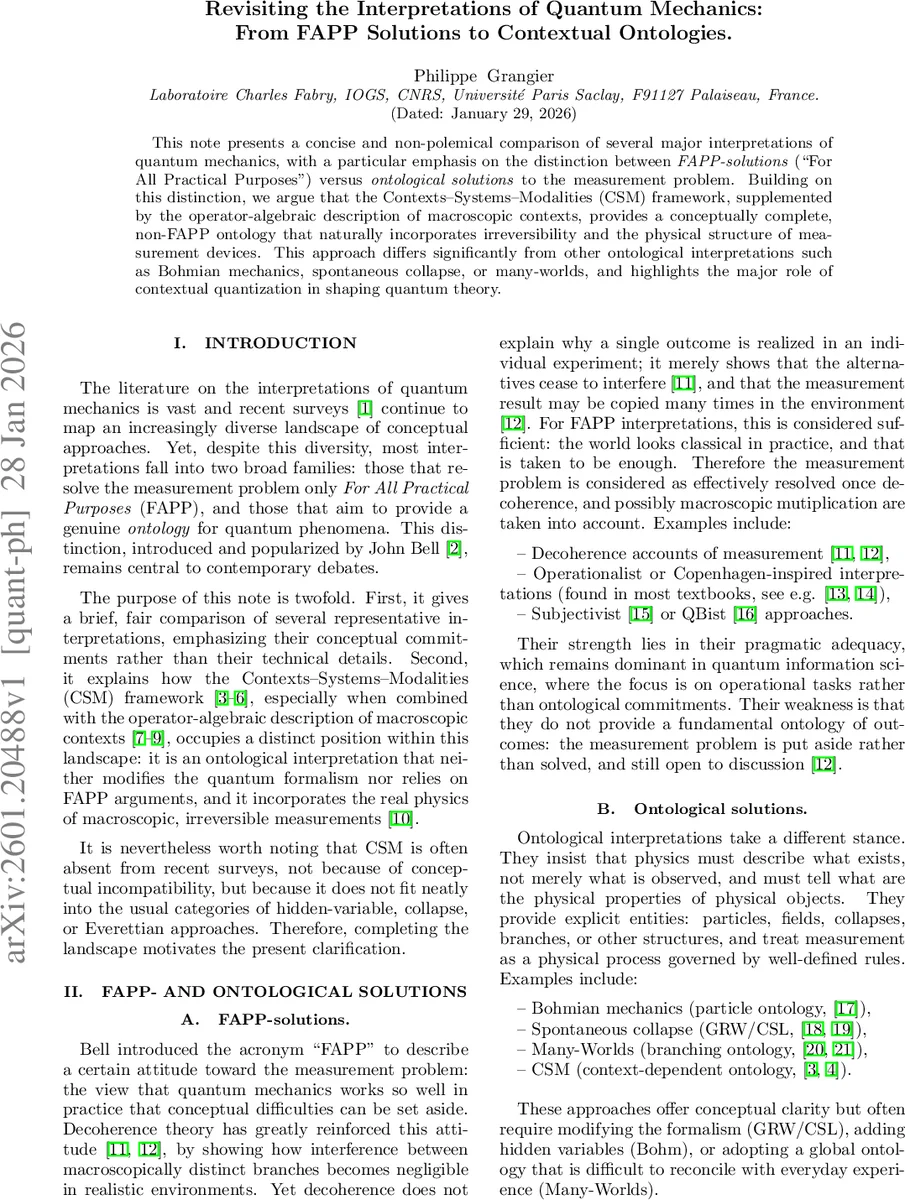
This note presents a concise and non-polemical comparison of several major interpretations of quantum mechanics, with a particular emphasis on the distinction between FAPP-solutions (“For All Practical Purposes’’) versus ontological solutions to the measurement problem. Building on this distinction, we argue that the Contexts-Systems-Modalities (CSM) framework, supplemented by the operator-algebraic description of macroscopic contexts, provides a conceptually complete, non-FAPP ontology that naturally incorporates irreversibility and the physical structure of measurement devices. This approach differs significantly from other ontological interpretations such as Bohmian mechanics, spontaneous collapse, or many-worlds, and highlights the major role of contextual quantization in shaping quantum theory.
💡 Research Summary
The paper begins by dividing quantum‑mechanical interpretations into two broad families: “FAPP” (For All Practical Purposes) solutions and genuine ontological solutions. FAPP approaches treat the measurement problem as a pragmatic issue that can be set aside because quantum theory works extraordinarily well in practice. The author lists decoherence‑based accounts, operationalist or Copenhagen‑style narratives, QBism, and subjectivist positions as representatives. While these frameworks explain why interference between macroscopic branches becomes negligible, they do not explain how a single, definite outcome is realized in any given run; they merely accept the appearance of classicality as sufficient for practical work.
Ontological approaches, by contrast, insist that physics must describe what exists, not only what is observed. The paper reviews Bohmian mechanics (hidden particle positions guided by the wavefunction), spontaneous‑collapse models such as GRW/CSL (stochastic modifications of the Schrödinger dynamics), and the Many‑Worlds (Everettian) picture (branching universal wavefunction). Each of these provides a clear ontology—particles, collapses, or branches—but at the cost of either altering the formalism, introducing non‑local hidden variables, or positing an ever‑splitting multiverse that many find counter‑intuitive.
The author then introduces the Context‑Systems‑Modalities (CSM) framework as a third, distinct option. CSM is built on three primitive notions:
- Context – the macroscopic measurement arrangement (detectors, magnets, etc.).
- System – the quantum object under study.
- Modality – a repeatable, definite property that belongs to the system‑within‑a‑context pair.
A modality is ontologically real but only relative to a specific context; within a given context modalities are mutually exclusive and quantized. When one moves between incompatible contexts, probabilities necessarily appear, and the Born rule emerges from the structure of these context changes. The derivation relies on Uhlhorn’s and Gleason’s theorems, showing that the quantitative aspects of quantum probabilities are a direct consequence of contextual quantization rather than an ad‑hoc collapse postulate.
A central innovation of the paper is the treatment of macroscopic contexts using operator‑algebraic mathematics (C*‑ and von Neumann algebras). The author argues that finite‑dimensional Hilbert spaces cannot capture the infinite degrees of freedom, dissipative dynamics, and thermodynamic irreversibility characteristic of real measurement devices. By representing a context as an infinite‑type III algebra, one can model the irreversible flow of information from the quantum system to the macroscopic apparatus. A modality corresponds to a pure state or sector within this algebra. Changing context corresponds to moving between inequivalent representations of the same algebra, a process that cannot be undone by a unitary transformation—precisely the mathematical expression of the “single‑outcome” fact.
The paper illustrates this with a Stern‑Gerlach experiment. The magnet orientation defines the context; the detectors at the output channels are modeled as infinite spin‑chain reservoirs initially in thermal (KMS) states. The interaction Hamiltonian couples the spin of the particle to one of the reservoirs, causing a transition that places the reservoir into one of two inequivalent algebraic sectors. Because the reservoirs are infinite, the two resulting sectors cannot be unitarily connected, encoding both irreversibility and the uniqueness of the observed result.
Table 1 provides a comparative overview of several interpretations across four criteria: (i) how outcomes become definite, (ii) the role of context, (iii) whether macroscopic irreversibility is built in, and (iv) whether the interpretation modifies quantum‑mechanical predictions. CSM scores positively on (i) and (ii) by positing contextual ontological properties, on (iii) by employing type‑III algebras, and on (iv) by leaving the standard formalism untouched. In contrast, decoherence‑only accounts lack a mechanism for definiteness, Bohmian mechanics introduces hidden variables, GRW/CSL adds stochastic collapse terms, and Many‑Worlds relies on universal unitarity and branching.
The conclusion emphasizes that CSM occupies a unique niche: it provides a non‑FAPP, fully ontological interpretation without altering the quantum formalism, while simultaneously incorporating the real physics of macroscopic, irreversible measurement devices through operator algebras. The author suggests that this contextual‑objectivity viewpoint can aid quantum‑technology engineers in building intuition, and that CSM may, in certain respects, surpass existing ontological proposals by grounding both contextuality and irreversibility in the mathematically rigorous structure of infinite quantum systems. The paper ends with acknowledgments and a brief note on the use of an AI‑assisted editing tool.
Comments & Academic Discussion
Loading comments...
Leave a Comment