Regularity of the trace of nonlocal minimal graphs
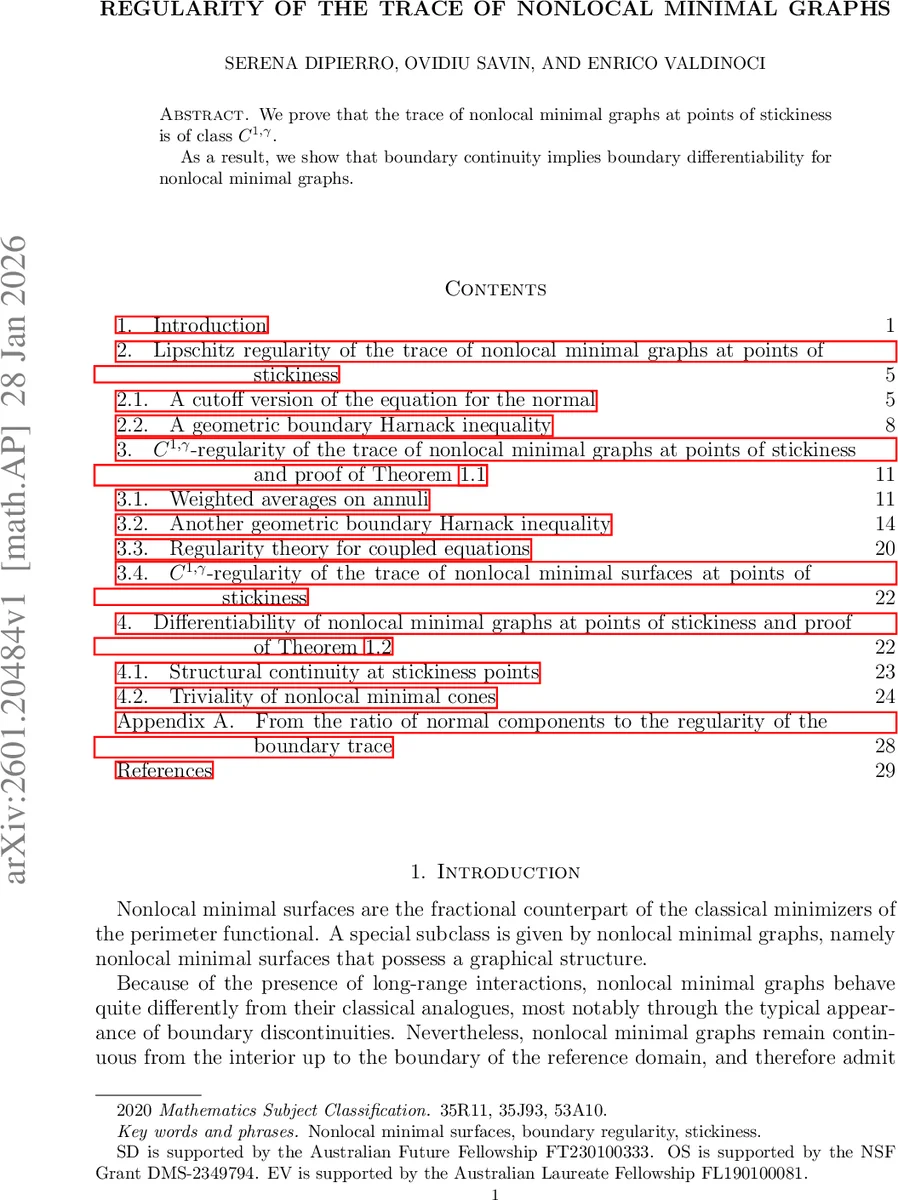
We prove that the trace of nonlocal minimal graphs at points of stickiness is of class~$C^{1,γ}$. As a result, we show that boundary continuity implies boundary differentiability for nonlocal minimal graphs.
💡 Research Summary
The paper studies the boundary regularity of nonlocal minimal graphs, i.e. sets E⊂ℝ^{n+1} that minimize the s‑perimeter (0<s<1) under a prescribed exterior datum of graphical form. While interior regularity of such graphs is well understood (they are smooth inside the domain Ω⊂ℝ^{n}), the presence of “stickiness” at the boundary—where the graph may jump and the normal vector becomes horizontal—has prevented a precise description of the trace u_E|_{∂Ω}. The authors prove two main results.
Theorem 1.1 (C^{1,γ} regularity of the trace).
Assume Ω is C^{2,1} near a boundary point x₀ and the interior limit of u_E equals the exterior limit of the datum u₀ at x₀. Then there exists a radius ρ>0 such that the set of points (x′,u_E(x′)) with x′∈∂Ω∩B_ρ(x₀) forms an (n−1)‑dimensional C^{1,γ} surface in ℝ^{n+1}. This is the first result establishing any Lipschitz (let alone C^{1,γ}) regularity for the boundary trace of a nonlocal minimal surface.
Theorem 1.2 (Boundary continuity implies differentiability).
In a flat setting (Ω∩B′₁={x_n>0}) with zero exterior datum on the opposite side, if the origin is a point of boundary continuity for the minimal graph, then |u_E(x′)|≤C|x′|^{3+s/2} for x′ sufficiently close to the origin. Consequently u_E is C^{1,1+s/2} at the origin, showing that mere continuity across the boundary forces higher differentiability.
The proof proceeds in two stages. First, the authors derive a localized nonlocal equation for the exterior normal ν of the minimal surface Σ=∂E. Using the integral identity (2.1) and a careful cutoff argument (Lemma 2.1), they separate the contribution of the smooth part of ν from the geometric measure‑theoretic part. Lemma 2.2 provides a commutator estimate for the fractional operator L acting on products of functions, which is essential for handling the nonlinearity.
With this framework they establish a geometric boundary Harnack inequality (Lemma 2.3) that yields a uniform bound on the ratio of the tangential to vertical components of ν, even when ν_{n+1} approaches zero. This bound translates directly into a Lipschitz estimate for the trace, i.e. u_E|_{∂Ω} is locally Lipschitz at stickiness points without any a‑priori regularity assumption.
In the second stage they improve the Lipschitz bound to a Hölder one. Assuming the set where ν_{n+1}=0 is already Lipschitz, Lemma 3.4 furnishes a refined boundary Harnack inequality that controls the oscillation of the same ratio by a power γ of the distance. The proof uses weighted averages on annuli and the commutator estimate from Lemma 2.2 to obtain a quantitative decay of the oscillation. Consequently the tangential component of ν becomes C^{0,γ}, which implies that the trace is C^{1,γ}.
The paper also discusses the relationship with existing literature on boundary Harnack inequalities for nonlocal operators. Earlier works (Bogdan 1997; Ros‑Oton & Serra 2017, 2019) dealt with symmetric kernels in Euclidean domains and homogeneous equations. Here the kernel is generally non‑symmetric, the equation is non‑homogeneous due to geometric terms, and the domain is a hypersurface. The authors adapt the two‑step strategy (pointwise bound + Hölder improvement) to this more intricate setting.
Finally, Theorem 1.2 follows from Theorem 1.1 together with the newly developed boundary Harnack tools. The result resolves several open problems posed in earlier works (e.g., DSV20b) concerning the absence of vertical tangents and the differentiability of nonlocal minimal graphs at points of boundary continuity.
In summary, the paper makes a substantial contribution to the regularity theory of nonlocal minimal surfaces: it shows that even in the presence of stickiness, the boundary trace is C^{1,γ}, and that continuity across the boundary automatically upgrades to differentiability. The techniques blend nonlocal geometric analysis, delicate integral estimates, and novel boundary Harnack inequalities, opening the way for further investigations of nonlocal free‑boundary problems and related variational models.
Comments & Academic Discussion
Loading comments...
Leave a Comment