Cheap2Rich: A Multi-Fidelity Framework for Data Assimilation and System Identification of Multiscale Physics -- Rotating Detonation Engines
Bridging the sim2real gap between computationally inexpensive models and complex physical systems remains a central challenge in machine learning applications to engineering problems, particularly in multi-scale settings where reduced-order models typically capture only dominant dynamics. In this work, we present Cheap2Rich, a multi-scale data assimilation framework that reconstructs high-fidelity state spaces from sparse sensor histories by combining a fast low-fidelity prior with learned, interpretable discrepancy corrections. We demonstrate the performance on rotating detonation engines (RDEs), a challenging class of systems that couple detonation-front propagation with injector-driven unsteadiness, mixing, and stiff chemistry across disparate scales. Our approach successfully reconstructs high-fidelity RDE states from sparse measurements while isolating physically meaningful discrepancy dynamics associated with injector-driven effects. The results highlight a general multi-fidelity framework for data assimilation and system identification in complex multi-scale systems, enabling rapid design exploration and real-time monitoring and control while providing interpretable discrepancy dynamics. Code for this project is is available at: github.com/kro0l1k/Cheap2Rich.
💡 Research Summary
Cheap2Rich is a novel multi‑fidelity data‑assimilation framework designed to close the simulation‑to‑reality gap for complex multi‑scale systems, demonstrated on rotating detonation engines (RDEs). The authors combine a fast, low‑fidelity one‑dimensional RDE surrogate (the “cheap” model) with learned, interpretable discrepancy corrections (the “rich” component) to reconstruct full‑state fields from sparse sensor histories.
The architecture consists of two parallel pathways. The low‑frequency (LF) pathway follows the DA‑SHRED methodology: a two‑layer LSTM encoder compresses a window of sensor data into a latent vector, which is then aligned to real‑world distributions via a shallow GAN (generator + discriminator). The aligned latent code is decoded by a three‑layer MLP and explicitly low‑pass filtered in Fourier space, retaining only modes with wavenumber ≤ k_c. This ensures the LF reconstruction captures only the dominant large‑scale dynamics that the cheap model already represents (detonation‑front propagation, average pressure/temperature fields).
The high‑frequency (HF) pathway addresses the residual discrepancy between the LF prediction and the actual sensor measurements. Sensor‑space residuals are formed by subtracting the LF prediction projected onto sensor locations from the measured values. An attention‑augmented LSTM encoder processes these residual histories, while a time‑derivative embedding supplies velocity and acceleration information. The decoder generates a spatial correction pattern and applies a learned deformation to account for phase and amplitude mismatches. Crucially, the HF output is regularized for spectral sparsity (ℓ₁ penalty) and a band‑limit penalty, forcing the correction to consist of only a few dominant Fourier modes. In the RDE case these modes align with injector‑driven forcing frequencies, providing a physically interpretable description of the missing physics.
Training proceeds in four sequential stages: (1) SHRED pre‑training on synthetic data from the cheap model, (2) latent‑GAN training for distribution alignment, (3) HF‑SHRED training with spectral sparsity constraints, and (4) end‑to‑end fine‑tuning. This staged approach stabilizes learning and prevents interference between LF and HF components.
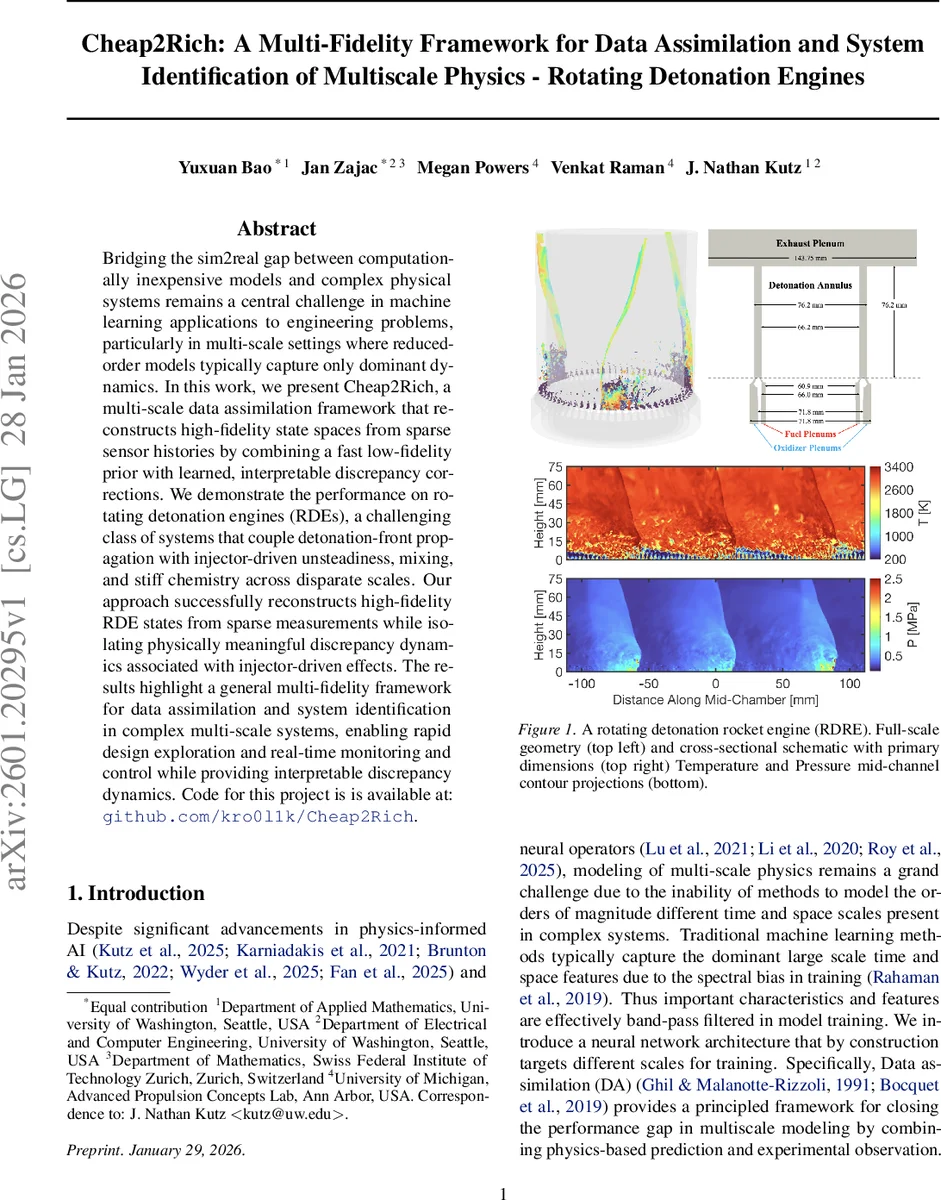
The authors evaluate Cheap2Rich on a high‑fidelity CFD dataset of an AFRL methane‑oxygen RDRE. The CFD simulation resolves 178 million cells, consumes >2 million CPU‑hours, and provides 250 snapshots (one full rotation). The cheap 1‑D model runs in seconds. Using only sparse sensor data (a handful of pressure/temperature probes), Cheap2Rich reconstructs the full 3‑D state with an 80.9 % reduction in mean‑square error relative to the cheap model alone. Spectral analysis of the HF correction shows energy concentrated at harmonics of the three‑wave rotating pattern, confirming that the network has isolated injector‑modulated dynamics absent from the low‑fidelity surrogate. The sparse, interpretable HF modes can be fed into system‑identification tools such as SINDy to discover governing equations for the missing physics.
In summary, Cheap2Rich delivers (i) a practical bridge between inexpensive reduced‑order models and expensive high‑fidelity simulations, (ii) an interpretable decomposition that separates dominant dynamics from fine‑scale discrepancy, and (iii) a scalable pipeline for real‑time monitoring, design exploration, and control of multi‑scale engineering systems. The code is publicly released, enabling broader adoption across propulsion, combustion, and other multi‑physics domains.
Comments & Academic Discussion
Loading comments...
Leave a Comment