A low regularity exponential-type integrator for the derivative nonlinear Schrödinger equation
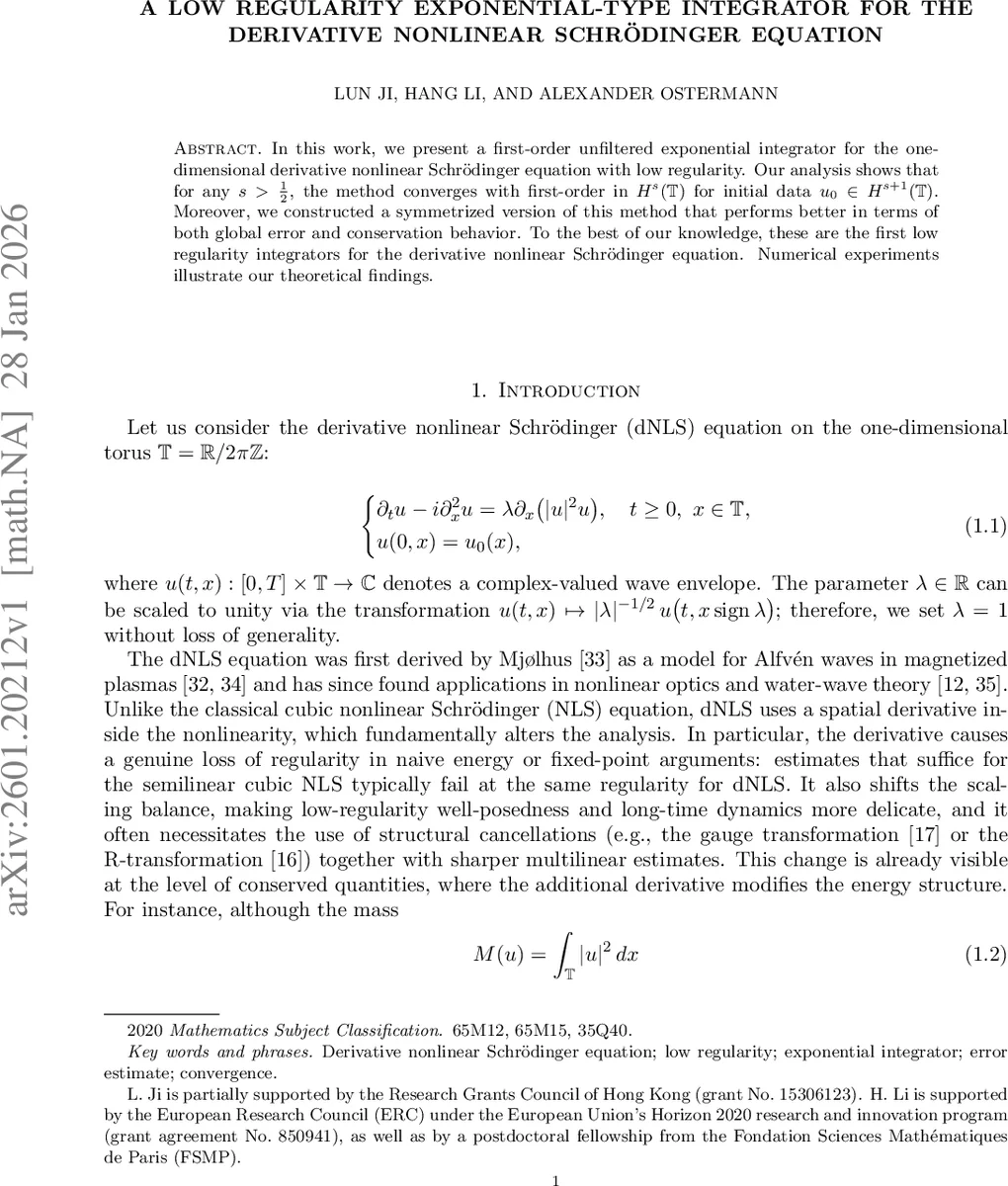
In this work, we present a first-order unfiltered exponential integrator for the one-dimensional derivative nonlinear Schrödinger equation with low regularity. Our analysis shows that for any $s>\frac12$, the method converges with first-order in $H^s(\mathbb{T})$ for initial data $u_0\in H^{s+1}(\mathbb{T})$. Moreover, we constructed a symmetrized version of this method that performs better in terms of both global error and conservation behavior. To the best of our knowledge, these are the first low regularity integrators for the derivative nonlinear Schrödinger equation. Numerical experiments illustrate our theoretical findings.
💡 Research Summary
The paper addresses the numerical integration of the one‑dimensional derivative nonlinear Schrödinger equation (dNLS) on the periodic domain 𝕋, a model that features a spatial derivative inside the nonlinearity and therefore suffers from a genuine loss of regularity compared with the standard cubic NLS. Classical explicit schemes require high smoothness of the solution, and implicit finite‑difference methods, while stable, also rely on smoothness assumptions. The authors propose the first low‑regularity exponential‑type integrators for dNLS, establishing rigorous first‑order convergence in Sobolev spaces H^s(𝕋) for any s > ½, provided the initial data belong to H^{s+1}(𝕋).
The analysis begins with the periodic gauge transformation introduced by Herr (2017). For a function f∈L²(𝕋) the gauge map is defined as
G₀(f)(x)=e^{-iI(f)(x)}f(x), I(f)(x)=½∫₀^{2π}∫x^ξ(|f(y)|²−(2π)^{-1}‖f‖²{L²}) dy dξ,
and the full transformation G(u)(t,x)=κ_{−μ(u)}G₀(u(t))(x) with μ(u)=Π₀|u|² (the spatial average of |u|²). This map is a homeomorphism on H^γ for γ≥½ and its inverse enjoys the same regularity. After applying G, the dNLS is rewritten as a semilinear equation
∂_t v−i∂_x²v = F(v), v(0)=G₀(u₀),
where F(v)=F₁(v)+F₂(v)+F₃(v)+F₄(v) with
F₁(v)=−v²∂_x v, F₂(v)=i2|v|⁴v, F₃(v)=−iμ|v|²v, F₄(v)=iψ(v)v,
and ψ(v)=Π₀(2Im(v_x \bar v)−½|v|⁴)+μ². The most delicate term is F₁, containing a derivative of the product, which is responsible for the regularity loss.
Using Duhamel’s formula, the authors construct a first‑order exponential integrator. The key idea is to treat the linear part exactly via the propagator e^{iτ∂_x²} and to approximate the nonlinear Duhamel integrals by carefully designed low‑regularity quadratures. For the F₁ contribution they approximate the highly oscillatory phase e^{iν(k²+k₁²−k₂²−k₃²)} by e^{−2iνk k₁}, which captures the dominant derivative interaction while allowing the integral to be evaluated analytically. This leads to a correction term involving the operator ∂_x^{-1} applied to a bilinear expression g₁(v,τ). The remaining nonlinearities are handled with the standard φ₁‑function φ₁(z)=(e^{z}−1)/z, yielding compact expressions such as v² φ₁(−2iτ∂_x²)(v²v). The resulting scheme reads
v^{n+1}=e^{iτ∂_x²}\Big(v^{n}−½i∂_x^{-1}g₁(v^{n},τ)−τΠ₀(v^{n,2}∂_x v^{n})
+ iτ/2 v^{n,2} φ₁(−2iτ∂_x²)(v^{n,2}v^{n})−iμτ v^{n,2} φ₁(−2iτ∂_x²)v^{n}+iτψ(v^{n})v^{n}\Big).
A symmetric two‑step variant is also derived to improve conservation properties. By applying the basic step forward and backward and averaging, the authors obtain a time‑reversible scheme that preserves the mass more accurately while retaining essentially the same computational cost.
The convergence proof proceeds entirely in the Sobolev framework, without any filtering or CFL‑type restriction. Local truncation error is shown to be O(τ²) using bilinear estimates
‖fg‖{H^{s}} ≤ C_s‖f‖{H^{s}}‖g‖{H^{s}}, s>½,
and a refined estimate
‖fg‖{H^{s−1}} ≤ C_s‖f‖{H^{s−1}}‖g‖{H^{s}}.
The gauge map’s Lipschitz continuity (‖G(u)−G(v)‖{H^{s}} ≤ C‖u−v‖{H^{s}}) allows the error in the transformed variable v to be transferred back to the original variable u. Summing the local errors over the interval
Comments & Academic Discussion
Loading comments...
Leave a Comment