Weil conjectures and affine hypersurfaces
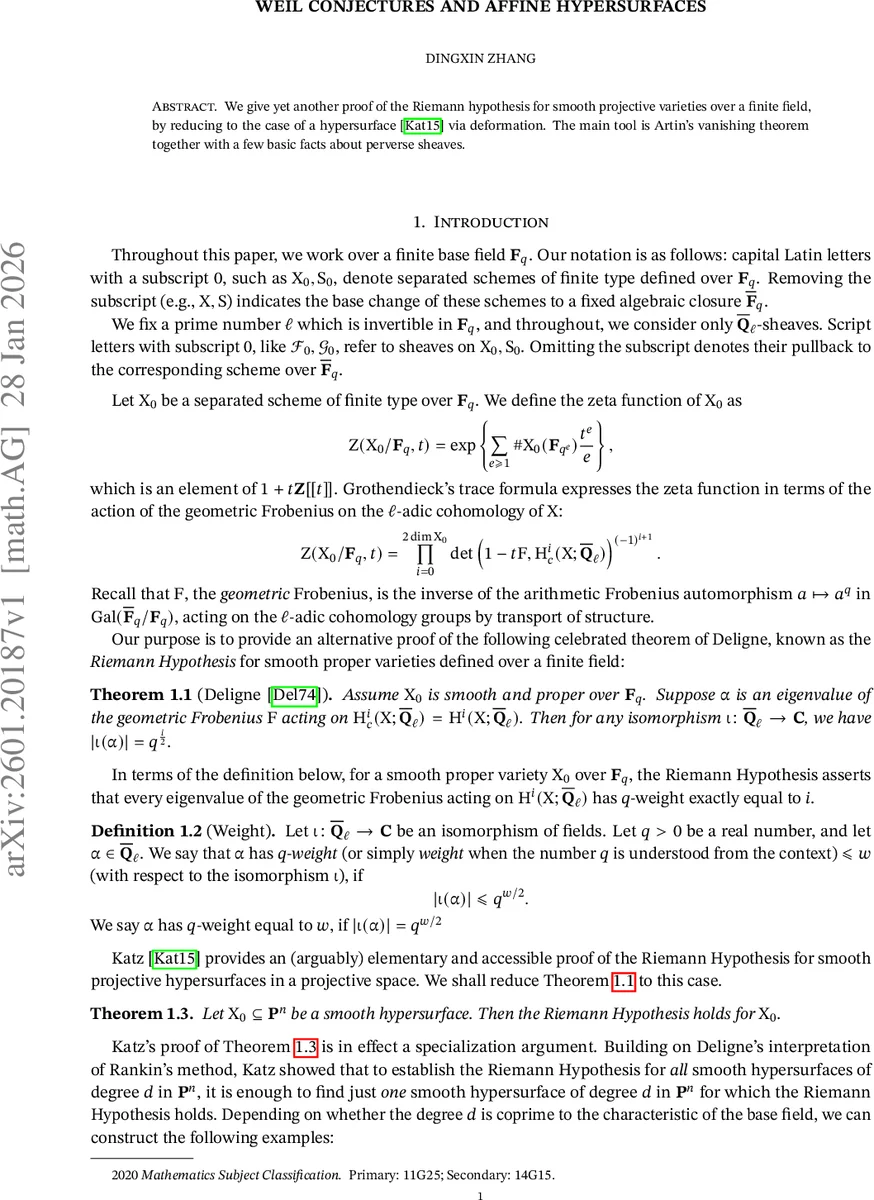
We give yet another proof of the Riemann hypothesis for smooth projective varieties over a finite field (Deligne’s theorem), by reducing to the hypersurface case. The latter was established by N. Katz via an elementary argument. A reduction of this kind was previously carried out by A. J. Scholl. Our approach is slightly different, and relies on deformation to an affine hypersurface, together with Artin’s vanishing theorem and basic properties of perverse sheaves.
💡 Research Summary
The paper presents a new proof of Deligne’s Riemann hypothesis for smooth proper varieties over a finite field, by reducing the problem to the case of smooth projective hypersurfaces, a case already settled by N. Katz via an elementary argument. The author’s strategy differs from the earlier reduction of A. J. Scholl, relying instead on a deformation to an affine hypersurface together with Artin’s vanishing theorem and elementary properties of perverse sheaves.
The exposition begins by fixing notation: (X_0) denotes a separated scheme of finite type over (\mathbf{F}q), (\ell) is a prime invertible in (\mathbf{F}q), and all sheaves are (\mathbf{Q}\ell)-sheaves. The zeta function of (X_0) is defined in the usual way, and Grothendieck’s trace formula expresses it as a product of characteristic polynomials of Frobenius acting on (\ell)-adic cohomology. Deligne’s theorem (Theorem 1.1) asserts that for a smooth proper (X_0) the eigenvalues of Frobenius on (H^i(X;\mathbf{Q}\ell)) have absolute value (q^{i/2}) under any embedding (\iota:\mathbf{Q}_\ell\to\mathbf{C}). This is equivalent to saying that every eigenvalue has (q)-weight exactly (i).
Katz’s result (Theorem 1.3) establishes the Riemann hypothesis for any smooth hypersurface (X_0\subset\mathbf{P}^n). Katz’s proof uses a specialization argument: it suffices to find a single smooth hypersurface of each degree for which the hypothesis holds. For degrees coprime to the characteristic, diagonal hypersurfaces satisfy the hypothesis via elementary Gauss sum calculations; for degrees divisible by the characteristic, Gabber’s hypersurface does the job.
The core of the new proof is a reduction from a general smooth proper variety to a hypersurface. The author constructs a one‑parameter family (\mathcal{X}\to\mathbf{A}^1) whose generic fiber is a smooth hypersurface (hence already known to satisfy the hypothesis) and whose special fiber is the original variety. The family is chosen so that the total space is affine over the base, allowing the use of Artin’s vanishing theorem: if (\mathcal{F}) is perverse coconnective on an affine variety, then (R\pi_!\mathcal{F}) remains perverse coconnective. This ensures that the cohomology of the special fiber inherits the weight bounds from the generic fiber.
To make the argument precise, the paper reviews the perverse (t)-structure on a curve, introduces the “perverse degeneration lemma” (Lemma 2.6), and proves it using the distinguished triangle relating (j^\mathcal{F}), (Rj_), and (R\iota_!). The lemma shows that for a perverse coconnective complex on a curve, the (-1)st stalk cohomology at a closed point injects into the stalk of (R^0j_\mathcal{H}^{-1}(j^\mathcal{F})). Consequently, the dimension of this stalk is bounded by the rank of the local system on the open part. This bound is crucial for controlling weights at the special fiber.
Section 3 collects standard facts about perverse sheaves: the definition via support conditions, duality, stability under smooth pull‑back, and the key Artin vanishing theorem (Theorem 3.4). The paper also states a perverse weak Lefschetz theorem (Lemma 3.5), which guarantees surjectivity (or isomorphism) of Gysin maps for a general hyperplane section when the complex is perverse connective.
Section 4 establishes two technical ingredients from Deligne’s “Weil II”. Lemma 4.5 gives a trivial bound for L‑functions of sheaves of pointwise weight (\le w): the L‑function converges and has no zeros or poles in the disc (|t|<q^{-w/2-d}), where (d) is the dimension of the base. Lemma 4.6 proves semicontinuity of weights for the direct image (R^0j_*) of a local system on a curve: if the local system has pointwise weight (\le w), then so does its extension. Both lemmas are proved by elementary counting arguments and by invoking Artin vanishing.
With these tools, Theorem 1.4 is proved: for any separated finite‑type scheme (X_0) over (\mathbf{F}q) and any integer (i), all Frobenius eigenvalues on (H_c^i(X;\mathbf{Q}\ell)) have weight (\le i). The proof proceeds by induction on dimension, using the perverse degeneration lemma to reduce to a curve, applying Lemma 4.6 to control weights after extending across missing points, and finally invoking Lemma 4.5 to rule out eigenvalues of too large weight. Poincaré duality then upgrades the “(\le i)” bound to an equality, yielding Deligne’s Riemann hypothesis (Theorem 1.1).
The paper concludes with acknowledgments, noting that the proof originated from a graduate course on the Weil conjectures, and that the perverse degeneration lemma provides a cleaner alternative to Scholl’s more technical alteration‑based reduction.
Overall, the work showcases how a modest set of sheaf‑theoretic tools—Artin vanishing, perverse (t)-structures, and elementary weight arguments—suffice to re‑derive one of the deepest results in arithmetic geometry, offering a pedagogically appealing and technically streamlined proof of the Riemann hypothesis for smooth proper varieties over finite fields.
Comments & Academic Discussion
Loading comments...
Leave a Comment